
Ask questions which are clear, concise and easy to understand.
Ask QuestionPosted by Monu Kumar 7 years, 8 months ago
- 0 answers
Posted by Yuv Raj Singh 7 years, 8 months ago
- 5 answers
Posted by Mahendran P 7 years, 8 months ago
- 3 answers
Posted by Mahendran P 7 years, 8 months ago
- 1 answers
Posted by Sivadath Ms 7 years, 8 months ago
- 0 answers
Posted by Himanshu Nainwal 7 years, 8 months ago
- 1 answers
Posted by Sunny Kumar 6 years, 5 months ago
- 1 answers
Sia ? 6 years, 5 months ago
If g(x) = x2 + 2x + k is a factor of f(x) = 2x4 + x3 - 14x2 + 5x + 6, then remainder is zero when f(x) is divided by g(x).
Let quotient = Q and remainder = R
Let us now divide f(x) by g(x).
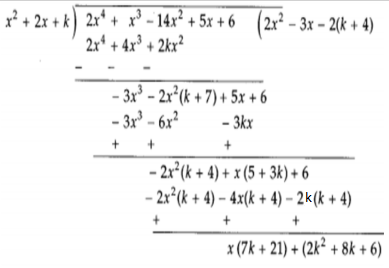
R = x(7k + 21) + (2k2 + 8k + 6) -------(1) and Q = 2x2 - 3x - 2(k + 4).------------(2)
Now, R = 0.
{tex}\Rightarrow{/tex} x (7k + 21) + 2 (k2 + 4k + 3) = 0
{tex}\Rightarrow{/tex} 7x (k + 3) + 2 (k+1)(k+3) = 0
{tex}\Rightarrow{/tex} (k+3) [7x + 2(k+1)] = 0
{tex}\Rightarrow{/tex} k + 3 = 0
{tex}\Rightarrow{/tex} k = -3
Thus, polynomial f(x) can be written as,
2x4 + x3 - 14x2 + 5x + 6 = (x2 + 2x + k) [2x2 - 3x - 2(k + 4)] = (x2 + 2x - 3) (2x2 - 3x - 2)
Zeros of x2 + 2x - 3 are,
x2 + 2x - 3 = 0
{tex}\Rightarrow{/tex} (x + 3) (x - 1) = 0
{tex}\Rightarrow{/tex} x = -3 or x = 1
Zeros of (2x2 - 3x - 2) are,
2x2 - 3x - 2 = 0
{tex}\Rightarrow{/tex} 2x2 - 4x + x - 2 = 0
{tex}\Rightarrow{/tex} 2x(x - 2) + 1(x - 2) = 0
{tex}\Rightarrow{/tex} (x - 2)(2x + 1) = 0
x = 2 or x = -{tex}\frac12{/tex}
Thus, the zeros of f(x) are: -3 ,1, 2 and -{tex}\frac12{/tex}
Posted by Raushan Kumar 5 years, 8 months ago
- 1 answers
Posted by Srushti Kunkolienkar 7 years, 8 months ago
- 1 answers
Priyanshi Narang 7 years, 8 months ago
Posted by Vishal Sharma 7 years, 8 months ago
- 2 answers
Posted by Srushti Kunkolienkar 7 years, 8 months ago
- 1 answers
Posted by Ritika Singh 7 years, 8 months ago
- 0 answers
Posted by Abhijeet Ahire 7 years, 8 months ago
- 0 answers
Posted by Arun Kumar Arun Kumar 7 years, 8 months ago
- 1 answers
Priyanshi Narang 7 years, 8 months ago
Posted by Arun Kumar Arun Kumar 7 years, 8 months ago
- 0 answers
Posted by Manas Rawat 7 years, 8 months ago
- 1 answers
Posted by Kshitiz Aggarwal 7 years, 8 months ago
- 0 answers
Posted by Pintu Singh 7 years, 8 months ago
- 0 answers
Posted by Ranjan Kumar 7 years, 8 months ago
- 0 answers
Posted by Kanak Rai 7 years, 8 months ago
- 3 answers
Posted by Rohit Kumar 6 years, 5 months ago
- 1 answers
Sia ? 6 years, 5 months ago
Here we have to find HCF of 1190 and 1445 and express the HCF in the form 1190m + 1445n.
1445 = 1190 × 1 + 255
1190 = 255 × 4 + 170
255 = 170 × 1 + 85
170 = 85 × 2 + 0
So, now the remainder is 0, then HCF is 85
Now,
85 = 255 - 170
= (1445 - 1190) - (1190 - 255 × 4)
= 1445 - 1190 - 1190 + 255 × 4
= 1445 - 1190 × 2 + (1445 - 1190) × 4
= 1445 - 1190 × 2 + 1445 × 4 - 1190 × 4
= 1445 × 5 - 1190 × 6
= 1190 × (- 6) + 1445 × 5
= 1190m + 1445n , where m = - 6 and n = 5
Posted by J@Nvi Kansal ? 7 years, 8 months ago
- 0 answers
Posted by #Aditi~ Angel???? 7 years, 8 months ago
- 2 answers
Posted by Kunal Gupta 7 years, 8 months ago
- 2 answers
Rashi Ulman 7 years, 8 months ago
Posted by Riya Baitule 6 years, 5 months ago
- 1 answers
Sia ? 6 years, 5 months ago
Given: Size of bathroom = 10 ft by 8 ft.
= (10 {tex}\times{/tex} 12) inch by (8 × 12) inch
= 120 inch by 96 inch
Area of bathroom = 120 inch by 96 inch
To find the largest size of tile required , we find HCF of 120 and 96.
By applying Euclid’s division lemma
120 = 96 {tex}\times{/tex} 1 + 24
96 = 24 {tex}\times{/tex} 4 + 0
Therefore, HCF = 24
Therefore, Largest size of tile required = 24 inches
no.of tiles required {tex} {\text{ = }}\frac{{{\text{area of bathroom}}}}{{{\text{area of 2 tile}}}} = \frac{{120 \times 96}}{{24 \times 24}} = 5 \times 4{/tex} = 20 tiles
Hence number of tiles required is 20 and size of tiles is 24 inches.
Posted by Rohan Singh 7 years, 8 months ago
- 0 answers

myCBSEguide
Trusted by 1 Crore+ Students

Test Generator
Create papers online. It's FREE.

CUET Mock Tests
75,000+ questions to practice only on myCBSEguide app

Sia ? 6 years, 5 months ago
Let the speed of the boat in still water be 'x' km/hr and speed of the stream be 'y' km/
Speed = Distance / Time
{tex}\therefore{/tex} {tex}\frac { 30 } { x - y } + \frac { 28 } { x + y } = 7{/tex}
and {tex}\frac { 21 } { x - y } + \frac { 21 } { x + y } = 5{/tex}
Let {tex}\frac { 1 } { x - y } \text { be } a \text { and } \frac { 1 } { x + y } \text { be } b{/tex}
30a + 28b = 7 ......(i)
21a + 21b = 5 ......(ii)
Multiplying (i) by 3 and (ii) by 4 and then subtracting.
{tex}90a+84b=21{/tex} ..............(iii)
{tex}84a+84b=20 {/tex} ..............(iv)
By solving (iii) and (iv)
{tex}90a-21=84a-20{/tex}
{tex}\Rightarrow{/tex}6a= 1
{tex}\Rightarrow{/tex} {tex}a = \frac { 1 } { 6 }{/tex}
Putting this value of ,a in eqn., (i),
{tex}30 \times \frac { 1 } { 6 } + 28 b = 7{/tex}
{tex}28 b = 7 - 30 \times \frac { 1 } { 6 } = 2{/tex}
{tex}\therefore{/tex}{tex}b = \frac { 1 } { 14 }{/tex}
x + y = 14 ...(iv)
Now, {tex}a = \frac { 1 } { x - y } = \frac { 1 } { 6 }{/tex}
{tex}\Rightarrow{/tex} x - y = 6
{tex}\Rightarrow{/tex}x = y + 6 .....(v)
Putting (iv) in (v)
y + 6 + y = 14
{tex}\Rightarrow{/tex} y = 4
Hence, speed of the boat in still water = 10 km/hr and speed of the stream = 4 km/hr.
0Thank You