
Ask questions which are clear, concise and easy to understand.
Ask QuestionPosted by Kaustubh Deshpande 7 years, 8 months ago
- 0 answers
Posted by Kanish Kumar 6 years, 5 months ago
- 1 answers
Sia ? 6 years, 5 months ago
Degree of remainder is always less than the degree of divisor.
So, Degree of remainder will be less than 2{{tex}\because{/tex} degree of divisor is 2}
Hence, degree of remainder is 1 or 0.
Posted by Rakhi Goyal 7 years, 8 months ago
- 1 answers
Posted by Harsh Kumar Rai I Love You Soni 7 years, 8 months ago
- 0 answers
Posted by Harshit Sahu 7 years, 8 months ago
- 0 answers
Posted by Shreyas Pandey 7 years, 8 months ago
- 0 answers
Posted by Shreyas Pandey 7 years, 8 months ago
- 0 answers
Posted by Islam Khan 7 years, 8 months ago
- 0 answers
Posted by Sushovan Mishra 6 years, 5 months ago
- 1 answers
Sia ? 6 years, 5 months ago
Every even integer greater than 2 can be expressed as the sum of two primes.
Posted by Muskan Kumari 7 years, 8 months ago
- 1 answers
Posted by Ayushu Kushwaha 7 years, 8 months ago
- 1 answers
Posted by Varsha Rajput 7 years, 8 months ago
- 1 answers
Posted by Soubhagyashree Das 7 years, 8 months ago
- 0 answers
Posted by Aditya Ramchandani 7 years, 8 months ago
- 1 answers
Karan Gandhi 7 years, 8 months ago
Posted by M. Harsha Vardhan 7 years, 8 months ago
- 1 answers
Posted by Harsi Annur 7 years, 8 months ago
- 0 answers
Posted by Faisal Khan 7 years, 8 months ago
- 2 answers
Posted by Jiim Revanth 7 years, 8 months ago
- 0 answers
Posted by Hritik Singh 7 years, 8 months ago
- 0 answers
Posted by Nidhi Gupta 6 years, 6 months ago
- 1 answers
Sia ? 6 years, 6 months ago
{tex}2x + y = 2{/tex} ...(i)
{tex}2y - x = 4{/tex} ...(ii)
from (i), {tex}2x + y = 2 {/tex}
| 1 | 0 | 2 |
| 0 | 2 | -2 |
from (ii), {tex}2y - x = 4 {/tex}
<th scope="row">x</th> <th scope="row">y</th>| 0 | -4 | 2 |
| 2 | 0 | 3 |
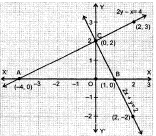
Area {tex}\triangle{/tex} = {tex}\frac{1}{2}{/tex}AB {tex}\times{/tex} CO
={tex}\frac{1}{2}{/tex} {tex}\times{/tex}5 {tex}\times{/tex} 2
=5 square units.
Posted by Shree Saxena 7 years, 8 months ago
- 1 answers
Posted by Vaibhav Tripathi 6 years, 6 months ago
- 1 answers
Sia ? 6 years, 6 months ago
We have to find the value of k for which x4 + 10x3 + 25x2 + 15x + k is exactly divisible by x + 7.
If x + 7 is a factor then (-7) is a root.
So f(-7) = (-7)4 + 10 (-7)3 + 25(-7)2 + 15(-7) + k = 0
2401 - 3430 + 1225 -105 + k = 0
or, 3626 - 3535 + k = 0
or, 91 + k = 0
{tex}\therefore{/tex}k = -91
Posted by Heet Gokani 6 years, 6 months ago
- 1 answers
Sia ? 6 years, 6 months ago
Suppose the first and second number be x and y respectively.
According to the question,
{tex}2x + 3y = 92{/tex} .......(i)
{tex}4x - 7y = 2{/tex} .......(ii)
Multiplying equation (i) by 7 and (ii) by 3,
{tex}\Rightarrow 14x + 21y = 644{/tex} .......(iii)
{tex}12x - 21y = 6{/tex} .........(iv)
Adding equations (iii) and (iv),
{tex}\Rightarrow 26x = 650{/tex}
{tex}\Rightarrow x = \frac { 650 } { 26 } = 25{/tex}
Putting {tex}x = 25{/tex} in equation (i),
{tex}\Rightarrow 2 \times 25 + 3 y = 92{/tex}
{tex}\Rightarrow50 + 3y = 92{/tex}
{tex}\Rightarrow 3 y = 92 - 50{/tex}
{tex}y = \frac { 42 } { 3 } = 14{/tex}
y = 14
{tex}\therefore{/tex} the first number is 25 and second is 14
Posted by Aishwarya Hunashikatti 7 years, 8 months ago
- 0 answers
Posted by Vishesh Sharma 7 years, 8 months ago
- 1 answers
Rashi Ulman 7 years, 8 months ago
Posted by Harshit Tiwari 7 years, 8 months ago
- 0 answers
Posted by Madu Mitha 6 years, 6 months ago
- 1 answers
Sia ? 6 years, 6 months ago
We have to find the zeroes of the quadratic polynomial 4y2 – 15 and verify the relationship between the zeroes and coefficient of polynomial.
Let {tex}f(y)\;=\;4y^2\;–\;15{/tex}
Compare it with the quadratic {tex}ay^2\;+\;by\;+\;c{/tex}.
Here, coefficient of{tex}\;y^2\;=\;4{/tex}, coefficient of y = 0 and constant term = - 15.
Now {tex}4y^2\;–\;15\;=\;(2y)^2\;–\;(\;\sqrt{15})^2{/tex}
= {tex}(2y\;+\;\;\sqrt{15})(2y\;-\;\sqrt{15}){/tex}
The zeroes of f(y) are given by {tex}f(y) = 0{/tex}
⇒{tex}(2y)\;+\;\;\sqrt{15})(2y\;-\;\sqrt{15}){/tex} = 0
⇒ {tex}(2y)\;+\;\;\sqrt{15}){/tex} = 0 or {tex}(2y\;-\;\;\sqrt{15}){/tex} = 0
⇒ {tex}2y\;=\;-\;\;\sqrt{15}{/tex} or {tex}2y\;=\; \;\;\sqrt{15}{/tex}
⇒ {tex}\;y\;=\;-\frac{\;\;\sqrt{15}}2{/tex} or {tex}\;y\;=\;\frac{\;\;\sqrt{15}}2{/tex}
Hence, the zeroes of the given quadratic polynomial are {tex}-\frac{\;\;\sqrt{15}}2{/tex}, {tex} \frac{\;\;\sqrt{15}}2{/tex}

myCBSEguide
Trusted by 1 Crore+ Students

Test Generator
Create papers online. It's FREE.

CUET Mock Tests
75,000+ questions to practice only on myCBSEguide app
