
Ask questions which are clear, concise and easy to understand.
Ask QuestionPosted by Mrudula Pangul 7 years, 7 months ago
- 0 answers
Posted by Vivek Jaiswal 7 years, 7 months ago
- 0 answers
Posted by Shagun Sharma 7 years, 7 months ago
- 0 answers
Posted by Nazis Khan 7 years, 7 months ago
- 0 answers
Posted by Komal Chandak 7 years, 7 months ago
- 1 answers
Posted by Pryanka Grover 7 years, 7 months ago
- 1 answers
Monika Singh 7 years, 7 months ago
Posted by Labdhi Doshi 7 years, 7 months ago
- 1 answers
Sukhi Sukhi 7 years, 7 months ago
Posted by Sonu Patel 7 years, 7 months ago
- 1 answers
Tejeswani Jangra 7 years, 7 months ago
Posted by Monish C 7 years, 7 months ago
- 1 answers
Sukhi Sukhi 7 years, 7 months ago
Posted by Hemant Sharma 7 years, 7 months ago
- 1 answers
Posted by Sameer Ranjan 7 years, 8 months ago
- 0 answers
Posted by Mohit Chaudhary 7 years, 8 months ago
- 1 answers
Vishva Dhanani 7 years, 8 months ago
Posted by Jiim Revanth 6 years, 6 months ago
- 1 answers
Sia ? 6 years, 6 months ago
The given equations are
37x + 43y = 123 ... (i)
43x + 37y = 117. ... (ii)
Clearly, the coefficients of x and y in one equation are interchanged in the other.
Adding (i) and (ii), we get
(37x + 43y) + (43x + 37y) = 123 + 117
(37 + 43)x+ (43 + 37)y = (123 +117)
{tex} \Rightarrow{/tex}80x + 80y = 240
{tex} \Rightarrow{/tex}80(x + y) = 240
{tex} \Rightarrow{/tex} x + y = 3 ....... (iii)
Subtracting (i) from (ii), we get
(37x + 43y) - (43x + 37y) = 123 - 117
6x - 6y = -6
{tex}\Rightarrow{/tex} 6 (x - y) = -6
{tex}\Rightarrow{/tex} x - y = -1 ... (iv)
Adding (iii) and (iv), we get
(x + y) + (x - y) = 3 + (-1)
{tex}\Rightarrow{/tex} x + y + x - y = 2
{tex}\Rightarrow{/tex} 2x = 2
{tex}\Rightarrow{/tex} x = 1.
Subtracting (iv) from (iii), we get
(x + y) - (x - y) = 3 - (-1)
{tex}\Rightarrow{/tex}x + y - x + y = 4
{tex}\Rightarrow{/tex}2y = 4
{tex}\Rightarrow{/tex} y = 2.
Hence, x = 1 and y = 2.
Posted by Gomji Jaiswal 6 years, 6 months ago
- 1 answers
Sia ? 6 years, 6 months ago
Numbers are of two types - prime and composite.
Prime numbers can be divided by 1 and only itself, whereas composite numbers have factors other than 1 and itself.
It can be observed that
7 × 11 × 13 + 13 = 13 × (7 × 11 + 1)
= 13 × (77 + 1)= 13 × 78= 13 ×13 × 6
The given expression has 6 and 13 as its factors.
Therefore, it is a composite number.
7 × 6 × 5 × 4 × 3 × 2 × 1 + 5
= 5 ×(7 × 6 × 4 × 3 × 2 × 1 + 1)
= 5 × (1008 + 1)= 5 ×1009
1009 cannot be factorized further
Therefore, the given expression has 5 and 1009 as its factors.
Hence, it is a composite number.
Posted by Aniket Tupe 7 years, 8 months ago
- 0 answers
Posted by Shreya Sharma 7 years, 8 months ago
- 1 answers
Posted by Sarthak Raj 7 years, 8 months ago
- 1 answers
Happy Kumar 7 years, 8 months ago
Posted by Sudhanshu Rajput 7 years, 8 months ago
- 1 answers
Posted by Vivek Maurya 6 years, 6 months ago
- 1 answers
Sia ? 6 years, 6 months ago
Let {tex} \alpha{/tex} and {tex} \frac { 1 } { \alpha }{/tex} be the zeros of (a2 + 9)x2 + 13x + 6a.
Then, we have
{tex} \alpha \times \frac { 1 } { \alpha } = \frac { 6 a } { a ^ { 2 } + 9 }{/tex}
⇒ 1 = {tex} \frac { 6 a } { a ^ { 2 } + 9 }{/tex}
⇒ a2 + 9 = 6a
⇒ a2 - 6a + 9 = 0
⇒ a2 - 3a - 3a + 9 = 0
⇒ a(a - 3) - 3(a - 3) = 0
⇒ (a - 3) (a - 3) = 0
⇒ (a - 3)2 = 0
⇒ a - 3 = 0
⇒ a = 3
So, the value of a in given polynomial is 3.
Posted by Yuvraj Chauhan 7 years, 8 months ago
- 1 answers
Posted by Manvi Singh 6 years, 4 months ago
- 1 answers
Sia ? 6 years, 4 months ago
The given pair of equations is
ax + by = c ...(1)
bx + ay = 1 + c ...(2)
{tex}\Rightarrow{/tex} ax + by - c = 0 ...(3)
{tex}\Rightarrow{/tex} bx + ay - (1 + c) = 0 ...(4)
To solve the equations by the cross multiplication method, we draw the diagram below:
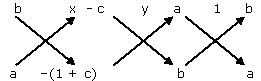
Then,
{tex}\frac{x}{{(b)( - (1 + c)) - (a)( - c)}}{/tex}{tex} = \frac{y}{{( - c)(b) - ( - (1 + c))(a)}}{/tex} {tex} = \frac{1}{{(a)(a) - ({b})(b)}}{/tex}
{tex}\Rightarrow \frac{x}{{ - b - bc + ac}} = \frac{y}{{ - bc + a + ac}} = \frac{1}{{{a^2} - {b^2}}}{/tex}
{tex} \Rightarrow x = \frac{{ - b - bc + ac}}{{{a^2} - {b^2}}}{/tex}
{tex}y = \frac{{ - bc + a + ac}}{{{a^2} - {b^2}}}{/tex}
Hence, the solution of the given pair of linear equations is
{tex}x = \frac{{ - b - bc + ac}}{{{a^2} - {b^2}}},\;y = \frac{{ - bc + a + ac}}{{{a^2} - {b^2}}}{/tex}
Verification, Substituting
{tex}x = \frac{{ - b - bc + ac}}{{{a^2} - {b^2}}},\;y = \frac{{ - bc + a + ac}}{{{a^2} - {b^2}}}{/tex}
We find that both the equations (1) and (2) are satisfied as shown below:
ax + by {tex} = a\left( {\frac{{ - b - bc + ac}}{{{a^2} - {b^2}}}} \right) + b\left( {\frac{{ - bc + a + ac}}{{{a^2} - {b^2}}}} \right){/tex}
{tex} = \frac{{ - ab - abc + {a^2}c - {b^2}c + ab + abc}}{{{a^2} - {b^2}}} = c{/tex}
bx + ay {tex}= b\left( {\frac{{ - b - bc + ac}}{{{a^2} - {b^2}}}} \right) + a\left( {\frac{{ - bc + a + ac}}{{{a^2} - {b^2}}}} \right){/tex}
{tex}= \frac{{ - {b^2} - {b^2} + abc - abc + {a^2} + {a^2}c}}{{{a^2} - {b^2}}}{/tex}
This verifies the solution.
Posted by Sanaya Sinha 7 years, 8 months ago
- 2 answers
Punit Khandelwal 7 years, 7 months ago
Posted by Rahul Rana 7 years, 8 months ago
- 1 answers
Tarun Kumar 7 years, 8 months ago
Posted by Aditi Chaudhary 7 years, 8 months ago
- 1 answers
Aahna Pushpa 7 years, 8 months ago
Posted by Bikant Raj 7 years, 8 months ago
- 1 answers
Posted by Sonali Sonali Jaiswal 7 years, 8 months ago
- 1 answers
Posted by Basant Singh 5 years, 8 months ago
- 3 answers
Savi Gupta 7 years, 8 months ago
Neha Patil 7 years, 8 months ago
Manan Khandelwal 7 years, 8 months ago
Posted by Pooja Goyal 7 years, 8 months ago
- 0 answers
Posted by Geetika Rathore 7 years, 8 months ago
- 1 answers
Savi Gupta 7 years, 8 months ago

myCBSEguide
Trusted by 1 Crore+ Students

Test Generator
Create papers online. It's FREE.

CUET Mock Tests
75,000+ questions to practice only on myCBSEguide app
