
Ask questions which are clear, concise and easy to understand.
Ask QuestionPosted by Aayushi Raj 7 years, 7 months ago
- 0 answers
Posted by Sanjana Singh 7 years, 7 months ago
- 1 answers
Posted by Manoj Singhal 6 years, 6 months ago
- 1 answers
Sia ? 6 years, 6 months ago
As we know,
{tex}a ^ { 3 } + b ^ { 3 } + c ^ { 3 } - 3 a b c ={/tex}{tex}( a + b + c ) \left( a ^ { 2 } + b ^ { 2 } + c ^ { 2 } - a b - b c - c a \right){/tex}
{tex}= ( a + b + c ) \left[ a ^ { 2 } + b ^ { 2 } + c ^ { 2 } - ( a b + b c + c a ) \right]{/tex}
{tex}= 5 \left\{ a ^ { 2 } + b ^ { 2 } + c ^ { 2 } - ( a b + b c + c a ) \right\}{/tex}
{tex}= 5 \left( a ^ { 2 } + b ^ { 2 } + c ^ { 2 } - 10 \right){/tex}
Now, {tex} a + b + c = 5{/tex}
Squaring both sides, we get
{tex}( a + b + c ) ^ { 2 } = 5 ^ { 2 }{/tex}
{tex}\Rightarrow a ^ { 2 } + b ^ { 2 } + c ^ { 2 } + 2 ( a b + b c + c a ) = 25{/tex}
{tex}\therefore a ^ { 2 } + b ^ { 2 } + c ^ { 2 } + 2 ( 10 ) = 25{/tex}
{tex}\Rightarrow a ^ { 2 } + b ^ { 2 } + c ^ { 2 } = 25 - 20 = 5{/tex}
Now, {tex}a ^ {3} + b ^ {3} + c ^ { 3 } - 3 a b c = 5 \left( a ^ { 2 } + b ^ { 2 } + c ^ { 2 } - 10 \right){/tex}
{tex}= 5 ( 5 - 10 ) = 5 ( - 5 ) = - 25{/tex}
Hence, proved.
Posted by Sneha Mishra 7 years, 7 months ago
- 0 answers
Posted by Anurag Pandey 6 years, 6 months ago
- 1 answers
Sia ? 6 years, 6 months ago
A twin prime is a prime number that is either 2 less or 2 more than another prime number—for example, either member of the twin prime pair (41, 43).
Posted by Himanshu Rana 7 years, 7 months ago
- 0 answers
Posted by Shruti Kumari 7 years, 7 months ago
- 6 answers
Aditya Kumar 7 years, 7 months ago
Posted by Naidu Sudikhya 7 years, 7 months ago
- 0 answers
Posted by Jaskaran Singh 7 years, 7 months ago
- 2 answers
Yash Patil 7 years, 7 months ago
Posted by Prashant Kumar 7 years, 7 months ago
- 0 answers
Posted by Ayaz Akhtar 7 years, 7 months ago
- 2 answers
Valsamma Joseph 7 years, 7 months ago
Yash Patil 7 years, 7 months ago
Posted by Nisha Rawat 6 years, 6 months ago
- 1 answers
Sia ? 6 years, 6 months ago
Given polynomial is
f(x) = x2 + px + q
Sum of the zeroes = {tex}α + β = -p{/tex}
Product of the zeroes = {tex}αβ = q{/tex}
As per given condition
Sum of the zeroes of new polynomial = {tex}(α+β)^2 + (α-β)^2{/tex}
= {tex}(α+β)^2 + α^2 + β^2 - 2αβ{/tex}
= {tex}(α+β)^2 + (α+β)^2 - 2αβ - 2αβ{/tex}
= {tex}(-p)^2 + (-p)^2 - 2 × q - 2 × q{/tex}
= {tex}p^2 + p^2 - 4q{/tex}
= {tex}2p^2 - 4q{/tex}
Product of the zeroes of new polynomial ={tex} (α + β)^2 (α - β)^2{/tex}
= {tex}(-p)^2((-p)^2 - 4q){/tex}
= {tex}p^2(p^2 - 4q){/tex}
So, the quadratic polynomial is,
x2 - (sum of the zeroes)x + (product of the zeroes)
= x2 - (2p2 - 4q)x + p2(p2 - 4q)
Hence, the required quadratic polynomial is f(x) = x2 - (2p2 - 4q)x + p2(p2 - 4q).
Posted by Jintu Mandal 7 years, 7 months ago
- 1 answers
Shivani Pradhan 7 years, 7 months ago
Posted by Ashutosh Mishra 7 years, 7 months ago
- 1 answers
Nandani Singh 7 years, 7 months ago
Posted by Shivani Pradhan 7 years, 7 months ago
- 1 answers
Shivani Pradhan 7 years, 7 months ago
Posted by Tsewang Norbo Norbo 7 years, 7 months ago
- 1 answers
Posted by Navdeep Kumar 7 years, 7 months ago
- 1 answers
Posted by Harshit Mehta 5 years, 8 months ago
- 0 answers
Posted by Harshit Mehta 6 years, 6 months ago
- 1 answers
Sia ? 6 years, 6 months ago
The given equation is:
x2 - x + k = 0
As it is given that 3 is root of the equation x2 - x + k = 0, therefore we have:
(3)2 - 3 + k = 0
{tex}\Rightarrow{/tex} 9 - 3 + k = 0
{tex}\Rightarrow{/tex} 6 + k = 0
{tex}\Rightarrow{/tex} k = - 6
For p = - 6 the other given equation becomes:
x2 - 6(2x - 6 + 2) + p = 0
{tex}\Rightarrow{/tex} x2 -12x + 24 + p = 0
This is the form of ax2 + bx + c = 0,
where a = -1, b = -12 and c = 24 + p
Since the given equation has equal roots, therefore D = 0.
i.e., b2 - 4ac = 0
{tex}\Rightarrow{/tex} (-12)2 - 4(1)(24 + p) = 0
{tex}\Rightarrow{/tex} 144 - 96 - 4p = 0
{tex}\Rightarrow{/tex} 48 - 4p = 0
{tex}\Rightarrow{/tex} 4p = 48
{tex}\Rightarrow{/tex} p = 12
Hence, the value of p is 12.
Posted by Hemant Pratap Singh 7 years, 7 months ago
- 1 answers
Hemant Pratap Singh 7 years, 7 months ago
Posted by Ani Sharma 7 years, 7 months ago
- 0 answers
Posted by Vineet Mishra 7 years, 7 months ago
- 0 answers
Posted by Shradhya Pradhan 7 years, 7 months ago
- 1 answers
Posted by Sabana Banu 7 years, 7 months ago
- 0 answers
Posted by Dhananjay Singh 6 years, 4 months ago
- 1 answers
Sia ? 6 years, 4 months ago
Let f(x) = x2 + {tex} \frac 16{/tex}x - 2.
Then, f(x) = {tex} \frac 16{/tex}(6x2+ x -12) = {tex} \frac 16{/tex}(6x2 + 9x - 8x - 12)
{tex} \Rightarrow{/tex} f(x) = {tex} \frac 16{/tex}{(6x2 + 9x) - (8x + 12)}
= {tex} \frac 16{/tex}{3x (2x + 3) - 4 (2x + 3)}
= {tex} \frac 16{/tex}(2x + 3) (3x - 4)
Now f(x)=0 if
{tex}\style{font-family:Arial}{\style{font-size:12px}{\begin{array}{l}i.e.\;x=-\frac32\;or\;x=\frac43\\\end{array}}}{/tex}
Hence, {tex} \alpha = \frac { - 3 } { 2 } \text { and } \beta = \frac { 4 } { 3 }{/tex} are the zeros of the given polynomial.
{tex}\style{font-family:Arial}{\style{font-size:12px}{\begin{array}{l}Now\;\alpha+\beta=\frac{-3}2+\frac43=\frac{-9+8}6=-\frac16\\\end{array}}}{/tex}
and {tex}\style{font-family:Arial}{\style{font-size:12px}{\begin{array}{l}\alpha\beta=\frac{-3}2\times\frac43=-2\\\end{array}}}{/tex}
The given polynomial is f(x) =x2 + {tex} \frac 16{/tex}x - 2.
so a=1 b={tex}\frac16{/tex} c=-2
{tex}\style{font-family:Arial}{\style{font-size:12px}{\begin{array}{l}\alpha+\beta=\frac ba=\frac{-{\displaystyle\frac16}}1=-\frac16\\\end{array}}}{/tex}
and {tex}\style{font-family:Arial}{\style{font-size:12px}{\begin{array}{l}\alpha\beta=\frac ca=\frac{-2}1=-2\\\end{array}}}{/tex}
Hence, the relation between the coefficients and zeros is verified.

myCBSEguide
Trusted by 1 Crore+ Students

Test Generator
Create papers online. It's FREE.

CUET Mock Tests
75,000+ questions to practice only on myCBSEguide app

Sia ? 6 years, 6 months ago
Let A (x1, y1), B (x2, y2) and C (x3, y3) be the vertices of {tex}\triangle{/tex}ABC.
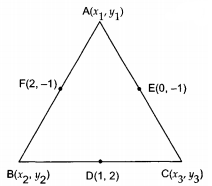
Let D (1, 2), E (0, -1), and F (2, -1) be the mid-points of sides BC, CA and AB respectively.
Since D is the mid-point of BC
{tex}\therefore \quad \frac { x _ { 2 } + x _ { 3 } } { 2 } = 1 \text { and } \frac { y _ { 2 } + y _ { 3 } } { 2 } = 2{/tex}
{tex}\Rightarrow{/tex}x2 + x3 = 2 and y2 + y3 = 4.............(i)
Similarly, E and F are the mid-points of CA and AB respectively.
{tex}\therefore \quad \frac { x _ { 1 } + x _ { 3 } } {2 } = 0 \text { and } \frac { y _ { 1 } + y _ { 3 } } { 2 } = - 1{/tex}
{tex}\Rightarrow{/tex}x1 + x3 = 0 and y1 + y3 = -2...........(ii)
and, {tex}\frac { x _ { 1 } + x _ { 2 } } { 2 } = 2 \text { and } \frac { y _ { 1 } + y _ { 2 } } { 2 } = - 1{/tex}
{tex}\Rightarrow{/tex}x1 + x2 = 4 and y1 + y2 = -2........(iii)
From (i), (ii) and (iii), we get
(x2 + x3) + (x1 + x3) + (x1 + x2)= 2 + 0 + 4:
and, (y2 + y3) + (y1 + y3) + (y1 + y2) =4 - 2 -2
{tex}\Rightarrow{/tex} 2(x1 + x2 + x3) = 6 and 2 (y1 + y2 + y3) = 0........(iv)
{tex}\Rightarrow{/tex}x1 + x2 + x3 = 3 and y1 + y2 + y3 = 0
From (i) and (iv), we get
x1 +2 = 3 and y1 + 4 = 0
{tex}\Rightarrow{/tex} x1 = 1 and y1 = -4
So, the coordinates of A are (1,-4)
From (ii) and (iv), we get
x2 + 0 = 3 and y2 - 2 = 0
{tex}\Rightarrow{/tex}x2 = 3 and y2 = 2
So, coordinates of B are (3, 2)
From (iii) and (iv), we get
x3 + 4 = 3 and y3 - 2 = 0
{tex}\Rightarrow{/tex}x3 = -1 and y3=2
So, coordinates of C are (-1, 2)
Hence, the vertices of the triangle ABC are A (1, -4), B (3, 2) and C (-1,2).
0Thank You