
Ask questions which are clear, concise and easy to understand.
Ask QuestionPosted by Sukhman Randhawa 7 years, 7 months ago
- 4 answers
Anuj Nuju 7 years, 7 months ago
Posted by Fiza Arshi 5 years, 8 months ago
- 0 answers
Posted by Angel ☺☺☺ Manu 7 years, 7 months ago
- 2 answers
Raj Thakur 7 years, 7 months ago
Posted by Vivasvan Singh 7 years, 7 months ago
- 2 answers
Utkarsh Patel 7 years, 7 months ago
Utkarsh Patel 7 years, 7 months ago
Posted by Vivasvan Singh 7 years, 7 months ago
- 0 answers
Posted by Sneha Maheshwari 7 years, 7 months ago
- 0 answers
Posted by Sumit Tiwari 6 years, 4 months ago
- 1 answers
Sia ? 6 years, 4 months ago
Let the three consecutive positive integers be n, n + 1 and n + 2, where n is any integer.
By Euclid’s division lemma, we have
a = bq + r; 0 ≤ r < b
For a = n and b = 3, we have
n = 3q + r ...(i)
Where q is an integer and 0 ≤ r < 3, i.e. r = 0, 1, 2.
Putting r = 0 in (i), we get
{tex}n = 3q{/tex}
∴ n is divisible by 3.
{tex}n + 1 = 3q + 1{/tex}
∴ n + 1 is not divisible by 3.
{tex}n + 2 = 3q + 2{/tex}
∴ n + 2 is not divisible by 3.
Putting r = 1 in (i), we get
{tex}n = 3q + 1{/tex}
∴ n is not divisible by 3.
{tex}n + 1 = 3q + 2{/tex}
∴ n + 1 is not divisible by 3.
{tex}n + 2 = 3q + 3 = 3(q + 1){/tex}
∴ n + 2 is divisible by 3.
Putting r = 2 in (i), we get
{tex}n = 3q + 2{/tex}
∴ n is not divisible by 3.
{tex}n + 1 = 3q + 3 = 3(q + 1){/tex}
∴ n + 1 is divisible by 3.
{tex}n + 2 = 3q + 4{/tex}
∴ n + 2 is not divisible by 3.
Thus for each value of r such that 0 ≤ r < 3 only one out of n, n + 1 and n + 2 is divisible by 3.
Posted by Avinash Maurya 7 years, 7 months ago
- 2 answers
Poorva Sethi 7 years, 7 months ago
Posted by Abhishek Chaudhary 7 years, 7 months ago
- 4 answers
Posted by Sachin Sharma 7 years, 7 months ago
- 2 answers
Anupam Kumar 7 years, 7 months ago
Posted by Himanshu Sharma 7 years, 7 months ago
- 1 answers
Avisha Chandak 7 years, 7 months ago
Posted by Anuvart Chaudhary 7 years, 7 months ago
- 1 answers
Posted by Aryan Singh 7 years, 7 months ago
- 1 answers
Azhad Jamal 7 years, 7 months ago
Posted by Paridhi Agrawal 7 years, 7 months ago
- 2 answers
Virat Thakur 7 years, 7 months ago
Posted by Eshaan Kundra 7 years, 7 months ago
- 3 answers
Posted by Ashfaquealam Alam 7 years, 7 months ago
- 0 answers
Posted by Sidharth Pandey 7 years, 7 months ago
- 1 answers
Posted by Mohit Yadav 6 years, 4 months ago
- 1 answers
Sia ? 6 years, 4 months ago
Let us draw a triangle ABC such that, {tex}\angle{/tex}B = 90°.
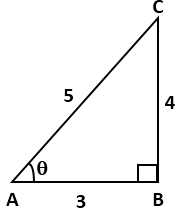
Let {tex}\angle{/tex}A = {tex}\theta{/tex}°.
We have, {tex}\cot \theta = \frac { 3 } { 4 }{/tex}
Then, {tex}\cot \theta = \frac { \text { Base } } { \text { Perpendiaular } } = \frac { A B } { B C } = \frac { 3 } { 4 }{/tex}
Let AB = 3 and BC = 4,
By Pythagoras' theorem, we know that
AC2 = AB2 + BC2
= 32 + 42 = 9 + 16 = 25
{tex}\Rightarrow \quad AC = 5{/tex}
Now,
{tex}\sec \theta = \frac { \text { Hypotenuse } } { \text { Base } } = \frac { A C } { A B } = \frac { 5 } { 3 }{/tex}
{tex}\text{cosec} \theta = \frac { \text { Hypotenuse } } { \text { Perpendicular } } = \frac { A C } { B C } = \frac { 5 } { 4 }{/tex}
L.H.S = {tex}\sqrt { \frac { \sec \theta - \text{cosec} \theta } { \sec \theta + \text{cosec} \theta } }{/tex}
{tex}= \sqrt { \frac { 5 / 3 - 5 / 4 } { 5 / 3 + 5 / 4 } }{/tex}
{tex}= \sqrt { \frac { \frac { 20 - 15 } { 12 } } { \frac { 20 + 15 } { 12 } } }{/tex}
{tex}= \sqrt { \frac { 5 } { 35 } }{/tex}
{tex}= \sqrt { \frac { 1 } { 7 } }{/tex}
{tex}= \frac { 1 } { \sqrt { 7 } }{/tex}
= R.H.S
therefore, {tex}\sqrt { \frac { \sec \theta - \text{cosec} \theta } { \sec \theta + \text{cosec} \theta } }{/tex}{tex}= \frac { 1 } { \sqrt { 7 } }{/tex}
Hence proved.
Posted by Nitin Saini 7 years, 7 months ago
- 2 answers
Posted by Manthan Kumar 7 years, 7 months ago
- 0 answers
Posted by Deepak Jha 7 years, 7 months ago
- 0 answers
Posted by Maheshwari Damor 7 years, 7 months ago
- 0 answers
Posted by Prajjwal Kapri 6 years, 4 months ago
- 1 answers
Sia ? 6 years, 4 months ago
Let a be the positive integer and b = 4.
Then, by Euclid’s algorithm, a = 4q + r for some integer q ≥ 0 and r = 0, 1, 2, 3 because 0 ≤ r < 4.
So, a = 4q or 4q + 1 or 4q + 2 or 4q + 3.
{tex}(4q)^3\;=\;64q^3\;=\;4(16q^3){/tex}
= 4m, where m is some integer.
{tex}(4q+1)^3\;=\;64q^3+48q^2+12q+1=4(\;16q^3+12q^2+3q)+1{/tex}
= 4m + 1, where m is some integer.
{tex}(4q+2)^3\;=\;64q^3+96q^2+48q+8=4(\;16q^3+24q^2+12q+2){/tex}
= 4m, where m is some integer.
{tex}(4q+3)^3\;=\;64q^3+144q^2+108q+27{/tex}
=4×(16q3+36q2+27q+6)+3
= 4m + 3, where m is some integer.
Hence, The cube of any positive integer is of the form 4m, 4m + 1 or 4m + 3 for some integer m.
Posted by Ashok Choudhary 7 years, 7 months ago
- 4 answers
Ashok Choudhary 7 years, 7 months ago
Shivani Pradhan 7 years, 7 months ago
Posted by Sk Harsh 7 years, 7 months ago
- 2 answers
Posted by Yash Garg 7 years, 7 months ago
- 0 answers

myCBSEguide
Trusted by 1 Crore+ Students

Test Generator
Create papers online. It's FREE.

CUET Mock Tests
75,000+ questions to practice only on myCBSEguide app

Aryan Mittal 7 years, 7 months ago
0Thank You