
Ask questions which are clear, concise and easy to understand.
Ask QuestionPosted by Mr Harry 7 years, 7 months ago
- 0 answers
Posted by Nirakar Patnaik 7 years, 7 months ago
- 0 answers
Posted by Niranjan Aryan 7 years, 7 months ago
- 2 answers
Aman Lohiya 7 years, 7 months ago
Posted by Naman Naman 7 years, 7 months ago
- 1 answers
Posted by Abhishek Varma 7 years, 7 months ago
- 1 answers
Apoorva Pavan 7 years, 7 months ago
Posted by Monika Hajong 6 years, 4 months ago
- 1 answers
Sia ? 6 years, 4 months ago
Given {tex}a = 8, d =10 - 8 = 2{/tex}
{tex}\because{/tex} tn = {tex}a + (n - 1 )d{/tex}
{tex}\therefore{/tex}t60 = 8 + (60 - 1)2
= 8 + 59 {tex}\times{/tex} 2
= 8 + 118
= 126
t51 = 8 + (51 -1) 2
= 8 + 50 {tex}\times{/tex} 2
= 8 + 100
= 108
Sum of last 10 terms = t51 + t52 + .... + t60
Here,{tex} a = 108 {/tex} and {tex} d = 2{/tex}
Sn = {tex}\frac{n}{2}{/tex} {tex} [2a + (n-1)d]{/tex}
S10 = {tex}\frac{10}{2}{/tex}[2{tex}\times{/tex}108 + (10 -1)2]
= 5[216 + 9(2)]
= 5(216 + 18)
= 5 {tex}\times{/tex} 234
{tex}=1170{/tex}
Hence, Sum of last 10 terms = 1170
Posted by Chandan Kumar 6 years, 4 months ago
- 1 answers
Sia ? 6 years, 4 months ago
Suppose man's 1 day's work be {tex}\frac 1x{/tex} and boy's 1 day's work be {tex}\frac 1y{/tex}
Suppose, {tex}\frac 1x{/tex}= u and {tex}\frac 1y{/tex}= v
By first condition,
{tex}\frac { 2 } { x } + \frac { 5 } { y } = \frac { 1 } { 4 } \Rightarrow 2 u + 5 v = \frac { 1 } { 4 }{/tex}...........(i)
By second condition,
{tex}\frac { 3 } { x } + \frac { 6 } { y } = \frac { 1 } { 3 } \Rightarrow 3 u + 6 v = \frac { 1 } { 3 }{/tex}.............(ii)
Multiplying (i) by 6 and (ii) by 5,
{tex}\Rightarrow 12 u + 30 v = \frac { 6 } { 4 }{/tex}..........(iii)
{tex}15 u + 30 v = \frac { 5 } { 3 }{/tex}...........(iv)
Subtracting (iii) and (iv),
{tex}\Rightarrow 3u ={/tex} {tex} \frac { 5 } { 3 } - \frac { 6 } { 4 }{/tex}
{tex}\Rightarrow 3 u = \frac { 20 - 18 } { 12 }{/tex}
{tex}\Rightarrow 3 u = \frac { 2 } { 12 }{/tex}
{tex}\Rightarrow 3 u = \frac { 1 } { 6 }{/tex}
{tex}\Rightarrow u = \frac { 1 } { 18 }{/tex}
Putting u = {tex}\frac{1}{18}{/tex} in (i),
{tex}\Rightarrow 2 \times \frac { 1 } { 18 } + 5 v = \frac { 1 } { 4 }{/tex}{tex}\Rightarrow \frac { 1 } { 9 } + 5 v = \frac { 1 } { 4 } \Rightarrow 5 v = \frac { 1 } { 4 } - \frac { 1 } { 9 }{/tex}
{tex}\Rightarrow 5 v = \frac { 5 } { 36 } \Rightarrow v = \frac { 1 } { 36 }{/tex}
Now, {tex}u ={/tex} {tex}\frac { 1 } { 18 } \Rightarrow x = \frac { 1 } { 4 } = 18{/tex}
and {tex}v ={/tex} {tex}\frac { 1 } { 36 } \Rightarrow y = \frac { 1 } { v } = 36{/tex}
{tex}\therefore{/tex}{tex} x = 18, y = 26{/tex}
The man will complete the given work in {tex}18\ days{/tex} and the boy will complete the given work in {tex}36 days{/tex} when they work alone.
Posted by Muky Thakur 7 years, 7 months ago
- 1 answers
Posted by Samiksha Bharti 6 years, 4 months ago
- 1 answers
Sia ? 6 years, 4 months ago
A special economic zone is an area in which the business and trade laws are different from the rest of the country.
Posted by Subodh Kumar Mishra 7 years, 7 months ago
- 0 answers
Posted by Subodh Kumar Mishra 7 years, 7 months ago
- 0 answers
Posted by Shiva Yadav Shiva Yadav 7 years, 7 months ago
- 0 answers
Posted by Khushi Verma 6 years, 4 months ago
- 1 answers
Sia ? 6 years, 4 months ago
The given pair of equations are:
{tex}\frac{b}{a}x + \frac{a}{b}y = {a^2} + {b^2} {/tex}
So, {tex}\frac{b}{a}x + \frac{a}{b}y -[ {a^2} + {b^2} ] = 0{/tex} ...................(i)
And x + y = 2ab
x + y - 2ab = 0 ....................(ii)
Here,
{tex}{a_1} = \frac{b}{a},{b_1} = \frac{a}{b}{/tex}, c1 = -(a2 + b2)
a2 = 1, b2 = 1, c2 = -(2ab)
By cross-multiplication method
{tex}\begin{array}{l}\;\frac x{{\displaystyle\frac ab}\times-(2ab)\;-1\lbrack-(a^2\;+\;b^2)\rbrack}=\;\frac y{-(a^2\;+\;b^2)\;-{\displaystyle\frac ba}\lbrack\;-(2ab)\rbrack}=\;\frac1{{\displaystyle\frac ba}-{\displaystyle\frac ab}}\\\frac x{\displaystyle\frac{-2a^2b}b\;\;+(a^2\;+\;b^2)}=\;\frac y{-(a^2\;+\;b^2)\;+{\displaystyle\frac{2ab^2}a}}=\;\frac1{\displaystyle\frac{b^2\;-\;a^2}{ab}\;}\\\end{array}{/tex}
{tex} \frac{x}{{{\frac ba - \frac ab} }} = \frac{{ - y}}{{ - {b^2} + {a^2}}} = \frac{1}{{\frac{{{b^2} - {a^2}}}{{ab}}}} {/tex}
{tex} \frac{x}{{{b^2} - {a^2}}} = \frac{{ - y}}{{ - {b^2} + {a^2}}} = \frac{1}{{\frac{{{b^2} - {a^2}}}{{ab}}}} {/tex}
{tex} \frac{x}{{{b^2} - {a^2}}} = \frac{1}{{\frac{{{b^2} - {a^2}}}{{ab}}}} {/tex}
{tex}⇒ x = ab{/tex}
And, {tex}\frac{{ - y}}{{ - {b^2} + {a^2}}} = \frac{1}{{\frac{{{b^2} - {a^2}}}{{ab}}}} {/tex}
{tex}⇒ y = ab{/tex}
The solutions of the given pair of equations is x= ab and y = ab .
Posted by Pritam Mitra 7 years, 7 months ago
- 2 answers
Posted by Keerthi Dev Keerthi Dev 7 years, 7 months ago
- 1 answers
Posted by Manan Khandelwal 7 years, 7 months ago
- 2 answers
Manan Khandelwal 7 years, 7 months ago
Posted by Bhoomi Ozha 7 years, 7 months ago
- 1 answers
Posted by Rishi Ral 7 years, 7 months ago
- 1 answers
Posted by Oguri Sai Mahesh 7 years, 7 months ago
- 3 answers
Posted by Arjun Siddharth 7 years, 7 months ago
- 0 answers
Posted by Jagraj Basumtary 5 years, 8 months ago
- 0 answers
Posted by Venkatesh 7 years, 7 months ago
- 5 answers
Posted by Shraddha Jaiswal 6 years, 4 months ago
- 1 answers
Sia ? 6 years, 4 months ago
For (2p - 1)x + (p - 1 )y - (2p + 1) = 0
{tex}a _ { 1 } = 2 p - 1 , b _ { 1 } = p - 1 \text { and } c _ { 1 } = - ( 2 p + 1 ){/tex}
and for 3x + y - 1 = 0
{tex}a _ { 2 } = 3 , b _ { 2 } = 1 \text { and } c _ { 2 } = - 1{/tex}
The condition for no solution is
{tex}\frac { a _ { 1 } } { a _ { 2 } } = \frac { b _ { 1 } } { b _ { 2 } } \neq \frac { c _ { 1 } } { c _ { 2 } }{/tex}
{tex}\frac { 2 p - 1 } { 3 } = \frac { p - 1 } { 1 } \neq \frac { 2 p + 1 } { 1 }{/tex}
By {tex}\frac { 2 p - 1 } { 3 } = \frac { p - 1 } { 1 }{/tex}
3/7-3 = 2 /7 -1
3/7 - 2/7 = 3 - 1
{tex}\therefore {/tex} p = 1
from {tex}\frac { p - 1 } { 1 } \neq 2 p + 1{/tex}
We have {tex}p - 1 \neq 2 p + 1 \text { or } 2 p - p = - 1 - 1{/tex}
{tex}p \neq - 2{/tex}
from {tex}\frac{{2p - 1}}{3} \ne \frac{{2p + 1}}{1}{/tex}
{tex}\Rightarrow \quad 2 p - 1 \neq 6 p + 3{/tex}
{tex} \Rightarrow \quad 4p \ne - 4{/tex}
{tex}p \neq - 1{/tex}
Posted by Shraddha Jaiswal 6 years, 4 months ago
- 1 answers
Sia ? 6 years, 4 months ago
Here f(x)=x4 + 4x3 - 2x2 - 20x - 15
{tex}\sqrt { 5 }{/tex} and - {tex}\sqrt { 5 }{/tex} are zeros of f(x)
{tex}\begin{array}{l}\text{so (x-}\sqrt5)(\mathrm x+\sqrt{5)}=\mathrm x^2-5\;\mathrm{is}\;\mathrm a\;\mathrm{factor}\;\mathrm{of}\;\mathrm f(\mathrm x)\\\end{array}{/tex}
Dividing x4 + 4x3 - 2x2 - 20x - 15 by x2 - 5, we get
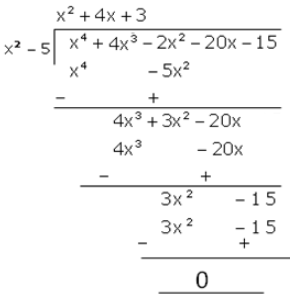
The quotient q(x)=x2+4x+3
=x2+x+3x+3
=x(x+1)+3(x+1)
=(x+3)(x+1)
q(x)=0 if x+3=0 or x+1 =0
Hence zeros of q(x) are -3 and -1
Thus, the zeros of the given polynomial f(x) are
{tex}\sqrt { 5 } , - \sqrt { 5 }{/tex} , -3 , -1

myCBSEguide
Trusted by 1 Crore+ Students

Test Generator
Create papers online. It's FREE.

CUET Mock Tests
75,000+ questions to practice only on myCBSEguide app
