
Ask questions which are clear, concise and easy to understand.
Ask QuestionPosted by Jimmy Barnwal 7 years, 7 months ago
- 0 answers
Posted by Disha Patel 6 years, 4 months ago
- 1 answers
Sia ? 6 years, 4 months ago
{tex}{\frac{1}{{2x}} + \frac{1}{{3y}} = 2}{/tex} ... (1)
{tex}\frac{1}{{3x}} + \frac{1}{{2y}} = \frac{{13}}{6}{/tex} ...(2)
Let {tex}\frac{1}{x}{/tex}= p and {tex}\frac{1}{y}{/tex}= q
Putting this in equation (1) and (2), we get
{tex}\frac{p}{2} + \frac{q}{3} = 2{/tex} and {tex}\;\frac{p}{3} + \frac{q}{2} = \frac{{13}}{6}{/tex}
{tex}\Rightarrow{/tex} 3p + 2q = 12 and 6(2p +3q) = 13 (6)
{tex}\Rightarrow{/tex} 3p + 2q = 12 and 2p + 3q = 13
{tex}\Rightarrow{/tex} 3p + 2q - 12 = 0 .................. (3) and
2p + 3q - 13 = 0 ................. (4)
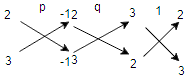
{tex}\frac{p}{{2( - 13) - 3( - 12)}} = \frac{q}{{( - 12)2 - ( - 13)3}}{/tex}{tex} = \frac{1}{{3 \times 3 - 2 \times 2}}{/tex}
{tex}\Rightarrow \frac{p}{{ - 26 + 36}} = \frac{q}{{ - 24 + 39}} = \frac{1}{{9 - 4}}{/tex}
{tex} \Rightarrow \frac{p}{{10}} = \frac{q}{{15}} = \frac{1}{5} \Rightarrow \frac{p}{{10}} = \frac{1}{5}\,{\text{and}}\,\frac{q}{{15}} = \frac{1}{5}{/tex}
{tex}\Rightarrow{/tex} p = 2 and q = 3
But {tex}\frac{1}{x}{/tex} = p and {tex}\frac{1}{y}{/tex} = q
Putting value of p and q in this we get,
x = {tex}\frac{1}{2}{/tex}and y = {tex}\frac{1}{2}{/tex}
Posted by Vaishali Pundir 7 years, 7 months ago
- 4 answers
V Sridhar 7 years, 7 months ago
if one of the root is 3 then , f(3) = 3*3 - 2k*3+6 =0 (replacing x by 3 in the equation
i.e., k = 15/6
Posted by Shubham Singh 7 years, 7 months ago
- 1 answers
Posted by Ayush Sharma 7 years, 7 months ago
- 1 answers
Vaishali Pundir 7 years, 7 months ago
Posted by Abhi Dwivedi 7 years, 7 months ago
- 1 answers
Posted by Nikki Sahu 7 years, 7 months ago
- 0 answers
Posted by Rohan Rathod 6 years, 4 months ago
- 1 answers
Sia ? 6 years, 4 months ago
Given: Let, ABCD is a rhombus and since diagonals of a rhombus bisect each other at {tex} 90 ^ { \circ }{/tex}
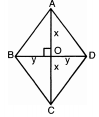
To Prove: {tex} \therefore A B ^ { 2 } + B C ^ { 2 } + C D ^ { 2 } + A D ^ { 2 } = A C ^ { 2 } + B D ^ { 2 }{/tex}
Proof :
{tex}\therefore {/tex}{tex}A O = O C {/tex}
{tex}\Rightarrow A O ^ { 2 } = O C ^ { 2 }{/tex}
{tex}B O = O D {/tex}
{tex}\Rightarrow B O ^ { 2 } = O D ^ { 2 }{/tex}
and {tex}\angle A O B = 90 ^ { \circ }{/tex}
{tex}\therefore {/tex} {tex} A B ^ { 2 } = O A ^ { 2 } + B O ^ { 2 }{/tex}
Similarly, {tex} A D ^ { 2 } = x ^ { 2 } + y ^ { 2 } {/tex}
{tex}BC ^ { 2 } = x ^ { 2 } + y ^ { 2 } {/tex}
{tex}C D ^ { 2 } = x ^ { 2 } + y ^ { 2 } {/tex}
{tex} \therefore A B ^ { 2 } + B C ^ { 2 } + C D ^ { 2 } + D A ^ { 2 } = 4 A O ^ { 2 } + 4 D O ^ { 2 }{/tex}
{tex} = ( 2 A O ) ^ { 2 } + ( 2 D O ) ^ { 2 }{/tex}
{tex} = ( 2 x ) ^ { 2 } + ( 2 y ) ^ { 2 }{/tex}
{tex} \therefore A B ^ { 2 } + B C ^ { 2 } + C D ^ { 2 } + A D ^ { 2 } = A C ^ { 2 } + B D ^ { 2 }{/tex}
Hence proved.
Posted by Viraat Yadav 6 years, 4 months ago
- 1 answers
Sia ? 6 years, 4 months ago
Let a = bq + r : b = 2
0 {tex} \leqslant {/tex} r < 2 i.e., r = 0, 1
a = 2q + 0, 2q + 1,
If a = 2q (which is even)
If a = 2q + 1 (which is odd)
So, every positive even integer is of the form 2q and odd integer is of the form 2q + 1.
Posted by Dewanshu Singh 7 years, 7 months ago
- 1 answers
Kannu Kranti Yadav 7 years, 7 months ago
Posted by Vivek Choudhary 6 years, 4 months ago
- 1 answers
Sia ? 6 years, 4 months ago
Given integers are 408 and 1032 where 408 < 1032
By applying Euclid’s division lemma, we get 1032 = 408 {tex}\times{/tex} 2 + 216.
Since the remainder ≠ 0, so apply division lemma again on divisor 408 and remainder 216, we get the relation as
408 = 216 {tex}\times{/tex} 1 + 192.
Since the remainder ≠ 0, so apply division lemma again on divisor 216 and remainder 192
216 = 192 {tex}\times{/tex} 1 + 24.
Since the remainder ≠ 0, so apply division lemma again on divisor 192 and remainder 24
192 = 24 × 8 + 0.
Now the remainder has become 0. Therefore, the H.C.F of 408 and 1032 = 24.
Therefore,
24 = 1032m - 408 {tex}\times{/tex} 5
1032m = 24 + 408 {tex}\times{/tex} 5
1032m = 24 + 2040
1032m = 2064
{tex}m = \frac{{2064}}{{1032}}{/tex}
Therefore, m = 2.
Posted by Ujjwal Rawal 6 years, 4 months ago
- 1 answers
Sia ? 6 years, 4 months ago
HCF of 56 and 72
{tex}\begin{array}{l}56=8\times7=2^3\times7\\72=8\times9=2^3\times3^2\\So\;HCF(56,72)=2^3=8\end{array}{/tex}
d = 56x + 72y
⇒ 8 = 56x + 72y
Dividing by 8 both sides
1= 7x + 9y
Put x = 4 and y = –3
1 = 7 × 4 + 9(–3)
= 28 – 27
1 = 1
L.H.S = R.H.S.
Put x = –5 and y = 4
1 = 7(–5) + 9 {tex} \times {/tex} 4
= –35 + 36
1 = 1
L.H.S = R.H.S.
x = 4, and y = –3
x = –5 and y = 4
Satisfy the equations
∴ x and y are not unique.
Posted by Vanshika Meena 6 years, 4 months ago
- 1 answers
Sia ? 6 years, 4 months ago
If a and b are odd numbers then it should be in 2q+1 or 2q+3 form where q is a positive integer.
Let a = 2q + 3 , b = 2q + 1 and a > b
Now, {tex}\frac{a + b } {2} = \frac{ 2q + 3 + 2q + 1}{2}{/tex}
{tex}= \frac { 4 q + 4 } { 2 }{/tex}
= 2q + 2
{tex}\frac{a+b}{2}{/tex}=2(q+1) = an even number..........(1)
Now
{tex}\frac { a - b } { 2 } = \frac { ( 2 q + 3 ) - ( 2 q + 1 ) } { 2 }{/tex}
{tex}= \frac { 2 q + 3 - 2 q - 1 } { 2 }{/tex}
{tex}\frac{a-b}{2}= \frac { 2 } { 2 }{/tex} = 1 = an odd number..........(2)
Hence From (1) and (2) {tex}\frac{a+b}{2}{/tex} and {tex}\frac{a-b}{2}{/tex} are even and odd numbers respectively
Posted by Anil Kumar Ojha 7 years, 7 months ago
- 0 answers
Posted by Ananua Rai 6 years, 4 months ago
- 1 answers
Sia ? 6 years, 4 months ago
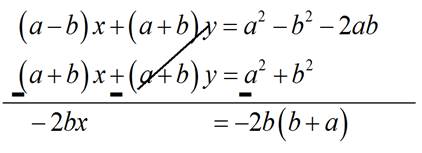
x = a + b
{tex}\therefore{/tex} (a - b)(a + b) + (a + b)y = a2 - b2 - 2ab
a2 - b2 + (a + b)y = a2 - b2 - 2ab
{tex}y = \frac{{ - 2ab}}{{a + b}}{/tex}
Posted by Sakshi Singh 7 years, 7 months ago
- 1 answers
Kannu Kranti Yadav 7 years, 7 months ago
Posted by Varun Punia 7 years, 7 months ago
- 1 answers
V Sridhar 7 years, 7 months ago
eqn 1/2x-1/y=-1 is now a/2 - b = -1 or a - 2b = -2 ----------(1)
eqn 1/x+1/2y=8 is now a + b/2 = 8 or 2a + b = 16 ---------(2)
solving (1) and (2) we get , a= 6. but a = 1/x . Therefore x= 1/6
similarly b = 4 . But b = 1/y. Therefore y = 1/4
Posted by Aryan Gupta 7 years, 7 months ago
- 1 answers
Posted by Parush Uppal 7 years, 7 months ago
- 1 answers
Utkarsh Patel 7 years, 7 months ago
Posted by Rumi Mondal 7 years, 7 months ago
- 2 answers
Varun Punia 7 years, 7 months ago
Posted by Vanshika Kesarwami 7 years, 7 months ago
- 0 answers
Posted by Raj Muria Kora 7 years, 7 months ago
- 1 answers
Varun Punia 7 years, 7 months ago
Posted by Vilas Vicky 7 years, 7 months ago
- 1 answers
Posted by Jatin Ahlawat 7 years, 7 months ago
- 1 answers
Kannu Kranti Yadav 7 years, 7 months ago
Posted by Yash Ojha 7 years, 7 months ago
- 6 answers
Charu Sharma 7 years, 7 months ago
Unnati Pragya 7 years, 7 months ago
Posted by Kamal Kumar 6 years, 4 months ago
- 1 answers
Sia ? 6 years, 4 months ago
The given quadratic polynomial is:
f(x) = x3 + 3px2 + 3qx + r
we have to show that the zeroes of given polynomial are in the form of AP.
Let, a - d, a, a + d be the zeroes of the polynomial, then
The sum of zeroes = {tex}\frac{{ - b}}{a}{/tex}
a + a - d + a + d = -3p
3a = - 3p
a = - p
Since, a is the zero of the polynomial f(x),
Therefore, f(a) = 0
f(a) = a3 + 3pa2 + 3qa + r = 0
{tex}\Rightarrow{/tex} a3 + 3pa2 + 3qa + r = 0
{tex}\Rightarrow{/tex} (-p)3 + 3p(-p)2 + 3q(-p) + r = 0
{tex}\Rightarrow{/tex} -p3 + 3p3 - 3pq + r = 0
{tex}\Rightarrow{/tex} 2p3 - 3pq + r = 0
Which is the required condition.
Posted by Tanya Sharmaa 7 years, 7 months ago
- 1 answers
Kannu Kranti Yadav 7 years, 7 months ago
Posted by Gulpreet Kaur 7 years, 7 months ago
- 1 answers
Tanya Sharmaa 7 years, 7 months ago

myCBSEguide
Trusted by 1 Crore+ Students

Test Generator
Create papers online. It's FREE.

CUET Mock Tests
75,000+ questions to practice only on myCBSEguide app
