
Ask questions which are clear, concise and easy to understand.
Ask QuestionPosted by Ravleen Sawhney 7 years, 6 months ago
- 0 answers
Posted by Gaurie Sharma 6 years, 4 months ago
- 1 answers
Sia ? 6 years, 4 months ago
The given equation is
x² - 2x(1 + 3k) +7(3 + 2k) = 0
or x² - 2(1 + 3k)x +7(3 + 2k) = 0
It is given that the given quadratic equation has equal roots,
⇒ b² -4ac = 0
In the given equation we have,
a= 1, b = - 2(1 + 3k) and c= 7(3 + 2k)
Now b² - 4ac = 0
⇒ [ - 2(1 + 3k) ]² - 4 ×1×7(3 + 2k) = 0
⇒ 4×(1 + 3k)² - 4×7(3 + 2k) = 0
⇒ 4(1 + 9k² + 6k) - 4(21 +14k) =0
⇒ (1 + 9k² + 6k) - (21 +14k) = 0
⇒ 1+ 9{tex}k^2{/tex}+ 6k - 21 - 14k = 0
⇒ 9k² - 8k - 20 = 0
Factorize above equation we get
9k² - 18k + 10k - 20 = 0
⇒ 9k( k- 2) + 10(k -2) =0
Therefore, either 9k +10=0 and k -2 = 0
⇒ k= -10/9and k = 2
Hence the values of k are -10/9, 2
Posted by Anupam Tiwari 7 years, 6 months ago
- 0 answers
Posted by Dnyaneshwar Chavan 7 years, 6 months ago
- 2 answers
Posted by Aditya Kumar 7 years, 6 months ago
- 2 answers
Posted by Abhishek Mund 7 years, 6 months ago
- 1 answers
Posted by Kanha Sheoran 7 years, 6 months ago
- 0 answers
Posted by Shivani K 7 years, 6 months ago
- 7 answers
Tanya Khichi 7 years, 6 months ago
Posted by Shivam Bhardwaj 7 years, 6 months ago
- 0 answers
Posted by Darshan Mendhule 7 years, 6 months ago
- 1 answers
Posted by Deepak Khatri 5 years, 8 months ago
- 0 answers
Posted by Komal Das 7 years, 6 months ago
- 0 answers
Posted by Sharanu Manthale 7 years, 6 months ago
- 3 answers
Ankit Chauhan 7 years, 6 months ago
Posted by Komal Das 7 years, 6 months ago
- 3 answers
Posted by Prince Kumar 7 years, 6 months ago
- 3 answers
Posted by Prabhas Behera 7 years, 6 months ago
- 0 answers
Posted by Lakshit Sharma 6 years, 4 months ago
- 1 answers
Sia ? 6 years, 4 months ago
{tex}{\frac{1}{{2x}} + \frac{1}{{3y}} = 2}{/tex} ... (1)
{tex}\frac{1}{{3x}} + \frac{1}{{2y}} = \frac{{13}}{6}{/tex} ...(2)
Let {tex}\frac{1}{x}{/tex}= p and {tex}\frac{1}{y}{/tex}= q
Putting this in equation (1) and (2), we get
{tex}\frac{p}{2} + \frac{q}{3} = 2{/tex} and {tex}\;\frac{p}{3} + \frac{q}{2} = \frac{{13}}{6}{/tex}
{tex}\Rightarrow{/tex} 3p + 2q = 12 and 6(2p +3q) = 13 (6)
{tex}\Rightarrow{/tex} 3p + 2q = 12 and 2p + 3q = 13
{tex}\Rightarrow{/tex} 3p + 2q - 12 = 0 .................. (3) and
2p + 3q - 13 = 0 ................. (4)
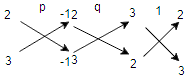
{tex}\frac{p}{{2( - 13) - 3( - 12)}} = \frac{q}{{( - 12)2 - ( - 13)3}}{/tex}{tex} = \frac{1}{{3 \times 3 - 2 \times 2}}{/tex}
{tex}\Rightarrow \frac{p}{{ - 26 + 36}} = \frac{q}{{ - 24 + 39}} = \frac{1}{{9 - 4}}{/tex}
{tex} \Rightarrow \frac{p}{{10}} = \frac{q}{{15}} = \frac{1}{5} \Rightarrow \frac{p}{{10}} = \frac{1}{5}\,{\text{and}}\,\frac{q}{{15}} = \frac{1}{5}{/tex}
{tex}\Rightarrow{/tex} p = 2 and q = 3
But {tex}\frac{1}{x}{/tex} = p and {tex}\frac{1}{y}{/tex} = q
Putting value of p and q in this we get,
x = {tex}\frac{1}{2}{/tex}and y = {tex}\frac{1}{2}{/tex}
Posted by Ramanpreet Singh 6 years, 4 months ago
- 1 answers
Sia ? 6 years, 4 months ago
Here R = {(x, x + 5): {tex}x \in {/tex}(0, 1, 2, 3, 4, 5)}
= {(a, b): a = 0, 1, 2,3, 4, 5}
Now a = x and b = x + 5
Putting a = 0, 1, 2, 3, 4, 5 we get b = 5, 6, 7, 8, 9, 10
{tex}\therefore {/tex} Domain of R = {0, 1, 2, 3, 4, 5}
Range of R = {5, 6, 7, 8, 9, 10}
Posted by Ritik Rathi 7 years, 6 months ago
- 1 answers
Posted by Neeraj Sisodiya 7 years, 6 months ago
- 4 answers
Posted by Premal Kumar Rajput 7 years, 6 months ago
- 1 answers
Posted by Ria Bansal 7 years, 6 months ago
- 4 answers
Posted by Raksha Krishna Ashtankar 6 years, 4 months ago
- 1 answers
Sia ? 6 years, 4 months ago
Let breadth of the rectangular park = {tex}x {/tex} m
Then, length of the rectangular park = ({tex}x+3{/tex}) m
Now, area of the rectangular park is = {tex}x(x+3)=(x^2+3x)m^2{/tex} {tex}[\because area=length\times breadth]{/tex}
Given, base of the triangular park = Breadth of the rectangular park
Therefore base of triangular park is = {tex}x{/tex} m
and it is given that altitude of triangular park is = {tex}12 {/tex} m
Therefore, area of the triangular park will be = {tex}\frac{1}{2}\times x\times 12= 6x {/tex} {tex}m^2{/tex} {tex}[\because area(Triangle)=\frac{1}{2}\times base\times altitude]{/tex}
As per the question area of rectangular park is = {tex}4 + {/tex} Area of triangular park
{tex}\Rightarrow x^2+3x=4+6x{/tex}
{tex}\Rightarrow x^2+3x-6x-4=0{/tex}
{tex}\Rightarrow x^2-3x-4=0{/tex}
{tex}\Rightarrow x^2-4x+x-4=0{/tex} [ by factorization ]
{tex}\Rightarrow x(x-4)+1(x-4)=0{/tex}
{tex}\Rightarrow (x-4)(x+1)=0{/tex}
{tex}\Rightarrow x-4=0 {/tex} or {tex}x+1=0{/tex} {tex}{/tex}
⇒ x = 4 or x = - 1
Since, breadth cannot be negative , so we will neglect {tex}x=-1{/tex} and choose {tex}x = 4{/tex}
Hence, breadth of the rectangular park will be = 4 m
and length of the rectangular park will be = {tex}x+3=4+3=7m{/tex}
Verification:
Area of rectangular park is = 28 m2
Area of triangular park is = 24 m2 = (28 – 4) m2
Posted by Rishika Burman 7 years, 6 months ago
- 0 answers
Posted by Abhishek Jha 7 years, 6 months ago
- 2 answers

myCBSEguide
Trusted by 1 Crore+ Students

Test Generator
Create papers online. It's FREE.

CUET Mock Tests
75,000+ questions to practice only on myCBSEguide app
