
Ask questions which are clear, concise and easy to understand.
Ask QuestionPosted by Satnam Singh 7 years, 6 months ago
- 1 answers
Posted by Tayyaba Khanum 5 years, 8 months ago
- 1 answers
Posted by Bhoomika Shukla 7 years, 6 months ago
- 1 answers
Posted by Arjun Bansal 7 years, 6 months ago
- 1 answers
Vishal Pathak 7 years, 6 months ago
Posted by Vikram Jha 6 years, 6 months ago
- 1 answers
Sia ? 6 years, 6 months ago
The given pair of equations is
px + qy = p - q .....(1)
qx - py = p + q ....(2)
Multiplying equation (1) by p and equation (2) by q, we get
p2x + pqy = p2 - pq....(3)
q2x - pqy = pq + q2.....(4)
Adding equation (3) and equation (4), we get
(p2 + q2)x = p2 + q2
{tex}\Rightarrow \;x = \frac{{{p^2} + {q^2}}}{{{p^2} + {q^2}}} = 1{/tex}
Substituting this value of x in equation (1), we get
p(1) + qy = p - q
{tex}\Rightarrow{/tex} qy = -q
{tex}\Rightarrow \;y = \frac{{ - q}}{q} = - 1{/tex}
So, the solution of the given pair of linear equations is x = +1, y = -1.
Verification, Substituting x = 1, y = -1,
We find that both the equations (1) and (2) are satisfied as shown below:
px + qy = p(1) + q(-1) = p - q
qx - py = q(1) - p(-1) = q + p = p + q
This verifies the solution.
Posted by Ankit Aarya 7 years, 6 months ago
- 1 answers
Sia ? 6 years, 6 months ago
A linear combination is an expression constructed from a set of terms by multiplying each term by a constant and adding the results (e.g. a linear combination of x and y would be any expression of the form ax + by, where a and b are constants).
Posted by Golu Kumar 7 years, 6 months ago
- 2 answers
Kannu Kranti Yadav 7 years, 6 months ago
Posted by Mallesh Ks 6 years, 6 months ago
- 1 answers
Sia ? 6 years, 6 months ago
Here α and β are the zeros of polynomial f(x) = x2 - px + q
So a=1,b=-p,c=q
Sum of the zeroes α + β={tex}-\frac ba{/tex} = p
Product of the zeroes αβ=q
{tex}\frac{{{\alpha ^2}}}{{{\beta ^2}}} + \frac{{{\beta ^2}}}{{{\alpha ^2}}}{/tex}
{tex}= \frac{{{\alpha ^4} + {\beta ^4}}}{{{\alpha ^2}{\beta ^2}}}{/tex}
{tex}=\frac{\left(\mathrm\alpha^2+\mathrm\beta^2\right)^2-2\left(\mathrm{αβ}\right)^2}{\left(\mathrm{αβ}\right)^2}=\frac{\{(\mathrm\alpha+\mathrm\beta)^2-2\mathrm{αβ}\}^2-2\left(\mathrm{αβ}\right)^2}{\left(\mathrm{αβ}\right)^2}{/tex}
{tex}=\frac{(\mathrm p^2-2\mathrm q)^2-2\mathrm q^2}{\mathrm q^2}=\frac{\mathrm p^4+4\mathrm q^2-4\mathrm p^2\mathrm q-2\mathrm q^2}{\mathrm q^2}=\frac{\mathrm p^4+2\mathrm q^2-4\mathrm p^2\mathrm q}{\mathrm q^2}{/tex}
{tex}=\frac{\mathrm p4}{\mathrm q^2}-\frac{4\mathrm p^2\mathrm q}{\mathrm q^2}+\frac{2\mathrm q^2}{\mathrm q^2}=\frac{\mathrm p4}{\mathrm q^2}-\frac{4\mathrm p^2}{\mathrm q}+2=\mathrm{RHS}{/tex}
Hence, proved.
Posted by Damini Rai 7 years, 6 months ago
- 1 answers
Posted by Nikhil Goel 5 years, 8 months ago
- 1 answers
Posted by Auz Siddique 7 years, 6 months ago
- 1 answers
Posted by Priyanshu Sahu 7 years, 6 months ago
- 0 answers
Posted by Rishika Verma 7 years, 6 months ago
- 1 answers
Posted by Akanksha Kamble 6 years, 6 months ago
- 1 answers
Sia ? 6 years, 6 months ago
In right {tex}\triangle{/tex}ABD, {tex}\angle D = 90 ^ { \circ }{/tex}
{tex}AB^2 = AD^2 + BD^2{/tex}
{tex}\Rightarrow{/tex} {tex}AB^2 = 4^2 + 3^2{/tex}
{tex}\Rightarrow{/tex} AB = {tex}\pm 5{/tex} cm
{tex}\Rightarrow{/tex} {tex}AB = 5 cm{/tex} (Neglecting negative value)
In right {tex}\triangle{/tex}ABC , cot {tex}\theta{/tex} = {tex}\frac { \mathrm { BC } } { \mathrm { AB } } = \frac { 12 } { 5 }{/tex}
Posted by Ujjwal Malhotra 7 years, 6 months ago
- 4 answers
Posted by Arjun Trivedi 7 years, 6 months ago
- 1 answers
Posted by Pooja Jha 6 years, 6 months ago
- 1 answers
Sia ? 6 years, 6 months ago
5437 × 1001 = 5437 × (1000 + 1)
= 5437 × 1000 + 5437 × 1
= 54,37,000 + 5437 = 54,42,437
Posted by Suresh Dutta 6 years, 6 months ago
- 1 answers
Sia ? 6 years, 6 months ago
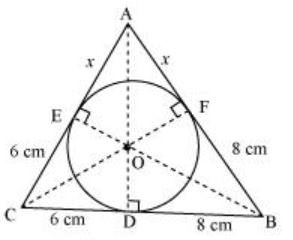
Let the sides BC, CA, AB of {tex}\triangle{/tex}ABC touch the incircle at D, E, F respectively.
Join the centre O of the circle with A, B, C, D, E, F
Since, tangents to a circle from an external point are equal
{tex}\therefore{/tex} CE = CD = 6 cm
BF = BD = 8 cm
AE = AF = x cm (say)
OE = OF = OD = 4 cm [Radii of the circle]
AB = (x + 8) cm and AC = (x + 6) cm and CB = 6 + 8 = 14 cm
Area of {tex}\triangle{/tex}OAB = {tex}\frac12{/tex}(8 + x) × 4 = (16 + 2x) cm2 ........(i)
area of {tex}\triangle{/tex}OBC = {tex}\frac12{/tex}×14 × 4 = 28 cm2 ............(ii)
area of {tex}\triangle{/tex}OCA = {tex}\frac12{/tex}(6 + x) × 4 = (12 + 2x) cm2 ...........(iii)
{tex}\therefore{/tex} area of {tex}\triangle{/tex}ABC = 16 + 2x + 12 + 2x + 28 = (4x + 56) cm2 ...........(iv)
Again, perimeter of {tex}\triangle{/tex}ABC = AC + AB + BC
= 6 + x + (8 + x) + (6 + 8)
= 28 + 2x = 2(14 + x) cm
S = {tex}\frac{2(14+x)}2{/tex} = 14 + x
Area of {tex}\triangle{/tex}ABC = {tex}\begin{array}{l}\sqrt{s(s-a)(s-b)(s-c)\;}\;\\\end{array}{/tex}
{tex}=\sqrt{(14+\;x)(14+\;x-14)(14+\;x-6-x)(14+\;x-8-x)\;}{/tex}
{tex}=\sqrt{(14\;+x)48x}{/tex}
{tex}\;\sqrt{672x+\;48x^2}{/tex}...........(v)
{tex}\therefore{/tex} (4x + 56) = {tex}\sqrt{672x+\;48x^2}{/tex}[By 4 and 5]
{tex}\Rightarrow{/tex} (4x + 56)2 = 672x + 48x2
{tex}\Rightarrow{/tex} 16(x + 14)2 = 16(42x +3x2)
{tex}\Rightarrow{/tex} (x + 14)2 = (42x +3x2)
{tex}\Rightarrow{/tex} x2 + 28x + 196 = 3x2 + 42x
(x + 14) (x -7) = 0
x = 7 , x = -14
But x = -14 is not possible
{tex}\therefore{/tex} x = 7
AB = x + 8 = 7 + 8 = 15 cm
and AC = x + 6 = 7 + 6 = 13 cm
Posted by Kavita Shekhawat 7 years, 6 months ago
- 4 answers
Posted by Munish Kumar 7 years, 6 months ago
- 0 answers
Posted by Meet Gurjas Kaur 7 years, 6 months ago
- 6 answers
Posted by Rishika Verma 7 years, 6 months ago
- 0 answers
Posted by Pragati Jain 6 years, 6 months ago
- 1 answers
Sia ? 6 years, 6 months ago
First find the HCF of 65 and 117 by Using Euclid's division algorithm,
117 = 65{tex}\times{/tex} 1 + 52
65 = 52{tex}\times{/tex} 1 + 13
52 = 13{tex}\times{/tex} 4 + 0
So, HCF of 117 and 65 = 13
HCF = {tex}65m + 117n{/tex}
For, {tex}m= 2{/tex} and {tex}n = -1{/tex},
HCF = 65{tex}\times{/tex} 2 + 117{tex}\times{/tex} (-1)
= 130 - 117
= 13
Hence, the integral values of m and n are 2 and -1 respectively and the HCF of 117 and 65 is 13.
Posted by Azad Singh Nain 7 years, 6 months ago
- 0 answers
Posted by Shubham Singh 7 years, 6 months ago
- 0 answers
Posted by Preet Singh 7 years, 6 months ago
- 0 answers

myCBSEguide
Trusted by 1 Crore+ Students

Test Generator
Create papers online. It's FREE.

CUET Mock Tests
75,000+ questions to practice only on myCBSEguide app

Shweta Yadav 7 years, 6 months ago
1Thank You