
Ask questions which are clear, concise and easy to understand.
Ask QuestionPosted by Amit Kumar 7 years, 6 months ago
- 1 answers
Sia ? 6 years, 6 months ago
Get NCERT solutions here : <a href="https://mycbseguide.com/ncert-solutions.html">https://mycbseguide.com/ncert-solutions.html</a>
Posted by Sujal Jha 7 years, 6 months ago
- 1 answers
Posted by Bimal Samal 6 years, 6 months ago
- 1 answers
Sia ? 6 years, 6 months ago
Let the amount of their respective capitals be x and y.
{tex}\therefore{/tex} According to the given condition,
x + 100 = 2(y - 100)
or, x + 100 = 2y - 200
or, x - 2y= - 300 ........(i)
and 6(x - 10) = y + 10
or, 6x - 60 = y + 10
{tex} \Rightarrow {/tex} 6x-y=70 .......(ii)
On multiplying eqn. (ii) by 2 and subtracting from eqn. (1),
{tex}\therefore{/tex}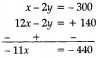
On substituting x = 40 in eqn. (1),
40 - 2y = - 300
or, 2y = 340
{tex}\therefore{/tex} y = 170
Hence, the amount of their respective capitals are 40 and 170.
Posted by Simanshu Singh 6 years, 6 months ago
- 1 answers
Sia ? 6 years, 6 months ago
{tex}D = [2(k -12)]^2 - 4(k - 12)\times 2{/tex}
= 4(k -12)2 - 8(k - 12)
For equal and real roots, D = 0
{tex}\Rightarrow{/tex}{tex}4(k - 12)^2 - 8(k - 12) = 0{/tex}
{tex}\Rightarrow{/tex}{tex}4(k - 12) (k - 12 - 2) = 0{/tex}
{tex}\Rightarrow{/tex}{tex}4(k - 12) (k - 14) = 0{/tex}
{tex}\Rightarrow{/tex}k =12 or k = 14
{tex}\because{/tex}a {tex}\ne{/tex} 0 {tex}\Rightarrow{/tex} k {tex}\ne{/tex}12; {tex}\therefore{/tex} k = 14.
Posted by Shristi Duarah 6 years, 6 months ago
- 1 answers
Sia ? 6 years, 6 months ago
Since, α and β are the zeroes of the quadratic polynomial f(x) = 6x2 + x - 2.
a=6, b=1, c=-2
sum of zeros =α+β={tex}-\frac ba{/tex}{tex}= \frac{{ - 1}}{6}{/tex}
Product of the zeroes = αβ={tex}\frac ca{/tex} {tex} = \frac{{ - 1}}{3}{/tex}
Now,
{tex}\frac{\mathrm\alpha}{\mathrm\beta}+\frac{\mathrm\beta}{\mathrm\alpha}=\frac{\mathrm\alpha^2+\mathrm\beta^2}{\mathrm{αβ}}=\frac{(\mathrm\alpha+\mathrm\beta)^2-2\mathrm{αβ}}{\mathrm{αβ}}{/tex}
{tex}=\frac{\left(-{\displaystyle\frac16}\right)^2-2(-{\displaystyle\frac13})}{\displaystyle-\frac13}=\frac{\displaystyle\frac1{36}+\frac23}{\displaystyle-\frac13}=-\frac{\displaystyle\frac{75}{36}}{\displaystyle\frac13}=-\frac{75}{36}\times\frac31=-\frac{25}4{/tex}
Posted by Devendra Jaiswal 7 years, 6 months ago
- 1 answers
Posted by Gajendra Patidar 7 years, 6 months ago
- 1 answers
Susai Raj 7 years, 6 months ago
Sum of zeroes = 0, product of zeroes = -7
So the required polynomiais
x^2 -(sum of zeroes)x product of zeroes.
ie. x^2 -0x +(-7)
ie x^2 -7
Posted by Kushagra Khajuria 7 years, 6 months ago
- 1 answers
Posted by Deepak Sethi 7 years, 6 months ago
- 0 answers
Posted by Rishika Verma 7 years, 6 months ago
- 1 answers
Susai Raj 7 years, 6 months ago
x^2 + x - a(a+1) =0 =>
x^2 + (a+1)x - ax - a(a+1) = 0 =>
x{x+(a+1)} - a{x+(a+1)} = 0 =>
{x+(a+1)}(x-a) = 0 =>
x+(a+1) = 0 or x+a = 0. (Since if ab=0 then either a=0 or b=0) =>
x = -(a+1) or x = -a ie x = -a -1 or x = -a
So the zeros of the given polynomial are -a -1 or -a.
Posted by Priyanshu Tomar 7 years, 6 months ago
- 1 answers
Posted by Ajaz Shaikh 7 years, 6 months ago
- 1 answers
Posted by Ankit Jain 7 years, 6 months ago
- 3 answers
Ankit Jain 7 years, 6 months ago
Shivani K 7 years, 6 months ago
Posted by Abjo Stanly 7 years, 6 months ago
- 1 answers
Posted by Basavaraj Basava 7 years, 6 months ago
- 1 answers
Posted by Abhishek Kanojia 7 years, 6 months ago
- 1 answers
Samit Gautam 7 years, 6 months ago
Posted by Yogesh Singh 5 years, 8 months ago
- 1 answers
Posted by Gurbakshish Singh 6 years, 6 months ago
- 1 answers
Sia ? 6 years, 6 months ago
Let in the first two digit number,
Unit's digit = x
And, ten's digit = y
Them, the number = 10y + x
On interchanging the digits, in the new number unit's digit = y
And, ten's digit = x
{tex}\therefore{/tex} The new number = 10x + y
According to the question,
(10y + x) + (10x + y) = 110
{tex}\Rightarrow{/tex} 11x + 11y = 110
{tex}\Rightarrow{/tex} x + y = 10 ....Dividing throughout by 11
{tex}\Rightarrow{/tex} x + y - 10 = 0 ....(1)
And (10y + x) - 10 = 5(x + y) + 4
{tex}\Rightarrow{/tex} 10y + x - 10 = 5x + 5y + 4
{tex}\Rightarrow{/tex} -4x +5y -14 =0
{tex}\Rightarrow{/tex} 4x - 5y + 14 = 0 ....(2)
To solve the equation (1) and (2) by cross multiplication method, we draw the diagram below;
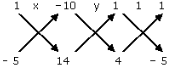
Then,
{tex}\Rightarrow \;\frac{x}{{(1)(14) - ( - 5)( - 10)}} = \frac{y}{{( - 10)(4) - (14)(1)}}{/tex}{tex}= \frac{1}{{(1)( - 5) - (4)(1)}}{/tex}
{tex}\Rightarrow \;\frac{x}{{14 - 50}} = \frac{y}{{ - 40 - 14}} = \frac{1}{{ - 5 - 4}}{/tex}
{tex}\Rightarrow \;\frac{x}{{ - 36}} = \frac{y}{{ - 54}} = \frac{1}{{ - 9}}{/tex}
{tex}\Rightarrow \;x = \frac{{ - 36}}{{ - 9}} = 4{/tex} and {tex}\Rightarrow \;y = \frac{{ - 54}}{{ - 9}} = 6{/tex}
Hence, the first two digit number = 10 {tex}\times{/tex} 6 + 4 = 60 + 4 = 64
Verification. Substituting x = 4, y = 6, we find that both the equations (1) and (2) are
satisfied as shown below:
x + y - 10 = 4 + 6 - 10 = 0
4x - 5y + 14 = 4(4) - 5(6) + 14
= 16 - 30 + 14 = 0
Hence, the solution we have got is correct.
Posted by Aman Bhatt 5 years, 8 months ago
- 1 answers
Bbavya Mittal 7 years, 6 months ago
Posted by Nikunj Rajpoot 7 years, 6 months ago
- 2 answers
Pratham Bajpai 7 years, 6 months ago
Posted by Yash Chopra 7 years, 6 months ago
- 0 answers
Posted by Parvez Kaul 7 years, 6 months ago
- 1 answers
Posted by Parvez Kaul 7 years, 6 months ago
- 1 answers
Posted by Rishika Verma 7 years, 6 months ago
- 2 answers
Posted by Harshit Pandey 7 years, 6 months ago
- 1 answers
Sia ? 4 years, 6 months ago
Posted by Gurleen Kaur 7 years, 6 months ago
- 2 answers
Posted by Kajal Jangra 7 years, 6 months ago
- 1 answers
Amaira Desai 7 years, 6 months ago
Posted by Pranshu Yadav 7 years, 6 months ago
- 0 answers
Posted by Sanjamjot Kaur 7 years, 6 months ago
- 1 answers

myCBSEguide
Trusted by 1 Crore+ Students

Test Generator
Create papers online. It's FREE.

CUET Mock Tests
75,000+ questions to practice only on myCBSEguide app

Sia ? 6 years, 6 months ago
The given system of equations may be written as
{tex}2x + 3y - 7 = 0{/tex}
{tex}2ax + ay + by - 28 = 0{/tex} {tex}\Rightarrow{/tex}{tex} 2ax + (a + b)y - 28 = 0{/tex}
This system of equations is of the form
{tex}a_1x + b_1y + c_1 = 0{/tex}
{tex}a_2x + b_2y + c_2 = 0{/tex}
where, a1 = 2, b1 = 3, c1 = -7
And, a2 = 2a, b2 = a + b, c2 = -28
For the system of equations to have infinite solutions,
{tex}\frac{{{a_1}}}{{{a_2}}} = \frac{{{b_1}}}{{{b_2}}} = \frac{{{c_1}}}{{{c_2}}}{/tex}
{tex} \Rightarrow \frac{2}{{2a}} = \frac{3}{{a + b}} = \frac{{ - 7}}{{ - 28}}{/tex}
{tex}\Rightarrow \frac{1}{a} = \frac{3}{{a + b}} = \frac{1}{4}{/tex}
Now, {tex}\frac{1}{a} = \frac{1}{4}{/tex}
{tex}\Rightarrow{/tex} a = 4
And, {tex}\frac{1}{a} = \frac{3}{{a + b}}{/tex}
{tex}\Rightarrow{/tex}{tex} a + b = 3a{/tex}
{tex}\Rightarrow{/tex} {tex}2a = b{/tex}
{tex}\Rightarrow{/tex} 2 {tex}\times{/tex} 4 = b
{tex}\Rightarrow{/tex}{tex} b = 8{/tex}
Hence, the given system of equations will have infinite number of solutions for {tex}a = 4\ and\ b = 8.{/tex}
0Thank You