
Ask questions which are clear, concise and easy to understand.
Ask QuestionPosted by Vishal Paswan 7 years, 6 months ago
- 0 answers
Posted by Usha Jain 6 years, 6 months ago
- 1 answers
Sia ? 6 years, 6 months ago
Since,
Sum of the zeroes of polynomial = α + β {tex}= \frac{{ - b}}{a}{/tex}
and product of zeroes of polynomial = αβ {tex}= \frac{c}{a}{/tex}
Simplify the given expression and substitutie the values, we obtain
{tex}\frac{\beta }{{a\alpha + b}} + \frac{\alpha }{{a\beta + b}}{/tex}{tex}= \frac{{\beta \left( {a\beta + b} \right) + \alpha \left( {a\alpha + b} \right)}}{{\left( {a\alpha + b} \right)\left( {a\beta + b} \right)}}{/tex}
{tex}= \frac{{\alpha {\beta ^2} + b\beta + \alpha^2 {a} + b\alpha }}{{{a^2}\alpha \beta + ab\alpha + ab\beta + {b^2}}}{/tex}
{tex} = \frac{{a{\alpha ^2} + b{\beta ^2} + b\alpha + b\beta }}{{{a^2} \times \frac{c}{a} + ab\left( {\alpha + \beta } \right) + {b^2}}}{/tex}
{tex}=\frac{{a\left[ {{{\left( {\alpha + \beta } \right)}^2} + b\left( {\alpha + \beta } \right)} \right]}}{{ac}}{/tex}
{tex} = \frac{{a\left[ {{{\left( {a + \beta } \right)}^2} - 2\alpha \beta } \right] - \frac{{{b^2}}}{a}}}{{ac}}{/tex}
{tex}= \frac{{a\left[ {\frac{{{b^2}}}{a} - \frac{{2c}}{a}} \right] - \frac{{{b^2}}}{a}}}{{ac}}{/tex}
{tex} = \frac{{a\left[ {\frac{{{b^2} - ac}}{a}} \right] - \frac{{{b^2}}}{a}}}{{ac}}{/tex}
{tex}= \frac{{a\left[ {\frac{{{b^2} - ac - {b^2}}}{a}} \right]}}{{ac}}{/tex}
{tex}= \frac{{{b^2} - 2c - {b^2}}}{{ac}}{/tex}
{tex}= \frac{{ - 2c}}{{ac}} = \frac{{ - 2}}{a}{/tex}
Posted by Darshna T 7 years, 6 months ago
- 3 answers
Posted by Shashank Srivastava 7 years, 6 months ago
- 1 answers
Posted by Shashank Srivastava 6 years, 6 months ago
- 1 answers
Sia ? 6 years, 6 months ago
The given pair of linear equation is
3x + y = 1, (2k - 1) x + (k - 1) y = 2k + 1
{tex}\Rightarrow{/tex} 3x + y - 1 = 0
Here, (2k - 1)x + (k - 1) y - (2k + 1) = 0
a1 = 3, b1 = 1, c1 = -1
a2 = 2k - 1, b2 = k - 1, c2 = -(2k + 1)
for having no solution, we must have {tex}\frac{{{a_1}}}{{{a_2}}} = \frac{{{b_1}}}{{{b_2}}} \ne \frac{{{c_1}}}{{{c_2}}}{/tex}
{tex}\Rightarrow \frac{3}{{2k - 1}} = \frac{1}{{k - 1}} \ne \frac{{ - 1}}{{ - (2k + 1)}}{/tex}
From above we have {tex}\frac{3}{{2k - 1}} = \frac{1}{{k - 1}}{/tex}
{tex}\Rightarrow{/tex} 3(k - 1) = 2k - 1
{tex}\Rightarrow{/tex} 3k - 3 = 2k - 1
{tex}\Rightarrow{/tex} 3k - 2k = 3 - 1
{tex}\Rightarrow{/tex} k = 2
Hence, the required value of k is 2.
Posted by Harsh Khanpara 7 years, 6 months ago
- 1 answers
Posted by Mohd Hussain 7 years, 6 months ago
- 1 answers
Tanya Sharmaa 7 years, 6 months ago
Posted by Aleena Gimmi 7 years, 6 months ago
- 1 answers
Jeenay Patel 7 years, 6 months ago
Posted by Anubhav Kumar Singh 7 years, 6 months ago
- 1 answers
Mohd Hussain 7 years, 6 months ago
Posted by Nikky Choudhary 7 years, 6 months ago
- 6 answers
Gulshan Kumar Yadav 7 years, 6 months ago
Jin Kazama 7 years, 6 months ago
Gulshan Kumar Yadav 7 years, 6 months ago
Gulshan Kumar Yadav 7 years, 6 months ago
Posted by Vishsl Kumar 7 years, 6 months ago
- 0 answers
Posted by Harshit Saxena 7 years, 6 months ago
- 0 answers
Posted by Anshuman Tandi 6 years, 6 months ago
- 1 answers
Sia ? 6 years, 6 months ago
{tex}\frac{1}{3}\pi h({r_1}^2 + {r_2}^2 + {r_1}{r_2}){\text{ }}c{m^3}{/tex}
Posted by Sjae 2115 7 years, 6 months ago
- 0 answers
Posted by Rajiv Ranjan 6 years, 6 months ago
- 1 answers
Sia ? 6 years, 6 months ago
Let us draw a right triangle ABC in which {tex}\angle B A C = \theta{/tex}
{tex}\sin \theta = \frac { a ^ { 2 } - b ^ { 2 } } { a ^ { 2 } + b ^ { 2 } }{/tex} ...... Given
{tex}\Rightarrow \frac { B C } { A C } = \frac { a ^ { 2 } - b ^ { 2 } } { a ^ { 2 } + b ^ { 2 } } \Rightarrow \frac { B C } { a ^ { 2 } - b ^ { 2 } } = \frac { A C } { a ^ { 2 } + b ^ { 2 } } = k ( \text { say } ){/tex}
where k is a positive number.
{tex}\Rightarrow B C = k \left( a ^ { 2 } - b ^ { 2 } \right){/tex}
{tex}A C = k \left( a ^ { 2 } + b ^ { 2 } \right){/tex}
In {tex}\Delta A B C{/tex}
{tex}\because \angle B = 90 ^ { \circ }{/tex}
{tex}\therefore A C ^ { 2 } = A B ^ { 2 } + B C ^ { 2 } \ldots \ldots{/tex} By Pythagoras theorem
{tex}\Rightarrow \mathrm { k } ^ { 2 } \left( \mathrm { a } ^ { 2 } + \mathrm { b } ^ { 2 } \right) ^ { 2 } = \mathrm { AB } ^ { 2 } + \mathrm { k } ^ { 2 } \left( \mathrm { a } ^ { 2 } - \mathrm { b } ^ { 2 } \right) ^ { 2 }{/tex}
{tex}\Rightarrow A B ^ { 2 } = k ^ { 2 } \left\{ \left( a ^ { 2 } + b ^ { 2 } \right) ^ { 2 } - \left( a ^ { 2 } - b ^ { 2 } \right) ^ { 2 } \right\}{/tex}
{tex}\Rightarrow A B ^ { 2 } = k ^ { 2 } \left( 4 a ^ { 2 } b ^ { 2 } \right) \Rightarrow A B = 2 a b k{/tex}
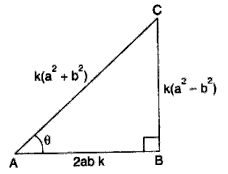
Therefore,
{tex}\cos \theta = \frac { A B } { A C } = \frac { 2 a b k } { k \left( a ^ { 2 } + b ^ { 2 } \right) } = \frac { 2 a b } { a ^ { 2 } + b ^ { 2 } }{/tex}
{tex}\tan \theta = \frac { B C } { A B } = \frac { k \left( a ^ { 2 } - b ^ { 2 } \right) } { 2 a b k } = \frac { a ^ { 2 } - b ^ { 2 } } { 2 a b }{/tex}
{tex}cosec \theta = \frac { A C } { B C } = \frac { k \left( a ^ { 2 } + b ^ { 2 } \right) } { k \left( a ^ { 2 } - b ^ { 2 } \right) } = \frac { a ^ { 2 } + b ^ { 2 } } { a ^ { 2 } - b ^ { 2 } }{/tex}
{tex}\sec \theta = \frac { A C } { A B } = \frac { k \left( a ^ { 2 } + b ^ { 2 } \right) } { 2 a b k } = \frac { a ^ { 2 } + b ^ { 2 } } { 2 a b }{/tex}
{tex}\cot \theta = \frac { A B } { B C } = \frac { 2 a b k } { k \left( a ^ { 2 } - b ^ { 2 } \right) } = \frac { 2 a b } { a ^ { 2 } - b ^ { 2 } }{/tex}
Posted by Sourav Rajput 7 years, 6 months ago
- 7 answers
Rajiv Ranjan 7 years, 6 months ago
Posted by Ekta Tembhre 7 years, 6 months ago
- 3 answers
Posted by Ayush Kumar 7 years, 6 months ago
- 1 answers
Posted by Rumana Banu 7 years, 6 months ago
- 0 answers
Posted by Karan Sharma 7 years, 6 months ago
- 1 answers
Posted by Neethu Jaisan 7 years, 6 months ago
- 3 answers
Abhishek Varma 7 years, 6 months ago
Posted by Harsh Kumar 7 years, 6 months ago
- 1 answers
Posted by Harsh Kumar 7 years, 6 months ago
- 3 answers
Posted by Prachi Singh 7 years, 6 months ago
- 5 answers
Ritu Sena 7 years, 6 months ago
Divya Kumari 7 years, 6 months ago
Varun Srivastav 7 years, 6 months ago
Ritu Sena 7 years, 6 months ago
Posted by Rajiv Ranjan 7 years, 6 months ago
- 2 answers
Posted by Stuti Sharma 7 years, 6 months ago
- 2 answers
Posted by Aneena M 6 years, 6 months ago
- 1 answers
Sia ? 6 years, 6 months ago
Let three consecutive numbers be x, (x + 1) and (x + 2)
Let x = 6q + r 0 {tex}\leq r < 6{/tex}
{tex}\therefore x = 6 q , 6 q + 1,6 q + 2,6 q + 3,6 q + 4,6 q + 5{/tex}
{tex}\text { product of } x ( x + 1 ) ( x + 2 ) = 6 q ( 6 q + 1 ) ( 6 q + 2 ){/tex}
if x = 6q then which is divisible by 6
{tex}\text { if } x = 6 q + 1{/tex}
{tex}= ( 6 q + 1 ) ( 6 q + 2 ) ( 6 q + 3 ){/tex}
{tex}= 2 ( 3 q + 1 ) .3 ( 2 q + 1 ) ( 6 q + 1 ){/tex}
{tex}= 6 ( 3 q + 1 ) \cdot ( 2 q + 1 ) ( 6 q + 1 ){/tex}
which is divisible by 6
if x = 6q + 2
{tex}= ( 6 q + 2 ) ( 6 q + 3 ) ( 6 q + 4 ){/tex}
{tex}= 3 ( 2 q + 1 ) .2 ( 3 q + 1 ) ( 6 q + 4 ){/tex}
{tex}= 6 ( 2 q + 1 ) \cdot ( 3 q + 1 ) ( 6 q + 1 ){/tex}
Which is divisible by 6
{tex}\text { if } x = 6 q + 3{/tex}
{tex}= ( 6 q + 3 ) ( 6 q + 4 ) ( 6 q + 5 ){/tex}
{tex}= 6 ( 2 q + 1 ) ( 3 q + 2 ) ( 6 q + 5 ){/tex}
which is divisible by 6
{tex}\text { if } x = 6 q + 4{/tex}
{tex}= ( 6 q + 4 ) ( 6 q + 5 ) ( 6 q + 6 ){/tex}
{tex}= 6 ( 6 q + 4 ) ( 6 q + 5 ) ( q + 1 ){/tex}
which is divisible by 6
if x = 6q + 5
{tex}= ( 6 q + 5 ) ( 6 q + 6 ) ( 6 q + 7 ){/tex}
{tex}= 6 ( 6 q + 5 ) ( q + 1 ) ( 6 q + 7 ){/tex}
which is divisible by 6
{tex}\therefore {/tex} the product of any three natural numbers is divisible by 6.
Posted by Nitin Raj 7 years, 6 months ago
- 2 answers
Pratibha Kumari 7 years, 6 months ago
Rajiv Ranjan 7 years, 6 months ago
Posted by Harsh Harsh 7 years, 6 months ago
- 5 answers
Varun Srivastav 7 years, 6 months ago
Varun Srivastav 7 years, 6 months ago
Varun Srivastav 7 years, 6 months ago

myCBSEguide
Trusted by 1 Crore+ Students

Test Generator
Create papers online. It's FREE.

CUET Mock Tests
75,000+ questions to practice only on myCBSEguide app
