
Ask questions which are clear, concise and easy to understand.
Ask QuestionPosted by Sukhbir Jass 7 years, 6 months ago
- 2 answers
Posted by Madan Sharma 7 years, 6 months ago
- 1 answers
Posted by Avdhesh Singh 7 years, 6 months ago
- 0 answers
Posted by Vivek Jindal 7 years, 6 months ago
- 2 answers
Shubham Kumar 7 years, 6 months ago
Posted by Sakshi Rai 7 years, 6 months ago
- 1 answers
Posted by Sakshi Rai 7 years, 6 months ago
- 3 answers
Posted by Thrupthi N 7 years, 6 months ago
- 3 answers
Md. Amjad Noor 4 years, 7 months ago
Hello
This is only test purpose you remove it from answer
√ 4 √ 5Vikas Goswami 5 years, 7 months ago
Posted by Sahil Baghade 7 years, 6 months ago
- 1 answers
Account Deleted 7 years, 6 months ago
Posted by Zeel Kakadiya 7 years, 6 months ago
- 2 answers
Posted by S Aniruddh 7 years, 6 months ago
- 4 answers
Ashutosh Pati 7 years, 6 months ago
Ritu Sena 7 years, 6 months ago
Pratibha Kumari 7 years, 6 months ago
Sarthak Arora 7 years, 6 months ago
Posted by Anushka Khandelwal 7 years, 6 months ago
- 2 answers
Maria Anna Alwin 7 years, 6 months ago
Given:
p(x) = 3x² + 5x - 2
α & β are the zeroes
To Find:
A polynomial with zeroes 3α + 2β and 2α + 3β
In p(x)
α + β = -b/a
α + β = -5/3
αβ = c/a
αβ = -2/3
Let the new polynomial g(x) = a'x² + b'x + c'
Zeroes of g(x) ⇒ 3α + 2β = α' & 2α + 3β = β'
α' + β' = -b'/a'
3α + 2β + 2α + 3β = -b'/a'
5(α + β) = 5(-5/3) = -b'/a'
-25/3 = -b'/a'
α'β' = c/a
(3α + 2β) x (2α + 3β) = c'/a'
6(α²+β²) +13αβ = c'/a'
6({α+β}² - 2αβ) + 13αβ = c'/a'
6(4/9 - 2(-2/3)) + 13(-2/3) = c'/a'
32/3 - 26/3 = c'/a'
6/3 = c'/a'
∴ The new polynomial is a'x² + b'x + c'
⇒3x² - 25x + 6
Posted by Rashmi Agrawal 6 years, 6 months ago
- 1 answers
Sia ? 6 years, 6 months ago
Let A (4, 4), B (3, 5) and C(-1, -1) be three vertices of a {tex}\Delta {\rm A}{\rm B}C{/tex}.
{tex}\therefore{/tex} Slope of AB {tex} = \frac{{5 - 4}}{{3 - 4}} = \frac{1}{{ - 1}} = - 1{/tex}
{tex}\therefore{/tex} Slope of BC {tex}= \frac{{ - 1 - 5}}{{ - 1 - 3}} = \frac{{ - 6}}{{ - 4}} = \frac{3}{2}{/tex}
{tex}\therefore{/tex} Slope of AC {tex} = \frac{{ - 1 - 4}}{{ - 1 - 4}} = \frac{{ - 5}}{{ - 5}} = 1{/tex}
Now slope of AB {tex}\times{/tex} slope of AC = -1{tex}\times{/tex}1 = -1
This shows thatAB{tex}\bot{/tex}AC. Thus {tex}\Delta {\rm A}{\rm B}C{/tex} is right angled at point A.
Posted by Sonal Kumari 7 years, 6 months ago
- 2 answers
Sonal Kumari 7 years, 6 months ago
Posted by Prakash Singh 7 years, 6 months ago
- 1 answers
Minal Sinha 7 years, 6 months ago
Posted by Darpit Darpit 7 years, 6 months ago
- 1 answers
Posted by Isha Gupta 6 years, 6 months ago
- 1 answers
Sia ? 6 years, 6 months ago
We have, 2x2 + x + 4 = 0
Dividing both sides by 2, we get
{tex}x^2 +{1 \over 2}x + 2 = 0 {/tex}
{tex}\implies (x)^2 + {1 \over 2}x + {1 \over 16} = -2 + {1 \over 16}{/tex}
{tex}\implies (x)^2 + 2(x) ({1 \over 4})+ ({1 \over4})^2= {- 32 +1 \over 16}{/tex}
{tex}\implies (x + {1 \over4})^2 = -{31 \over 16} <0{/tex}
Which is not possible, as square cannot be negative.
So, there is no real value of x which satisfy the given equation.
Therefore, the given equation has no real roots.
Posted by Monalisha Deori 6 years, 6 months ago
- 1 answers
Sia ? 6 years, 6 months ago
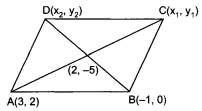
Let coordinates of C be (x1, y1) and D be (.x2, y2).
So, {tex}\frac { x _ { 1 } + 3 } { 2 }{/tex} = 2 .....(i) and {tex}\frac { y _ { 1 } + 2 } { 2 }{/tex} = -5 .....(ii) [Mid-point theorem]
Also, {tex}\frac { x _ { 2 } - 1 } { 2 }{/tex} = 2 ......(iii) and {tex}\frac { y _ { 2 } + 0 } { 2 }{/tex} = -5 ......(iv) [Mid-point theorem]
From equation (i), we get
{tex}\frac { x _ { 1 } + 3 } { 2 }{/tex} = 2
{tex}\Rightarrow{/tex} x1 + 3 = 4
{tex}\Rightarrow{/tex} x1 = 4 - 3 = 1
Solving equation (ii), we get
y1 + 2 = - 10
{tex}\Rightarrow{/tex} y1 = - 10 - 2
{tex}\Rightarrow{/tex} y1 = - 12
Solving equation (iii), we get
x2 - 1 = 4
x2 = 4 + 1 = 5
Solving equation (iv), we get
y2 + 0 = - 10
{tex}\Rightarrow{/tex} y2 = - 10
{tex}\therefore{/tex} Coordinates of C are (1, -12) and D are (5, -10).
Posted by Pratham Agarwal 7 years, 6 months ago
- 4 answers
Ritu Sena 7 years, 6 months ago
Venkat R 7 years, 6 months ago
Posted by Palzor Tamang 7 years, 6 months ago
- 1 answers
Posted by Aamir Khan 7 years, 6 months ago
- 1 answers
Posted by Azam Ali 7 years, 6 months ago
- 0 answers
Posted by Harsh Rathore 7 years, 6 months ago
- 1 answers
Ritu Sena 7 years, 6 months ago
Posted by Shivani Garg 7 years, 6 months ago
- 1 answers
Posted by Karman Jot Kaur Kahlon 7 years, 6 months ago
- 0 answers
Posted by Vrushabh Panwelkar 7 years, 6 months ago
- 2 answers
Posted by Tanishk Gupta 7 years, 6 months ago
- 3 answers
Gulshan Kumar Yadav 7 years, 6 months ago
Posted by Charanpreet Arora 6 years, 6 months ago
- 1 answers
Sia ? 6 years, 6 months ago
Suppose, the present age of father be x years and the present age of son be y years.
According to the question,
Five years hence,
Father's age = {tex}(x + 5) years{/tex}
Using the given information, we have
{tex}x + 5=3(y + 5){/tex}
{tex}\Rightarrow{/tex} {tex}x - 3y - 10=0{/tex} ...........(i)
Five years ago,
Father's age = {tex}(x - 5)years{/tex}
Son's age ={tex}(y - 5)years{/tex}
Using the given information, we get
{tex}(x - 5) = 7 (y - 5){/tex}
{tex}\Rightarrow{/tex} {tex}x - 7y + 30 = 0{/tex} ............(ii)
Subtracting equation (ii) from equation (i), we get
{tex}4y - 40 = 0{/tex}
{tex}\Rightarrow{/tex} {tex}y = 10{/tex}
Putting y = 10 in equation (i), we get
{tex}x - 30 - 10 = 0{/tex}
{tex}\Rightarrow{/tex} {tex}x = 40{/tex}
Hence, present age of father is 40 years and present age of son is 10 years.
Posted by Kuldeep Solanki 7 years, 6 months ago
- 1 answers
Tsalamo Humtsoe 7 years, 6 months ago

myCBSEguide
Trusted by 1 Crore+ Students

Test Generator
Create papers online. It's FREE.

CUET Mock Tests
75,000+ questions to practice only on myCBSEguide app

Shubham Kumar 7 years, 6 months ago
2Thank You