
Ask questions which are clear, concise and easy to understand.
Ask QuestionPosted by Arman Kanojia 7 years, 5 months ago
- 0 answers
Posted by Vanshika Mohit 6 years, 6 months ago
- 2 answers
Sia ? 6 years, 6 months ago
{tex}\frac { a x } { b } - \frac { b y } { a } = a + b{/tex}
{tex}\Rightarrow{/tex} {tex}a^2x - b^2y = a^2b + ab^2{/tex}............(i)
{tex}ax - by = 2ab{/tex}..............................(ii)
Multiply (ii) by -b, we get
{tex}-abx + b^2y = -2ab^2{/tex}.......................(iii)
Adding (i) and (iii), we get
{tex}a^2x - abx = a^2b + ab^2 - 2ab^2{/tex}
{tex}\Rightarrow{/tex} {tex}x(a^2 - ab) = a^2b - ab^2{/tex}
{tex}\Rightarrow x = \frac { a b ( a - b ) } { a ( a - b ) }{/tex}
{tex}\Rightarrow x = b{/tex}
Substituting x = b in (ii), we get
a(b) - by = 2ab
{tex}\Rightarrow{/tex} -by = ab
{tex}\Rightarrow{/tex} y = -a
So, x = b and y = -a
Vandan Dev Barnwal 4 years, 6 months ago
Posted by Yugam .. 7 years, 5 months ago
- 2 answers
Sachin Agrawal 7 years, 5 months ago
Posted by Dinesh Biswa 7 years, 5 months ago
- 0 answers
Posted by Rao D 7 years, 5 months ago
- 0 answers
Posted by Anuj Gautam 5 years, 8 months ago
- 1 answers
Sia ? 6 years, 6 months ago
The given equations are
{tex}x = 3{/tex} …(i)
{tex}x = 5{/tex} …(ii)
{tex}2x - y - 4 = 0{/tex}
⇒ {tex}y = 2x - 4{/tex}
{tex}\left. \begin{gathered} \begin{array}{*{20}{c}} {x = 0,then}&{y = 2(0) - 4 = 0 - 4 = - 4} \end{array} \hfill \\ \begin{array}{*{20}{c}} {x = 1,then}&{y = 2(1) - 4 = 2 - 4 = - 2} \end{array} \hfill \\ \begin{array}{*{20}{c}} {x = 2,then}&{y = 2(2) - 4 = 4 - 4 = 0} \end{array} \hfill \\ \begin{array}{*{20}{c}} {x = 3,then}&{y = 2(3) - 4 = 6 - 4 = 2} \end{array} \hfill \\ \begin{array}{*{20}{c}} {\mathop {x = 4,then}\limits_{x = 3} }&{\mathop {y = 2(4) - 4 = 8 - 4 = 4}\limits_{x = 5} } \end{array} \hfill \\ \end{gathered} \right\} \Rightarrow{/tex}
| x | 0 | 1 | 2 | 3 | 4 |
| y | -4 | -2 | 0 | 2 | 4 |
| III | G | H | J | K | L |
| x | 3 | 3 | 3 | x | 5 | 5 | 5 | |
| y | 1 | 2 | 3 | y | 3 | 4 | 5 | |
| I | A | B | C | II | D | E | F |

The coordinates of the vertices of the required quadrilateral {tex}PMNB{/tex} are {tex}P(3, 0),\ M(5, 0),\ N(5, 6)\ and\ B(3, 2){/tex}
The quadrilateral formed by these given three lines and x-axis is {tex}PMNB{/tex}. It is trapezium. So, area of the required trapezium
{tex}= \frac { 1 } { 2 } ( B P + M N ) \times P M{/tex}
{tex}= \frac { 1 } { 2 } [ ( 2 - 0 ) + ( 6 - 0 ) ] ( 5 - 3 ){/tex}
{tex}= \frac { 1 } { 2 } \times 8 \times 2 = 8{/tex}square units
{tex}\therefore{/tex} the area of required {tex}PMNB{/tex} = {tex}8\ square\ units.{/tex}
Posted by Pankaj Kumar 7 years, 5 months ago
- 2 answers
Posted by Anil Kushwah 7 years, 5 months ago
- 0 answers
Posted by Priyanshu Kumar 7 years, 5 months ago
- 1 answers
Sia ? 6 years, 6 months ago
Check exam pattern here : https://mycbseguide.com/cbse-syllabus.html
Posted by Amit Kumar Rawat 7 years, 5 months ago
- 2 answers
Shiv Kumar Chaudhary 7 years, 5 months ago
Posted by Ayush Jain Nkps Rajawas 6 years, 6 months ago
- 1 answers
Sia ? 6 years, 6 months ago
We have the following equation,
{tex}(m^2+n^2)x^2-2(mp+nq)x+p^2+q^2=0{/tex}
where, a = (m2 + n2), b = -2(mp + nq), and c = p2 + q2
The given equation will have equal roots,if D = 0
{tex}\Rightarrow{/tex} {tex}b^2-4ac=0{/tex}
{tex}\Rightarrow{/tex}{tex}[-2(mp+nq)]^2-4(m^2+n^2)(p^2+q^2)=0{/tex}
{tex}\Rightarrow{/tex}{tex}4m^2p^2+4n^2q^2+8mnpq-4m^2p^2-4m^2q^2-4n^2q^2-4n^2p^2=0{/tex}
{tex}\Rightarrow{/tex} {tex}-4m^2q^2-4p^2n^2+8mnpq=0{/tex}
{tex}\Rightarrow{/tex}{tex}-4(m^2q^2+p^2n^2-2mnpq)=0{/tex}
{tex}\Rightarrow{/tex} {tex}m^2q^2+p^2n^2-2mnpq=0{/tex}
{tex}\Rightarrow{/tex} {tex}(mq-pn)^2=0{/tex}
{tex}\Rightarrow{/tex} {tex}mq-pn=0{/tex}
{tex}\Rightarrow{/tex}{tex}mq=pn{/tex}
Posted by Chinmoy Das 7 years, 5 months ago
- 0 answers
Posted by Kavya Mahajan 7 years, 5 months ago
- 1 answers
Shalu Gupta 7 years, 5 months ago
Posted by Shatakshi Chandel 7 years, 5 months ago
- 0 answers
Posted by Senthil Balusamy 7 years, 5 months ago
- 2 answers
Asmita Kumari 7 years, 5 months ago
Reetika Srivastava 7 years, 5 months ago
Posted by Sunidhi Baghel 7 years, 5 months ago
- 6 answers
Shivani Sreenivas 7 years, 5 months ago
Shivani Sreenivas 7 years, 5 months ago
Alpna Suthar 7 years, 5 months ago
Posted by Nabajit Biswas 7 years, 5 months ago
- 4 answers
Vinayak Shukla 7 years, 5 months ago
Posted by Dheeraj Verma 6 years, 6 months ago
- 1 answers
Sia ? 6 years, 6 months ago
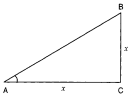
In {tex} \triangle A B C{/tex},
{tex}\tan A = 1{/tex}
{tex}\Rightarrow \quad \frac { B C } { A C } = 1{/tex}
{tex}\Rightarrow {/tex} BC = x and AC = x
Using Pythagoras theorem,
{tex}\Rightarrow A B ^ { 2 } = A C ^ { 2 } + B C ^ { 2 }{/tex}
{tex}\Rightarrow \quad A B ^ { 2 } = x ^ { 2 } + x ^ { 2 }{/tex}
{tex}\Rightarrow \quad A B = \sqrt { 2 } x{/tex}
{tex}\therefore \quad \sin A = \frac { B C } { A B } = \frac { x } { \sqrt { 2 } x } = \frac { 1 } { \sqrt { 2 } } \text { and } \cos A = \frac { A C } { \sqrt { 2 } x } = \frac { x } { \sqrt { 2 } x } = \frac { 1 } { \sqrt { 2 } } {/tex}
2 sin A cos A {tex}= 2 \times \frac { 1 } { \sqrt { 2 } } \times \frac { 1 } { \sqrt { 2 } } = 1{/tex}
Posted by Manvi Munpariya 7 years, 5 months ago
- 0 answers
Posted by Anmol Bawaskar 7 years, 5 months ago
- 1 answers
Posted by Jijith Jijith 7 years, 5 months ago
- 2 answers
Alpna Suthar 7 years, 5 months ago
Surya Thambirajan 7 years, 5 months ago
Posted by Vishal Prasad 7 years, 5 months ago
- 3 answers
Shivani Sreenivas 7 years, 5 months ago
Posted by Shruti Patil 7 years, 5 months ago
- 1 answers
Sia ? 6 years, 6 months ago
Let the common ratio term of income be x and expenditure be y.
So, the income of first person is Rs.9x and the income of second person is Rs.7x.
And the expenditures of first and second person is 4y and 3y respectively.
Then, Saving of first person =9x - 4y
and saving of second person = 7x - 3y
As per given condition
9x - 4y = 200
{tex}\Rightarrow{/tex} 9x - 4y - 200=0 ... (i)
and, 7x - 3y = 200
{tex}\Rightarrow{/tex} 7x - 3y - 200 =0 ..... (ii)
Solving equation (i) and (ii) by cross-multiplication, we have
{tex}\frac { x } { 800 - 600 } = \frac { - y } { - 1800 + 1400 } = \frac { 1 } { - 27 + 28 }{/tex}
{tex}\frac { x } { 200 } = \frac { - y } { - 400 } = \frac { 1 } { 1 }{/tex}
{tex}\Rightarrow{/tex} x =200 and y =400
So, the solution of equations is x = 200 and y = 400.
Thus, monthly income of first person = Rs.9x = Rs.(9 {tex}\times{/tex} 200)= Rs.1800
and, monthly income of second person = Rs.7x = Rs.(7{tex}\times{/tex} 200)= Rs. 1400
Posted by Zakiahemad Patel 7 years, 5 months ago
- 0 answers
Posted by Pradeep Yadav 7 years, 5 months ago
- 0 answers
Posted by Chinthan Gowda 7 years, 5 months ago
- 1 answers
Posted by Jitu Lucky Boss 7 years, 5 months ago
- 1 answers
Posted by Inam Ul Haq Haq 7 years, 5 months ago
- 1 answers
Sia ? 6 years, 6 months ago
Check Question Papers here : <a href="https://mycbseguide.com/cbse-question-papers.html">https://mycbseguide.com/cbse-question-papers.html</a>
Posted by Manish . 7 years, 5 months ago
- 2 answers
Samipya.M.P. Gowda 7 years, 5 months ago

myCBSEguide
Trusted by 1 Crore+ Students

Test Generator
Create papers online. It's FREE.

CUET Mock Tests
75,000+ questions to practice only on myCBSEguide app
