
Ask questions which are clear, concise and easy to understand.
Ask QuestionPosted by Prajwal Barsagade 7 years, 4 months ago
- 0 answers
Posted by Priyanshi Arya 7 years, 4 months ago
- 1 answers
Posted by Ashish Shukla 7 years, 4 months ago
- 2 answers
Posted by Manjima Anjubiju 7 years, 4 months ago
- 5 answers
Laawanya Sivakumar 7 years, 4 months ago
Posted by Rushita Kodali 6 years, 6 months ago
- 1 answers
Sia ? 6 years, 6 months ago
LCM of 18,24 and 36
18 = 2 {tex}\times{/tex} 32
24 = 23 {tex}\times{/tex} 3
36 = 22 {tex}\times{/tex} 32
LCM (18,24,36) = 23 {tex}\times{/tex} 32 = 72
Hence if any number is divisible by 72 that will be divisible by 18,24 and 36 also.
Now the largest 6 digit number is 999999
On dividing 999999 by 72 we get
{tex}\;999999=13888\times72+\;63=999936+63{/tex}
Hence 999936 is the greatest 6 digit number divisible by 18,24 and 36.
Posted by Navyashree B 7 years, 4 months ago
- 0 answers
Posted by Sindhu Sharma 6 years, 5 months ago
- 1 answers
Sia ? 6 years, 5 months ago
Let the numbers are x and y.
Given: {tex}\frac{x}{y}{/tex} = {tex}\frac{4}{5}{/tex}
{tex}\Rightarrow{/tex} 5x = 4y
{tex}\Rightarrow{/tex} 5x - 4y = 0 .......(1)
When 30 is subtracted from both x & y, the ratio becomes 1 : 2
{tex}{/tex}i.e. {tex}\frac{x - 30}{y - 30}{/tex} = {tex}\frac{1}{2}{/tex}
{tex}\Rightarrow{/tex} 2x - 60 = y - 30
{tex}\Rightarrow{/tex} 2x - y - 30 = 0.........(2)
Thus the two linear equations are:
5x - 4y = 0 .......(1)
2x - y - 30 = 0.........(2)
Points Coordinate table for 5x - 4y = 0 is
| 0 | 4 | 8 |
| 0 | 5 | 10 |
Points Coordinate Table for 2x - y - 30 = 0 is
<th scope="row">x</th> <th scope="row">y</th>| 15 | 12 | 10 |
| 0 | -6 | -10 |
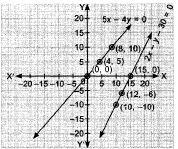
Graphical representation of pair of linear equations is shown in graph.
Posted by Anushree Murthy 7 years, 4 months ago
- 0 answers
Posted by Ann Maria 6 years, 6 months ago
- 1 answers
Sia ? 6 years, 6 months ago
We have,
x = asec{tex}\theta{/tex} + btan{tex}\theta{/tex} and y = atan{tex}\theta{/tex} + bsec{tex}\theta{/tex}
LHS = (x2 - y2) = (asec{tex}\theta{/tex} + btan{tex}\theta{/tex})2 - (atan{tex}\theta{/tex} + bsec{tex}\theta{/tex})2
= (a2sec2{tex}\theta{/tex} + b2tan2{tex}\theta{/tex} + 2absec{tex}\theta{/tex}tan{tex}\theta{/tex}) - (a2tan2{tex}\theta{/tex} + b2sec2{tex}\theta{/tex} + 2absec{tex}\theta{/tex}tan{tex}\theta{/tex})
= a2(sec2{tex}\theta{/tex} - tan2{tex}\theta{/tex}) - b2(sec2{tex}\theta{/tex} - tan2{tex}\theta{/tex})
= a2 - b2 = RHS
Therefore, LHS = RHS
Posted by Kanishka Sharma 7 years, 4 months ago
- 1 answers
Lovely Devnani 7 years, 4 months ago
Posted by Sohail Khan 7 years, 4 months ago
- 0 answers
Posted by Aditya Soni 6 years, 6 months ago
- 1 answers
Sia ? 6 years, 6 months ago
Given: {tex}\triangle {/tex}ABC {tex} \sim {/tex} {tex}\triangle {/tex}DEF
AM is a median in {tex}\triangle {/tex}ABC and DN is the corresponding median in {tex}\triangle {/tex}DEF
To prove: {tex}\frac{{area\vartriangle ABC}}{{area\vartriangle DEF}} = \frac{{A{M^2}}}{{D{N^2}}}{/tex}
Proof: {tex}\triangle {/tex}DBC {tex} \sim {/tex} {tex}\triangle {/tex}DEF
{tex}\Rightarrow {/tex} {tex}\angle{/tex} A = {tex}\angle{/tex} D, {tex}\angle{/tex} B = {tex}\angle{/tex} E, {tex}\angle{/tex} C = {tex}\angle{/tex} F and
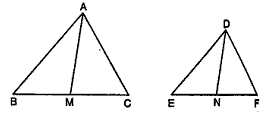
Also, {tex}\frac{{area\vartriangle ABC}}{{area\vartriangle DEF}}{/tex}={tex}\frac{{A{B^2}}}{{D{E^2}}} = \frac{{B{C^2}}}{{E{F^2}}} = \frac{{A{C^2}}}{{D{F^2}}}{/tex}........(i)[area theorem]
Now,{tex}\frac{{AB}}{{DE}} = \frac{{BC}}{{EF}} = \frac{{\frac{1}{2}BC}}{{\frac{1}{2}EF}} = \frac{{BM}}{{EN}}{/tex}..............(ii)
In {tex}\triangle {/tex}ABM and DEN
{tex}\angle{/tex} B= {tex}\angle{/tex} E and {tex}\frac{{AB}}{{DE}} = \frac{{BM}}{{EN}}{/tex} [From (ii)]
{tex}\Rightarrow {/tex} {tex}\triangle {/tex}ABM {tex} \sim {/tex}{tex}\triangle {/tex}DEN [SAS similarity]
{tex}\Rightarrow {/tex}{tex}\frac{{area\vartriangle ABM}}{{area\vartriangle DEN}} = \frac{{A{B^2}}}{{D{E^2}}} = \frac{{A{M^2}}}{{D{N^2}}} = \frac{{B{M^2}}}{{E{N^2}}}{/tex}............(iii)
From (i) and (iii), we get
{tex}\frac{{area\vartriangle ABC}}{{area\vartriangle DEF}} = \frac{{A{M^2}}}{{D{N^2}}}{/tex}
Posted by Amanjot Kaur 7 years, 4 months ago
- 2 answers
Aditya Kumar 7 years, 4 months ago
Posted by Diksha Sarwa 7 years, 4 months ago
- 3 answers
Posted by Suraj Deshwal 7 years, 4 months ago
- 1 answers
Posted by Vijaya Durga 7 years, 4 months ago
- 1 answers
Sakshi Naphade 7 years, 4 months ago
Posted by Chitra Prabakaran Chitra 7 years, 4 months ago
- 1 answers
Loveleen Kaur 7 years, 4 months ago
Posted by Yash Deo 7 years, 4 months ago
- 1 answers
Dibya Ranjan Das Das 7 years, 4 months ago
Posted by Suhail Ghaffar 7 years, 4 months ago
- 5 answers
U.Vamshi Krishna 7 years, 4 months ago
Kannu Kranti Yadav 7 years, 4 months ago
Posted by Raju Verma 7 years, 4 months ago
- 2 answers
Posted by Satyam Chimaniya 7 years, 4 months ago
- 4 answers
Posted by Anshu Singh 7 years, 4 months ago
- 1 answers
Pratyush Krishnan 7 years, 4 months ago
Posted by Aditya Raj Singh 7 years, 4 months ago
- 4 answers
Posted by Dev Kumar 7 years, 4 months ago
- 5 answers
Aditya Kumar 7 years, 4 months ago
Posted by Shabnam Jahan 7 years, 4 months ago
- 0 answers
Posted by Soumya Kumari 5 years, 8 months ago
- 1 answers
Posted by Mohit Kumar 5 years, 8 months ago
- 1 answers
Sia ? 6 years, 6 months ago
{tex}\frac{175}{15}=11.667{/tex}
Hence 175 is not divisible by 15
But LCM of two numbers should be divisible by their HCF.
{tex}\therefore{/tex} Two numbers cannot have their HCF as 15 and LCM as 175.
Posted by Priyanshi Chaurasiya 6 years, 6 months ago
- 1 answers
Sia ? 6 years, 6 months ago
Let us suppose that one man alone can finish the work in x days and one boy alone can finish it in y days. Then,
one man's one day's work {tex}= \frac { 1 } { x }{/tex}
One boy's one day's work {tex}= \frac { 1 } { y }{/tex}
{tex}\therefore{/tex} Eight men's one day's work = {tex}\frac { 8 } { x }{/tex}
{tex}12\ boy's{/tex} one day's work = {tex}\frac { 12 } { y }{/tex}
According to question it is given that {tex}8\ men{/tex} and {tex}12\ boys{/tex} can finish the work in {tex}10\ days{/tex}
{tex}10 \left( \frac { 8 } { x } + \frac { 12 } { y } \right) = 1 \Rightarrow \frac { 80 } { x } + \frac { 120 } { y } = 1{/tex} .................(i)
Again, {tex}6\ men{/tex} and {tex}8\ boys{/tex} can finish the work in {tex}14\ days{/tex}.
{tex}\therefore \quad 14 \left( \frac { 6 } { x } + \frac { 8 } { y } \right) = 1 \Rightarrow \frac { 84 } { x } + \frac { 112 } { y } = 1{/tex} ...........(ii)
Putting {tex}\frac { 1 } { x } = u{/tex} and {tex}\frac { 1 } { y } = v{/tex} in equations (i) and (ii), we get
{tex}80u + 120u - 1 = 0{/tex}
{tex}84u + 112v - 1 = 0{/tex}
By using cross-multiplication,
{tex}\Rightarrow \frac { u } { - 120 + 112 } = \frac { - v } { - 80 + 84 } = \frac { 1 } { 80 \times 112 - 120 \times 84 }{/tex}
{tex}\Rightarrow \quad \frac { u } { - 8 } = \frac { v } { - 4 } = \frac { 1 } { - 1120 }{/tex}
{tex}\Rightarrow \quad u = \frac { - 8 } { - 1120 } = \frac { 1 } { 140 } \text { and } v = \frac { - 4 } { - 1120 } = \frac { 1 } { 280 }{/tex}
{tex}u = \frac { 1 } { 140 } \Rightarrow \frac { 1 } { x } = \frac { 1 } { 140 } \Rightarrow x = 140{/tex}
{tex}v = \frac { 1 } { 280 } \Rightarrow \frac { 1 } { y } = \frac { 1 } { 280 } \Rightarrow y = 280{/tex}
One man alone can finish the work in {tex}140\ days{/tex} and one boy alone can finish the work in {tex}280\ days{/tex}.
Posted by Meraj Khan 7 years, 4 months ago
- 3 answers
Suhail Ghaffar 7 years, 4 months ago

myCBSEguide
Trusted by 1 Crore+ Students

Test Generator
Create papers online. It's FREE.

CUET Mock Tests
75,000+ questions to practice only on myCBSEguide app
