
Ask questions which are clear, concise and easy to understand.
Ask QuestionPosted by Sunil Kumar 5 years, 4 months ago
- 1 answers
Posted by Divyanshu Singh Sengar 5 years, 4 months ago
- 2 answers
Esha ? 5 years, 4 months ago
Meenu Gupta 5 years, 4 months ago
Posted by Madhav Sisodiya 5 years, 4 months ago
- 5 answers
Posted by Fahad Al Khaisi 5 years, 4 months ago
- 4 answers
Posted by Gravit Kulhari 5 years, 4 months ago
- 0 answers
Posted by Gravit Kulhari 5 years, 4 months ago
- 2 answers
Yogita Ingle 5 years, 4 months ago
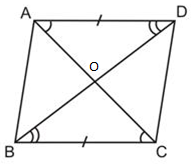
ABCD is a parallelogram, diagonals AC and BD intersect at O
In triangles AOD and COB,
∠DAO = ∠BCO (alternate interior angles)
AD = CB
∠ADO = ∠CBO (alternate interior angles)

 AOD
AOD  COB (ASA)
Hence, AO = CO and OD = OB (c.p.c.t)
Thus, the diagonals of a parallelogram bisect each other.
Posted by Its Queen 5 years, 4 months ago
- 1 answers
Yogita Ingle 5 years, 4 months ago
3√12 ÷ 6√27
= 3√4 × 3 ÷ 6√9 × 3
= 3 × 2√3 ÷6 ×3 √3
= 6√3 ÷ 18√3
= 6/18
= 1/3 is not a surd
Posted by Himanshu Sharma 5 years, 4 months ago
- 2 answers
Silviya Shrivastav 5 years, 4 months ago
Posted by J Divyasrinitha 5 years, 4 months ago
- 2 answers
Posted by Zainab Hanif 5 years, 4 months ago
- 3 answers
Meenu Gupta 5 years, 4 months ago
Posted by Rd Pandey 5 years, 4 months ago
- 2 answers
Manish Meena 5 years, 4 months ago
Silviya Shrivastav 5 years, 4 months ago
Posted by Himanshu Sharma 5 years, 4 months ago
- 4 answers
Manish Meena 5 years, 4 months ago
Silviya Shrivastav 5 years, 4 months ago
Posted by Dhanush M 5 years, 4 months ago
- 2 answers
Santosh Shukla 5 years, 4 months ago
Posted by Annu Kapasia 5 years, 4 months ago
- 1 answers
Posted by Kolli Pavan Kumar Reddy 5 years, 4 months ago
- 2 answers
Meenu Gupta 5 years, 4 months ago
Posted by Suhani Rai 5 years, 4 months ago
- 4 answers
Ashok Jain 5 years, 4 months ago
Manish Meena 5 years, 4 months ago
Parthav Udayasankar 5 years, 4 months ago
Posted by Suhani Rai 5 years, 4 months ago
- 1 answers
Silviya Shrivastav 5 years, 4 months ago
Posted by Manju Singh 5 years, 4 months ago
- 1 answers
Santosh Shukla 5 years, 4 months ago
Posted by Diksha Sangolkar 5 years, 4 months ago
- 3 answers
Posted by Annu Kapasia 5 years, 4 months ago
- 1 answers
Posted by Suhani Rai 5 years, 4 months ago
- 1 answers
Posted by Zeesha Ali 5 years, 4 months ago
- 2 answers
Posted by Himanshu Sharma 5 years, 4 months ago
- 3 answers
Posted by Karmit Chugh 5 years, 4 months ago
- 1 answers
Posted by Rohit Jadhav 5 years, 4 months ago
- 2 answers
Sunita Sah 5 years, 4 months ago
Gaurav Seth 5 years, 4 months ago
Given : A parallelogram ABCD , in which AC = BD
TO Prove : ABCD is a rectangle .
Proof : In △ABC and △ABD
AB = AB [common]
AC = BD [given]
BC = AD [opp . sides of a | | gm]
⇒ △ABC ≅ △BAD [ by SSS congruence axiom]
⇒ ∠ABC = △BAD [c.p.c.t.]
Also, ∠ABC + ∠BAD = 180° [co - interior angles]
⇒ ∠ABC + ∠ABC = 180° [∵ ∠ABC = ∠BAD]
⇒ 2∠ABC = 180°
⇒ ∠ABC = 1 /2 × 180° = 90°
Hence, parallelogram ABCD is a rectangle.
Posted by Pravidha Ch 5 years, 4 months ago
- 1 answers
Posted by Tanishka Khurana 5 years, 4 months ago
- 1 answers
Gaurav Seth 5 years, 4 months ago
a n s w er :
4x ^ 2 - 3 x + 7
x^2 - 3 x + 28
x^2- ( 7 - 4 ) x - 28
x^2 - 7 x +4 x - 28
x ( x - 7 )+ 4( x - 7 )
( x - 7 ) ( x + 4 )
Posted by Pratyaksh Kumar 5 years, 4 months ago
- 4 answers
Posted by Mahi Kumar 5 years, 4 months ago
- 1 answers
Hdm . 5 years, 4 months ago

myCBSEguide
Trusted by 1 Crore+ Students

Test Generator
Create papers online. It's FREE.

CUET Mock Tests
75,000+ questions to practice only on myCBSEguide app

Ashvin Kharadi 5 years, 4 months ago
1Thank You