
Ask questions which are clear, concise and easy to understand.
Ask QuestionPosted by Akashi Kaikyo 8 years, 10 months ago
- 3 answers
Bindu Agarwal 8 years, 10 months ago
Let the radius be 3x and height of the cone be 4x
Use pi=3.14
and using the formula (1/3)(pi)r2h = Volume
Find x , It comes x=2
Therefore radius is 6 and height is 8. Then FInd its CSA
Naveen Sharma 8 years, 10 months ago
Ans. Let radius of cone is r and height of cone is h and slant height of cone is l.
Then or
Volume of Cone = 301.44 cm3
=> We Know Volume of cone =
=>
=>
=>
=> cm
Put value of r in (1), We get
Slant Height of cone (l) =
Curved Surface Area =
Posted by Harsh Agrawal 8 years, 10 months ago
- 1 answers
Shweta Gulati 8 years, 10 months ago
The perpendicular from the centre to the chord bisects the chord
In the diagram below, AB is the chord of a circle with centre O.
OM is the perpendicular from the centre to the chord.

Look at triangles OAM and OBM.
The hypotenuses (OA and OB) are the same, as they are both the radius of the circle.
OM is common to both triangles.
OMA and OMB are both right angles.
Triangles OAM and OBM are congruent (RHS), so it follows that AM = MB.
Therefore, M is the midpoint of AB, and the chord has been bisected.
Posted by Shashant Ahuja 8 years, 10 months ago
- 1 answers
Shweta Gulati 8 years, 10 months ago

Draw AB and CD, the parallel chords of a circle such that M and N are the midpoints of the chords respectively.
The perpendicular bisector of the chord passes through the centre.
So, ON ⊥ CD.
and OM ⊥ AB.
But AB || CD
Therefore, NOM is a straight line.
Hence the line joining the midpoints of two chords of a circle parallel to each other passes through the centre of the circle.
Posted by Praveen Baskar 8 years, 10 months ago
- 1 answers
Naveen Sharma 8 years, 10 months ago
Ans. Let Probability of Success = x
Probability of Failure = y
According To Ques
x - y = 3/17 ......(1)
Also We Know
x + y = 1 ......(2)
adding (1) and (2), We Get
2x = 20/17
x = 10/17
y = 7/17
Posted by Umang Sethi 8 years, 10 months ago
- 1 answers
Shashant Ahuja 8 years, 10 months ago
We can not draw an angle of 65° with the compass as we can only draw angles which are a multiple of 15 with the help of the compass.
Posted by Prerna Shrivastava 8 years, 10 months ago
- 2 answers
Shweta Gulati 8 years, 10 months ago
Class mid point = Class mark = 20
Class width = Class size = 8
Lower limit of class interval = Class mark -
= 20 - (8/2) = 20-4 = 16
Upper limit of class interval = Class mark +
= 20 + (8/2) = 20+4 = 24
Naveen Sharma 8 years, 10 months ago
And. Class mid-point (a) = 20
width (h) = 8
we know,
Lower Limit = a - h/2
put given values, we get
Lower Limit = 20 - 8/2
=> Lower Limit = 20-4= 16
Posted by Vikas Aggarwal 8 years, 10 months ago
- 1 answers
Naveen Sharma 8 years, 10 months ago
Ans. Normal range = x
Overweight range = y
As per question
x = 8y
=> x - 8y = 0
required linear equation
Posted by Skn Sat 8 years, 10 months ago
- 1 answers
Naveen Sharma 8 years, 10 months ago
Ans. We know
x3+y3= (x+y)(x2+y2+xy) ......(1)
and
x2+y2 = (x+y)2 - 2xy .....(2)
put value x2+y2 from (2) in (1), we get
x3+y3 =(x+y)[(x+y)2 -xy] ...(3)
we need to find
a3+8b3 can be written as
=> a3+ (2b)3 = (a+2b)[(a+2b)2 -2a*b]
put given values, we get
=> a3+8b3= (7)[(7)2 - 2*5]
=> (7)(39)
=> 273
Posted by Sonu Dave 8 years, 10 months ago
- 1 answers
Naveen Sharma 8 years, 10 months ago
Ans.
present Age if father = x
present age of sheena = y
According to first condition
y = x/3
=> x =3y ........(1)
After 12 year
Age of father = x + 12
age of sheena = y +12
According to 2nd condition
y + 12 = (x+12)/2
=> 2y + 24 = x + 12
=> x - 2y = 12 ....(2)
put value of x from (1) we get
=> 3y - 2y = 12
=> y =12
x = 36
present Age of father = 36 years
present Age of Sheena = 12 years
Posted by Koratamaddi Vamsi 8 years, 10 months ago
- 1 answers
Naveen Sharma 8 years, 10 months ago
Solution: Given : Arc AB of a circle with center O, Subtending at the centre and at a point P on the remaining part of circle.
To Prove :
Proof :
We can have three cases;
i) AB is a minor arc
ii) AB is a diameter
iii) AB is a major arc
we are taking first case only at this time.
We know that, an exterior angle of a triangle is equal to the sum of the interior opposite angles.
OB = OP (Radius of the circle)
=> (In a triangle, equal sides have equal angle opposite to them)
=>
=>
OA = OP (Radius of the circle)
=> (In a triangle, equal sides have equal angle opposite to them)
=>
=>
Adding (2) and (4), We get
=>
Hence Proved
Posted by Guna Kaviya 8 years, 10 months ago
- 1 answers
Naveen Sharma 8 years, 10 months ago
A leap year has 366 days. This is equivalent to 52 weeks and 2 extra days. These 2 days can be combination of (sunday, Monday),
(Monday, Tuesday),
(Tuesday, Wednesday),
(Wednesday, Thursday),
(Thursday, Friday),
(Friday, Saturday) or
(saturday, sunday)
So,probability of getting a 53rd sunday = 2/7
Posted by Satish Kumar 8 years, 10 months ago
- 1 answers
Vikrant Singh 8 years, 10 months ago
How To Find if Triangles are Congruent
|
Two <a href="http://www.mathsisfun.com/geometry/triangles-congruent.html">triangles are congruent</a> if they have:
But we don't have to know all three sides and all three angles ...usually three out of the six is enough. |
There are five ways to find if two triangles are congruent: SSS, SAS, ASA, AAS and HL.
1. SSS <i>(side, side, side)</i>
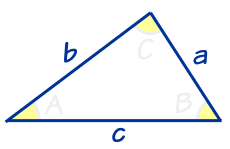
SSS stands for "side, side, side" and means that we have two triangles with all three sides equal.
For example:
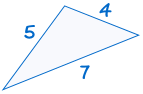 |
is congruent to: | 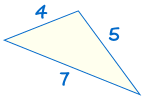 |
<i>(See <a href="http://www.mathsisfun.com/algebra/trig-solving-sss-triangles.html">Solving SSS Triangles</a> to find out more)</i>
If three sides of one triangle are equal to three sides of another triangle, the triangles are congruent.
2. SAS <i>(side, angle, side)</i>

SAS stands for "side, angle, side" and means that we have two triangles where we know two sides and the included angle are equal.
For example:
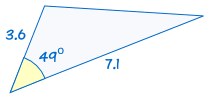 |
is congruent to: | 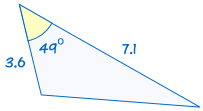 |
<i>(See <a href="http://www.mathsisfun.com/algebra/trig-solving-sas-triangles.html">Solving SAS Triangles</a> to find out more)</i>
If two sides and the included angle of one triangle are equal to the corresponding sides and angle of another triangle, the triangles are congruent.
3. ASA <i>(angle, side, angle)</i>
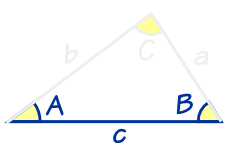
ASA stands for "angle, side, angle" and means that we have two triangles where we know two angles and the included side are equal.
For example:
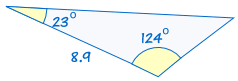 |
is congruent to: | 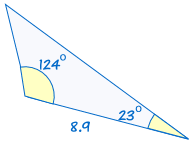 |
<i>(See <a href="http://www.mathsisfun.com/algebra/trig-solving-asa-triangles.html">Solving ASA Triangles</a> to find out more)</i>
If two angles and the included side of one triangle are equal to the corresponding angles and side of another triangle, the triangles are congruent.
4. AAS <i>(angle, angle, side)</i>
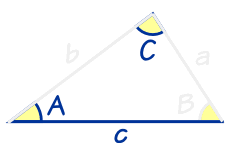
AAS stands for "angle, angle, side" and means that we have two triangles where we know two angles and the non-included side are equal.
For example:
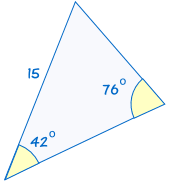 |
is congruent to: | 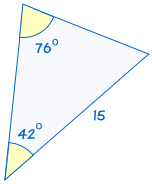 |
<i>(See <a href="http://www.mathsisfun.com/algebra/trig-solving-aas-triangles.html">Solving AAS Triangles</a> to find out more)</i>
If two angles and the non-included side of one triangle are equal to the corresponding angles and side of another triangle, the triangles are congruent.
5. HL <i>(hypotenuse, leg)</i>
This one applies only to <a href="http://www.mathsisfun.com/right_angle_triangle.html">right angled-triangles</a>!
 |
or | 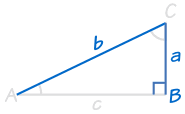 |
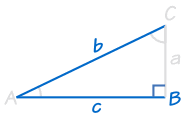
HL stands for "Hypotenuse, Leg" (the longest side of a right-angled triangle is called the "hypotenuse", the other two sides are called "legs")
It means we have two right-angled triangles with
- the same length of hypotenuse and
- the same length for one of the other two legs.
It doesn't matter which leg since the triangles could be rotated.
For example:
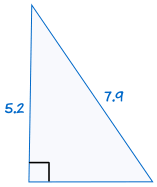 |
is congruent to: | 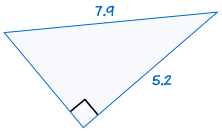 |
<i>(See <a href="http://www.mathsisfun.com/pythagoras.html">Pythagoras' Theorem</a> to find out more)</i>
If the hypotenuse and one leg of one right-angled triangle are equal to the corresponding hypotenuse and leg of another right-angled triangle, the two triangles are congruent.
Caution ! Don't Use "AAA" !
AAA means we are given all three angles of a triangle, but no sides.
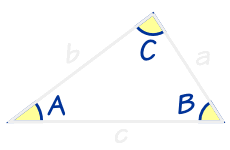
This is not enough information to decide if two triangles are congruent!
Because the triangles can have the same angles but be different sizes:
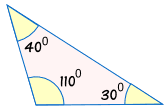 |
is not congruent to: | 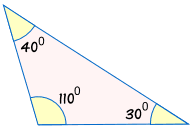 |
Without knowing at least one side, we can't be sure if two triangles are congruent.
Posted by Daksh Bhagat 8 years, 10 months ago
- 0 answers
Posted by Nimisha Singhal 8 years, 10 months ago
- 1 answers
Naveen Sharma 8 years, 10 months ago
Let Radius of Cone is r and slant height is l.
height of Cone (h) = 24 cm
CSA of cone = 550 cm2
We know,
=>
Also,
=>
Squaring both side,
=>
=>
=>
Put
=>
=>
=>
=>
=>
=> t = - 625 0r t = 49
=> r2 = -625 is not possible so r2 = 49
=> r = 7
put in (1), we get
=>
=> l = 25
=>
=>
=> Volume = 1232cm3
Posted by Arish Faraz 8 years, 11 months ago
- 1 answers
Naveen Sharma 8 years, 11 months ago
Ans. Let A denote the probability of guessing correct answer and B denote the probability of not guessing correct answer.
Then,
=>
=>
=>
=>
Posted by Shankar Kapoor 8 years, 11 months ago
- 0 answers
Posted by Anusha Arora 8 years, 11 months ago
- 1 answers
Ghanshyam Kumar 8 years, 11 months ago
Area of field=13:5×2:5=33:75
Upper area of tank=5×4:5=22:5
Area of field on which soil is spread=33:75_22:5
=11:25m Volume of tank=5×4:5×2:1=47:25m^3
Raised in level=volume of tank/area of field on which
soil spread=47:25/11:25=4:2
So,raised level=4:2m
Posted by Sudhanshu Yadav 8 years, 11 months ago
- 1 answers
Posted by Preetham Reddy 8 years, 11 months ago
- 1 answers
Posted by Chetan Deepak 8 years, 11 months ago
- 2 answers
Neeraj Sharma 8 years, 11 months ago
When the rectangular piece of paper is rolled along its length, we find that the length of paper forms the circumference of its base and breadth of paper becomes the height of the cylinder
Let r cm be the radius of the base and h cm be the height then h=10cm
Now
Sudhanshu Yadav 8 years, 11 months ago
Given: a rectangular piece of paper of length=22cm breadth=10cm.
As we will roll the rectangular piece along its length, then length of rectangle becomes height of cylinder and width of rectangular piece would become circular faces of diameter 10cm. So radius will be =5cm.
So, volume of cylinder=πr2h
22/7*5*5*22 =12100/7
=1728.57cm2 .
Volume of cylinder =1728.57cm2 .
Posted by Gaurav Singh 8 years, 11 months ago
- 1 answers
Posted by Savitajain Jain 8 years, 11 months ago
- 1 answers
Naveen Sharma 8 years, 11 months ago
Given : A quadrilateral ABCD in which the diagonals AC and BD intersect each other at O. It is given that the diagonals of ABCD are equal and bisect each other at right angles AC = BD, OA = OC, OB = OD, and ∠AOB = ∠BOC = ∠COD = ∠AOD = 90º.
To prove ABCD is a square, we have to prove that ABCD is a parallelogram, AB = BC = CD = AD, and one of its interior angles is 90º.
In ΔAOB and ΔCOD,
AO = CO (Diagonals bisect each other)
OB = OD (Diagonals bisect each other)
∠AOB = ∠COD (Vertically opposite angles)
∴ ΔAOB ≅ ΔCOD (SAS congruence rule)
∴ AB = CD (By CPCT) ... (1)
And, ∠OAB = ∠OCD (By CPCT)
However, these are alternate interior angles for line AB and CD and alternate interior angles are equal to each other only when the two lines are parallel.
∴ AB || CD ... (2)
From equations (1) and (2), we obtain
ABCD is a parallelogram.
In ΔAOD and ΔCOD,
AO = CO (Diagonals bisect each other)
∠AOD = ∠COD (Given that each is 90º)
OD = OD (Common)
∴ ΔAOD ≅ ΔCOD (SAS congruence rule)
∴ AD = DC ... (3)
However, AD = BC and AB = CD (Opposite sides of parallelogram ABCD)
∴ AB = BC = CD = DA
Therefore, all the sides of quadrilateral ABCD are equal to each other.
In ΔADC and ΔBCD,
AD = BC (Already proved)
AC = BD (Given)
DC = CD (Common)
∴ ΔADC ≅ ΔBCD (SSS Congruence rule)
∴ ∠ADC = ∠BCD (By CPCT)
However, ∠ADC + ∠BCD = 180° (Co-interior angles)
⇒ ∠ADC + ∠ADC = 180°
⇒ 2∠ADC = 180°
⇒ ∠ADC = 90°
One of the interior angles of quadrilateral ABCD is a right angle.
Thus, we have obtained that ABCD is a parallelogram, AB = BC = CD = AD and one of its interior angles is 90º. Therefore, ABCD is a square
Posted by Savitajain Jain 8 years, 11 months ago
- 1 answers
Naveen Sharma 8 years, 11 months ago
Given that A(3, 5) and B(1, 4) lie on the graph of the line ax + by = 7 → (1)
Hence both the points satisfy the given equation
Put x = 3 and y = 5 in (1)
⇒ 3a + 5b = 7 ........ (2)
Similarly, B(1, 4) satisfy (1)
Put x = 1 and y = 4 in (1), we get
a + 4b = 7
Multiply above equation with '3', we get
3a + 12b = 21 ....... (3)
Subtract (2) and (3)
3a + 12b = 21
3a + 5b = 7
---------------
7b = 14
∴ b = 2
Put b = 2 in (2), we get
3a + 5(2) = 7
⇒ 3a = – 3
∴ a = – 1
Posted by Savitajain Jain 8 years, 11 months ago
- 1 answers
Sudhanshu Yadav 8 years, 11 months ago
Given: point (1,-2) lies on on the graph of linear equation = x-2y+k=0
Put x=1 ,y=-2 in the given equation.
So, 1-2(-2)+k=0
1+4+k=0
5+k=0
K=-5
-------------------
Value of k= -5.
Posted by Savitajain Jain 8 years, 11 months ago
- 0 answers
Posted by Ramyasree H 8 years, 11 months ago
- 1 answers
Naveen Sharma 8 years, 11 months ago
p(x)=x3+8x2+17x+ax
As the remainder same in both case :
then p(-2) = p(-1)
(-2)3+ 8(-2)2 + 17(-2) + a(-2) = (-1)3 + 8(-1)2 + 17(-1) + a(-1)
=> -8 + 32 - 34 - 2a = -1 + 8 - 17 - a
=> -10 -2a = - 10 - a
=> -2a + a = -10 + 10
=> -a = 0
=> a = 0

myCBSEguide
Trusted by 1 Crore+ Students

Test Generator
Create papers online. It's FREE.

CUET Mock Tests
75,000+ questions to practice only on myCBSEguide app

Rashmi Bajpayee 8 years, 10 months ago
Let radius and height of the cone be 3x and 4x respectively.
Therefore,
(1/3)πr2h = 301.44
(1/3) × 3.14 × 3x × 3x × 4x = 301.44
x3 = 8
x = 2
Then, Radius = 3x = 3 × 2 = 6 cm and Height = 4x = 4 × 2 = 8 cm
Now, slant height (l) = (r2 + h2)1/2
= (62 + 82)1/2 = 10 cm
CSA of cone = πrl = 3.14 × 6 × 10 = 188.40 cm2
0Thank You