
Ask questions which are clear, concise and easy to understand.
Ask QuestionPosted by Sadhna Kashyap 8 years, 10 months ago
- 3 answers
Rashmi Bajpayee 8 years, 10 months ago
After digging and spreading the earth, we consider the shape of hollow cylinder.
Here, Radius of well = 5 m and Outer Radius of well = 5 + 7 = 12
Let height of embankment be h meters.
Now, Volume of Earth spread = Volume of Well
π(12)2 × h = π(5)2 × 8.4
h = 25 × 8.4 ÷ 144 = 1.46 m
But charge taken by contractor for 2 m height = Rs.500
Actual charge for 1.46 m height = 500/2 × 1.46 = Rs.365
Contractor charged more by Rs.500 - Rs.365 = Rs.135.
Posted by Sadhna Kashyap 8 years, 10 months ago
- 1 answers
Shweta Gulati 8 years, 10 months ago
\(CSA = {2\pi rh}\)
\(TSA = {2 \pi r(h+r) }\)
Their ratio is 1:2
i.e. \( {h\over h+r}= 1/2\)
2h = h+r
h=r
h :r = 1:1
Posted by Sadhna Kashyap 8 years, 10 months ago
- 1 answers
Shweta Gulati 8 years, 10 months ago
Let the two numbers be x and y
x>y
5x = 2y+9 { Dividend = Divisor X Quotient + Remainder}
Required linear equation is : 5x-2y-9=0
Solutions:
Put x=1
5=2y+9
2y=-4
y=-2
Also,
take x= 3
15=2y+9
2y=6
y=3
So, solutions are (1,-2) and (3,3)
Posted by Sadhna Kashyap 8 years, 10 months ago
- 2 answers
Naveen Sharma 8 years, 10 months ago
Ans. Thickness of Wooden Cylinder (t) = 2 cm
Height of Cylinder (h)= 35 cm
Inner radius (r)= 12 cm
Outer radius (R) = r + t = 12 +2 = 14 cm
Volume of Wood Required = Outer Volume of Cylinder - Inner Volume of Cylinder
=> \(({\pi \times R^2 \times h } ) - ({\pi \times r^2 \times h}) = {\pi \times h (R^2 - r^2)}\)
=> \({22 \over 7 }\times 35 \times ({196-144}) = {22 \over 7 }\times 35 \times52 = 5720 cm^3\)
=> Volume of Wood Required = 5720 cm3
Shweta Gulati 8 years, 10 months ago
Wooden cylinder
Thickness = 2cm
Inner radius = 12cm
Outer radius = Inner radius + thickness
= 12+2 = 14cm
Height of cylinder = 35cm
Volume of wood required in making the cylinder = \(V = {\pi (R^2-r^2)h }\)
= [22(142-122) X 35 ]/7
= 5720 cm3
Posted by Sadhna Kashyap 8 years, 10 months ago
- 2 answers
Shweta Gulati 8 years, 10 months ago
Let the length,breadth and height of the cuboid be l,b and h respectively.
Given l+b+h= 19cm
Squaring both sides
(l+b+h)2= 361
l2+b2+h2+2(lb+bh+hl)= 361 -(1)
Also, Length of the diagonal = \(d = { \sqrt{l^2+b^2+h^2}}\)= 11 cm
Squaring both sides , d2= l2+b2+h2
l2+b2+h2= 121
Putting it in eqn (1)
121 + 2(lb+bh+hl)= 361
2(lb+bh+hl)= 361-121
Surface area of cuboid = 240 cm2
Naveen Sharma 8 years, 10 months ago
Ans. let length of cuboid = l
breadth of cuboid = b
height of cuboid = h
According to question
l + b + h = 19 ............ (1)
We Know
Length of Diagonal of Cuboid = \({ \sqrt{ l^2+ b^2 + h^2}}\)
=> \({ \sqrt{ l^2+ b^2 + h^2}} = 11\)
Squaring both sides, we get
=> \({ l^2+ b^2 + h^2} = 121\) .......(2)
Also
=> \(({ l+ b + h})^2 = {l^2 + b^2 +h^2 + 2lb + 2lh +2bh }\)
=> \( { 2(lb + lh +bh) } = {({ l+ b + h})^2 - {(l^2 + b^2 +h^2)}}\)
put values from (1) and (2),
=> \( { 2(lb + lh +bh) } = 361 - 121 = 240\) ....... (3)
Surface Area of Cuboid = \( { 2(lb + lh +bh) } \)
=> So Surface Area of Cuboid = 240 cm2
Posted by Guthula Venkateswara Rao 8 years, 10 months ago
- 0 answers
Posted by Sadhna Kashyap 8 years, 10 months ago
- 2 answers
Naveen Sharma 8 years, 10 months ago
Ans.
Given : x = 3k - 2 and y = 2k is solution of eq. 4x -7y + 12 =0
To Find: value of k
Solution :
put value of x and y in eq., we get
4(3k-2) - 7(2k) + 12 = 0
=> 12k - 8 - 14k + 12 =0
=> -2k + 4 = 0
=> 2k = 4
=> k = 2
Value of k = 2
Rashmi Bajpayee 8 years, 10 months ago
Putting the given values of x and y in equation
4x + 7y + 12 = 0
4 + 3k + 7 × 2k + 12 = 0
12k + 14k + 12 = 0
26k = -12
k = -6/13
Posted by Sadhna Kashyap 8 years, 10 months ago
- 1 answers
Rashmi Bajpayee 8 years, 10 months ago
Putting the coordinates of point A in given equation,
4a + 6y = 8.
2a + 3y = 4. ..........(i)
Again putting the coordinates of point B in given equation
a + 3b = 8. ..........(i)
Subtracting eq.(ii) from eq.(i)
a = -4
Putting the value of a in eq.(ii)
-4 + 3b = 8
3b = 12
b = 4
Therefore values of a and b are -4 and 4 respectively.
Posted by Sadhna Kashyap 8 years, 10 months ago
- 2 answers
Rashmi Bajpayee 8 years, 10 months ago
Volume of tank = 5040 litres = 5040000 cu.cm
Dimensions of tank = 2.2 m x 1.7 m x 1.7 m = 220 cm x 170 cm x 170 cm
Walls of tank are 5 cm thick.
Therefore, length = 220 - 5 - 5 = 210 cm
Breadth = 170 - 5 - 5 = 160
According to question,
l x b x h = 5040000
210 x 160 x h = 5040000
h = 150 cm
Then thickness of bottom = 150 - 5 - 5 = 140 cm = 1.4 m
Posted by Siddhanth Kumaraswamy 8 years, 10 months ago
- 1 answers
Naveen Sharma 8 years, 10 months ago
Ans. Let Water raise by h meter height.
Length of Rectangular Reservoir = 10.8 m
Width of Rectangular Reservoir = 3.75 m
Volume of Rectangular Reservoir = \(10.8 \times 3.75 \times h = ({40.5 \times h } )m^3\) (1)
Cross section of Pipe = 7.5 * 4.5 = 33.75 cm2 = 0.003375 m2
Speed of water = 18m/s
Distace covered in 30m ( 1800s) = 18 * 1800 = 32400m
Volume of Water flowed in 30 m = cross section of pipe * distance covere = 0.003375 * 32400 = 109.35 m3 (2)
From (1) and (2)
40.5 * h = 109.35
=> h = 2.7 m
Posted by Sadhna Kashyap 8 years, 10 months ago
- 2 answers
Rashmi Bajpayee 8 years, 10 months ago
According to question
4πr2 = 6a2
r2/a2 = 6/4π.
r/a = √3/√2π
Now ratio of their volumes
(4/3)πr3 / a3
= 4π/3 × (√3/√2π)3
= (4π/3)(3/2π)(√3/√2π)
= 2(3×7/2×22)
= √21/√11
Therefore ratio of their volumes is √21 : √11
Naveen Sharma 8 years, 10 months ago
Ans. Suppose radius of sphere is r and side of cube is x.
now,
Surface Area of Sphere = Surface Area of Cube
=> \(4 \times \pi \times r^2 = 6 \times x^2\)
=> \({ r^2 \over x^2} = {3 \over 2\pi}\)
=> \({r \over x } = {\sqrt{3 \over 2\pi}}\)
Let volume of Sphere = Vs
and volume of Cube = Vc
Then
=> \({V_s \over V_c} ={{{ 4 \over 3 }{ \pi r^3} } \over x^3}\)
=> \( {{4 \over 3 }\pi {({r \over x})^3}}\)
=> \( {{4 \pi \over 3} \times {3 \over 2\pi } \times \sqrt{3 \over 2\pi }}\)
=> \( \sqrt{12\over 2\pi}\)
=> \({{ \sqrt 6} \over {\sqrt \pi}}\)
So Required Ratio is = \(\sqrt 6 : \sqrt \pi \)
Posted by Sadhna Kashyap 8 years, 10 months ago
- 1 answers
Naveen Sharma 8 years, 10 months ago
Ans. Let the length of each edge of the cube is a.
Volume of cube = a3 (1)
Since the Cylinder is within the Cube and it touches all the vertical faces of Cube.
Diameter of Cylinder = a
Radius of base of the cylinder = \(a\over 2\)
Height of Cylinder = a
Volume of Cylinder = \({ {22 \over 7} \times ({a \over 2})^2} \times a = {11 \over 14 }a^3\) (2)
As Cone and Cylinder has same base
Radius of the Cone = \(x \over a\)
Height of Cone = a
Volume of Cone = \({1 \over 3} \times { {22 \over 7} \times ({a \over 2})^2} \times a = {11 \over 42 }a^3\) (3)
Ratio of volumes, From (1) (2) and (3)
=> \( a^3 :{11 \over 14 }a^3:{11 \over 42 }a^3\)
Multiply by 42 and divide by a3, We get
=> 42 : 33 : 11
Posted by Sadhna Kashyap 8 years, 10 months ago
- 1 answers
Naveen Sharma 8 years, 10 months ago
Ans. Radius of Cylinderical Tub = 12 cm
Raised Height of Water in cylindrical tub = 6.75 cm
Suppose Radius of sphereical Ball = r
Then volume of raised water in tub = volume of ball
=> \(\pi\times (12)^2 \times 6.75 = {{4 \over 3} \times \pi\times r^3 }\)
=> \(4 \times r^3 = {3 \times 144 \times 6.75}\)
=> \(r^3 = {2916\over 4}\)
=> \(r^3 = 729\)
=> r = 9
Radius of Spherical Ball = 9 cm
Posted by Sadhna Kashyap 8 years, 10 months ago
- 1 answers
Rashmi Bajpayee 8 years, 10 months ago
Volume of sphere = 4851
(4/3)πr3 = 4851
r3= (4851 × 3 × 7)/(4 × 22)
r = 10.5 cm
Again,
Reduced volume of sphere = 4312/2
(4/3)πr3= 4312/2
r3= (4312 × 3 × 7)/(3 × 4 × 22)
r = 7 cm
There for radius should be reduced to 10.5 - 7 = 3.5 cm.
Posted by Sadhna Kashyap 8 years, 10 months ago
- 1 answers
Naveen Sharma 8 years, 10 months ago
Ans. Let Initial Radius of Sphere is R and FInal Radius of Sphere is r.
Initial Volume of the sphere = 4851 cm3
=> \({4 \over 3} \times {22 \over 7} \times R^3 = 4851\)
=> \(R^3 = {{4851 \times 21 } \over 88}\)
=> \(R^3 = 1157.625 \)
=> R = 10.5 (1)
Final Volume of Sphere = \({4312 \over 3} cm^3\)
=> \({4 \over 3} \times {22 \over 7} \times r^3 = {4312\over3}\)
=> \(r^3 = {{4312 \times 7 } \over 88}\)
=> \(r^3 = 343\)
=> r = 7
Radius to be Reduced by = 10.5 - 7 = 3.5 cm
Posted by Shri Niwas Jat 8 years, 10 months ago
- 1 answers
Naveen Sharma 8 years, 10 months ago
Ans.
1792662.png)
Given : An isosceles Right Triangle ABC. A square CMPN is Inscribed in it .
To Prove : CP bisects the hypotenuse AB. i.e. AP = PB
Proof : CMPN is square.
So,
CM = MP = PN = NC [ all sides are equal]
Also Triangle ABC is Isosceles.
So, AC = BC
=> AN + NC = CM + MB
=> AN = MB [as NC = CM]
Now, Consider Traingles ANP and PMB
AN = MB [Proved Above]
∠ANP = ∠ PMB [Both are 90]
PN = PM [Sides of square]
So, By SAS Rule
Triangle ANP = Triangle PMB
=> AP = PB [By CPCT]
Hence Proved
Posted by Sarika Kalra 8 years, 10 months ago
- 1 answers
Naveen Sharma 8 years, 10 months ago
Ans.

Given : In ΔABC, P, Q and R are the mid points of sides BC, CA and AB respectively. AD ⊥ BC.
To prove : P, Q, R and D are concyclic.
Proof : In ΔABC, R and Q are mid points of AB and CA respectively.
∴ RQ || BC (Mid point theorem)
Similarly, PQ || AB and PR || CA
In quadrilateral BPQR,
BP || RQ and PQ || BR [RQ || BC and PQ || AB]
∴ Quadrilateral BPQR is a parallelogram.
Similarly, quadrilateral ARPQ is a parallelogram
∴ ∠A = ∠RPQ (Opposite sides of parallelogram are equal)
PR || AC and PC is the transversal
∴ ∠BPR = ∠C (Corresponding angles)
∠DPQ = ∠DPR + ∠RPQ = ∠A + ∠C ... (1)
RQ || BC and BR is the transversal,
∴ ∠ARO = ∠B (Corresponding angles) ... (2)
In ΔABD, R is the mid point of AB and OR || BD.
∴ O is the mid point of AD (Converse of mid point theorem)
⇒ OA = OD
In ΔAOR and ΔDOR
OA = OD (Proved)
∠AOR = ∠DOR (90°) [∠ROD = ∠ODP (Alternate angles) & ∠AOR = ∠ROD = 90° (linear pair)]
OR = OR (Common)
∴ ΔAOR ≅ ΔDOR (SAS congruence criterion)
⇒ ∠ARO = ∠DRO (CPCT)
⇒ ∠DRO = ∠B (Using (2))
In quadrilateral PRQD,
∠DRO + ∠DPQ = ∠B + ( ∠A + ∠C) = ∠A + ∠B + ∠C (Using (1))
⇒ ∠DRO + ∠DPQ = 180° ( ∠A + ∠B + ∠C = 180°)
Hence, quadrilateral PRQD is a cyclic quadrilateral.
Posted by Kayarohanam Ramadass 8 years, 10 months ago
- 2 answers
Innocent Geeta 8 years, 10 months ago
hllo,
we know that the opposite angles are always equal in the case of parallelogram and also the sum of all angles is equal to 360 degree
by these properties of palrallelogram <i>L</i>s=Lq
so <i> </i>Lq=70 degree
so, by the second property
Lp=Lr,
so we can write Lp in the place of Lr
so Lp+Lq+Lr+Ls= 360
2 Lp +70+70=360
2 Lp=360-140
Lp=220/2
Lp=110
hence Lr=110
Posted by Harshit Agarwal 8 years, 10 months ago
- 1 answers
Naveen Sharma 8 years, 10 months ago
Ans. Follow these steps to construct a histogram if only mid-values of class interval are given:
- Subtract the first mid-value from the second mid-value, let the difference is h
- divide the difference h by 2 = h/2
- Subtract h/2 from first mid-value to get lower limit of first class-interval and add h/2 in first mid-value to get upper limit of class interval.
- repeat all the above stated steps for all remaining mid-values to get all class interval.
- Now you get all class interval.
- draw the histogram using these class interval
Posted by Rima Paul 8 years, 10 months ago
- 1 answers
Shweta Gulati 8 years, 10 months ago
Practice all the imp. theorems from NCERT and egs.
1) Equal chords subtend equal angles at their Centres.
2) The perpendicular from the Centre of a circle to a chord bisects the chord.
3) The angle subtended at the centre of a circle is double the angle subtended at any other point of the circle.
4) Prove that the opposite angles of a cyclic quadrilateral are supplementary.
5) Practice all the examples in NCERT.
Posted by Harshita Meena 8 years, 10 months ago
- 2 answers
Rashmi Bajpayee 8 years, 10 months ago
Let water level rises by h meters
Since displacement of water by a person = 4 cu.m
Therefore displacement of water by 500 persons = 500 × 4 = 2000 cu.m
Now,
Volume of tank = Volume of displaced water
80 x 50 x h = 2000
h = 2000/4000 = 0.5 m = 50 cm
Naveen Sharma 8 years, 10 months ago
Ans. Suppose water level rise by h meter.
Volume of water displaced by a Man = 4m3
Total Volume Displaced By 500 Men = 4 * 500 = 2000m3
As Tank is in cuboid shape:
Volume of tank = Volume of water displaced
=> 80 * 40 * h = 2000
=> h = 2000/3200 = 5/8m = 62.5cm
Posted by Abhishek1 Kumar1 8 years, 10 months ago
- 1 answers
Chandan Yadav 8 years, 9 months ago
abhi hope u recognised me
in chapter u need to just understand that:
two IIgm lie on same base are equal
same with triangle
triangle and IIgma= half of the area of IIgm
Posted by Akshad Tambe 8 years, 10 months ago
- 1 answers
Naveen Sharma 8 years, 10 months ago
Ans.
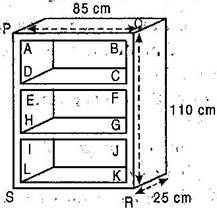
External faces to be polished
= Area of six faces of cuboidal bookshelf – 3 (Area of open portion ABCD)
= 2 (110 x 25 + 25 x 85 + 85 x 110) – 3 (75 x 30)
[AB = 85 – 5 – 5 = 75 cm and AD = (1/3 x 110) – 5 – 5 – 5 – 5 = 30 cm]
= 2 (2750 + 2125 + 9350) – 3 x 2250
= 2 x 14225 – 6750
= 28450 – 6750
= 21700 cm2
Now, cost of painting outer faces of wodden bookshelf at the rate of 20 paise.
= Rs. 0.20 per cm2 = Rs. 0.20 x 21700 = Rs. 4340
Here, three equal five sides inner faces.
Therefore total surface area
= 3 [ 2 (30 + 75) 20 + 30 x 75] [Depth = 25 – 5 = 20 cm]
= 3 [ 2 x 105 x 20 + 2250] = 3 [ 4200 + 2250]
= 3 x 6450 = 19350 cm2
Now, cost of painting inner faces at the rate of 10 paise i.e. Rs. 0.10 per cm2.
= Rs. 0.10 x 19350 = Rs. 1935
Total expenses required = Rs. 4340 + Rs. 1935 = Rs. 6275
Posted by Shashant Ahuja 8 years, 10 months ago
- 1 answers
Naveen Sharma 8 years, 10 months ago
Ans. Volume of cubical Tank = 15.625m3
Sides of cubical Tank = (15.625)1/3 = 2.5m
As now water level is now 1.3m
Volume of water remained = area of base*current water level= 2.5*2.5*1.3= 8.125m3
Volume of water used = total volume - remaining volume = 15.625 - 8.125 = 7.500m3
Posted by Shashant Ahuja 8 years, 10 months ago
- 1 answers
Naveen Sharma 8 years, 10 months ago
Ans. Diameter of Sphere = 4.2 cm
Radius of Sphere = 4.2/2 = 2.1cm
Water displaced by sphere = volume of sphere
=> 4*22*2.1*2.1*2.1/3*7 = 38.808cm3
Posted by Khushi Dubey 8 years, 10 months ago
- 1 answers
Naveen Sharma 8 years, 10 months ago
And. if it is asked to justify your answer or construction then you must give reason in support otherwise it is not compulsory.
Posted by Shashant Ahuja 8 years, 10 months ago
- 1 answers
Shweta Gulati 8 years, 10 months ago
Since they are right triangles, it is a cyclic quadrilateral and the circle with diameter AB passes through all 4 points. Since ∠BAC and ∠BDC both subtend the same arc, BC, of this circle, and since the vertices of these angles are both on the circle, the two angles are equal by the theorem that says all angles subtending the same arc with vertices on the circle are equal.

myCBSEguide
Trusted by 1 Crore+ Students

Test Generator
Create papers online. It's FREE.

CUET Mock Tests
75,000+ questions to practice only on myCBSEguide app

Naveen Sharma 8 years, 10 months ago
Ans. Diameter of Well = 10 m
Radius of Well = 10/2 = 5m
Depth (height) of well = 8.4 m
Volume of Well = \({22\over7} \times({5})^2 \times8.4 = {22\over7} \times25\times8.4 \)
= 660 m3
Volume of Well = Volume of Earth Taken Out
=> Volume of Earth Taken Out = 660m3 .....(1)
This earth spread around well, so it ll be in form of hollow cylinder.
Let Height of Embankment = h
Inner Radius (r) = 5m
Width of Embankment (t) = 7 m
Outer Radius (R) = r + t = 5+7 =12 m
Volume of Embankment = Volume of outer cylinder - volume of inner cylinder
=> \([{{22\over 7} \times ({R})^2\times h }] - [{{22\over7}\times ({r})^2\times h}]\)
=> \({22\over7}\times h[{144-25}] ={22\over7}\times h \times 119\)
=> 374h .........(2)
From (1) and (2)
=> 374h = 660
=> h = 1.765m
Rate For Digging And making embankment = Rs. 500 per cubic meter
Actual Amount = 500 * [ Total Volume of Well + Volume Of embankment ]
= 500*[660+660] = Rs. 660000
(as he consider height 2m)volume of embankment = 22*2*[144-25]/7= 44*119/7 = 748m3
Amount He Charged = 500* [ 660 +748 ]= 550*1408=774400
Extra money Made = 774400-660000 = Rs.114400
1Thank You