
Ask questions which are clear, concise and easy to understand.
Ask QuestionPosted by Pinky Choudhary 6 years, 7 months ago
- 3 answers
Rida Shaheen 6 years, 7 months ago
Posted by Nishita Baisoya 6 years, 7 months ago
- 2 answers
Ravi Kumar 6 years, 7 months ago
Posted by Abhishek Kumar 6 years, 7 months ago
- 3 answers
Posted by Guruvansh Singh Dhariwal 6 years, 7 months ago
- 2 answers
Fouzia Parveen 6 years, 7 months ago
Posted by Atikrant Bhosekar 6 years, 7 months ago
- 2 answers
Sia ? 6 years, 7 months ago
You can get NCERT books here : http://ncert.nic.in/textbook/textbook.htm
Posted by Mohit Jaat 6 years, 7 months ago
- 1 answers
Posted by Arushy Chettri 6 years, 7 months ago
- 0 answers
Posted by Arushy Chettri 6 years, 7 months ago
- 1 answers
Posted by Dasaradha Rami Reddy 6 years, 7 months ago
- 4 answers
Ansh Jain 6 years, 7 months ago
Ayesha Khatua 6 years, 7 months ago
Yogita Ingle 6 years, 7 months ago
The advantages of using compressed natural gas (CNG) and liquified petroleum gas (LPG) as fuels are:
(i) They can be burnt directly.
(ii) They can be transported easily through pipelines.
(iii) They are clean fuels and do not give smoke when burnt.
(iv) They give a lot of heat energy when burnt.
Posted by Pranav Thakur 6 years, 7 months ago
- 0 answers
Posted by Akhilesh Deshmukh 6 years, 7 months ago
- 0 answers
Posted by Shyambhavi Singh 6 years, 7 months ago
- 1 answers
Sameer Sahoo 6 years, 7 months ago
Posted by Shrija Shukla 6 years, 7 months ago
- 0 answers
Posted by Kunal Singh 6 years, 7 months ago
- 0 answers
Posted by Saloni Ghadge 6 years, 7 months ago
- 1 answers
Sia ? 6 years, 7 months ago
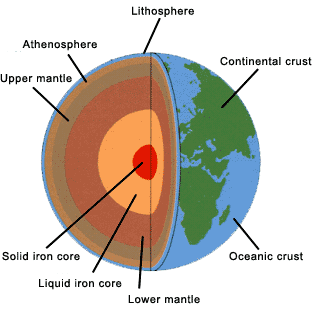
Our earth is made up of several concentric layers with one inside another. These layers are three in number-crust, mantle and core.
- Crust:
It is the uppermost layer over the earth's surface. It is the thinnest of all the layers. It is about 35 km on the continental masses and only 5 km on the ocean floors.
The continental masses are made up of silica and alumina. It is thus called sima (si-silica and al-alumina). The oceanic crust mainly consists of silica and magnesium. It is thus called sima (si-silica and ma-magnesium).
- Mantle:
It is just beneath the crust. It extends up to a depth of 2900 km below the crust. - Core:
It is the innermost layer. Its radius is about 3500 km. It is mainly made up of nickel and iron and is known as nife (ni-nickel and fe-ferrous, i.e., iron). The central core has very high temperature and pressure.
Posted by Saksham Kasaudhan 6 years, 7 months ago
- 1 answers
Posted by Loveleen Jouhal 6 years, 7 months ago
- 1 answers
Sia ? 6 years, 7 months ago
P = Rs. 10500
R = 5% per annum
h = 1 year
{tex}\therefore A = P{\left( {1 - \frac{R}{{100}}} \right)^n}{/tex}
{tex} = 10500{\left( {1 - \frac{5}{{100}}} \right)^1}{/tex}
{tex} = 10500\left( {1 - \frac{1}{{20}}} \right){/tex}
{tex} = 10500 \times \frac{{19}}{{20}}{/tex}
= 9975
Hence, value after 1 years is Rs. 9975
Posted by Faiza Saifi 6 years, 7 months ago
- 2 answers
Posted by Sanjay Sahani 6 years, 7 months ago
- 4 answers
Posted by Roopa Sanjay 6 years, 7 months ago
- 0 answers
Posted by Devanshi Goyal 6 years, 7 months ago
- 1 answers
Posted by Jamuna Bai 6 years, 7 months ago
- 1 answers
Sia ? 6 years, 7 months ago
Conventional sources of energy are those sources that are likely to get exhausted very soon. For example oil, gas and coal.
Posted by Komal Kadiyan 6 years, 7 months ago
- 6 answers
Posted by Jeet P Sulakhe 6 years, 7 months ago
- 3 answers
Posted by Swarnalata Pradhan 6 years, 7 months ago
- 2 answers
Devyansh Kumar Tulshyan 6 years, 7 months ago

myCBSEguide
Trusted by 1 Crore+ Students

Test Generator
Create papers online. It's FREE.

CUET Mock Tests
75,000+ questions to practice only on myCBSEguide app

Mabboob Ali 3 years, 7 months ago
2Thank You