
No products in the cart.

Ask questions which are clear, concise and easy to understand.

Ask Question
  • 1 answers
अभ्यासः (Exercise) प्रश्न 1. प्रश्नानामुत्तराणि एकपदेन लिखत-(प्रश्नों के उत्तर एक पद में लिखिए-) (क) केन पीडितः वैभव: बहिरागत:? (ख) भवनेत्यादीनां निर्माणाय के कर्त्यन्ते? (ग) मार्गे किं दृष्ट्वा बालाः परस्परं वार्तालापं कुर्वन्ति? (घ) वयं शिक्षिताः अपि कथमाचरामः? (ङ) प्लास्टिकस्य मृत्तिकायां लयाभावात् कस्य कृते महती क्षतिः भवति? (च) अद्य निदाघतापतप्तस्य किं शुष्कतां याति? उत्तरम्: (क) प्रचण्डोष्मणा (ख) वृक्षाः (ग) अवकरभाण्डारम् (घ) आशिक्षितेव (अशिक्षिताः इव) (ङ) पर्यावरणस्य (च) तालुः प्रश्न 2. पूर्णवाक्येन उत्तराणि लिखत-(पूर्ण वाक्य में उत्तर लिखिए-) (क) परमिन्दर् गृहात् बहिरागत्य किं पश्यति? (ख) अस्माभिः केषां निर्माणाय वृक्षाः कर्त्यन्ते? (ग) विनयः संगीतामाहूय किं वदति? (घ) रोजलिन् आगत्य किं करोति? (ङ) अन्त जोसेफ: पर्यावरणक्षायै कः उपायः बाधयति? उत्तरम्: (क) परमिन्दर् गृहात् बहिरागत्य सर्वथा अवरुद्ध वायुवेगं पश्यति। (ख) अस्माभिः यत्र-तत्र बहुभूमिकभवनानां, भूमिगतमार्गाणाम्, विशेषतः मैट्रोमार्गाणां, उपरिगमिसेतूनाम् मोत्यादीनाः निर्माणाय वृक्षाः कर्त्यन्ते।। (ग) विनयः संगीतामाहूय ‘महोदये! कृपां कुरु मार्गे भ्रमभ्यः’ इति वदति। (घ) रोजलिन् आगत्य बालैः साकं स्वक्षिप्तमवकरम् मार्गे विकीर्णमन्यदवकरं चापि संगृह्य अवकरकण्डोले प्रातयति। (ङ) अन्ते जोसेफ: पर्यावरणक्षायै ‘पर्यावरणेन सह पशवः अपि रक्षणीयाः’ इति उपाय: बोधयति।
  • 4 answers

Ayush Sharma 5 years ago

Why

Ayush Sharma 5 years ago

Thanks
Hii ayush hello my name Diksha
Happy birthday to advance hii
  • 3 answers
Hello ayush sharma can you send me a your whatapp no.

Gaurav Seth 5 years ago

Microscope is an instrument which has good resolving power and magnification. It is used for studying very small sized objects like cells. The very first microscope was built by Zacharias Janssen in 1590. It was first modified by Galileo and then by Robert Hooke.

Ayush Sharma 5 years ago

Robert hook
  • 2 answers

Gaurav Seth 5 years ago

Land:  All of us live on land. We need land for agriculture. We need land for making houses, factories, roads, railways, etc. We cannot imagine of a life without land. Land is considered an important resource.

Water: Human beings use water for a variety of purposes; like drinking, bathing and washing. Water is also used in production of various things for our use. Moreover, water is used in agriculture, industries and in electricity generation.

Please answer my question
  • 2 answers

Shruti ? 5 years ago

Budding

Yogita Ingle 5 years ago

 Hydra reproduces by the method of budding. A small outgrowth called bud is formed on one side of its body by repetitive mitotic division. This bud gradually grows into a full hydra, developing its mouth and tentacles. The new Hydra detaches itself from its parent and start living as a separate organism.

  • 2 answers

Shruti ? 5 years ago

Fertilisation

Yogita Ingle 5 years ago

The process of fusion of a sperm with an ovum is called fertilisation

  • 2 answers

Shruti ? 5 years ago

Uterus

Yogita Ingle 5 years ago

The development of fertilised egg takes place in the uterus (womb)

  • 2 answers

Shruti ? 5 years ago

Testis

Yogita Ingle 5 years ago

The testes produce sperms continuously from the stage of puberty onwards. Sperms from the testis pass through the sperm duct, known as vas deferens.

  • 1 answers
There is no question that Earth has been a giving planet. Everything humans have needed to survive, and thrive, was provided by the natural world around us: food, water, medicine, materials for shelter, and even natural cycles such as climate and nutrients
  • 2 answers
Land Revenue System What is Land Revenue? Definition of land revenue: Land revenue is tax or revenue levied on agricultural production on land. It is either collected as a percentage of the share of total crop or a monetary value is fixed on the land to be paid by the farmer. It has been the major source of revenue for empires. Land Revenue System Under Mughals Before the Britishers, the land revenue system in major parts of India was based on Mughal land revenue system. The land revenue system under Mughals can be divided into following three categories Ghalla Bakshi (crop sharing) also known as Batai and Bhaoli. Abu Fazal in his Ain-i-Akbari has described three methods of crops sharing, they are: Khet Batai: In this method, the standing crop was divided by dividing the field between the share of the ruler and the farmer. Lang Batai: In this system, the harvested crops were divided without the separation of grains from it. Division of grains at the threshing floor after the grain from the crop has been obtained. The division was on the basis of an agreement. The crops sharing method was expensive as the state had to employ a large number of employees for the division of the crops. However, it was referred as the best method of revenue assessment system and Collection. Kankut/ Dambandi: The word Kan means grain and Kat means to estimate, while the word Dam means grain and Bandi means fixing anything. In this method, the field was measured and then, per bigha productivity of good, middle and bad land was determined by an estimation. The revenue demand was based on this estimation. Zabti or Dhasala system: This land revenue system was initially started by Sher Shah Suri and later adopted and modified by Akbar. In this system, the land was divided into four types as per the continuity and discontinuity of cultivation. Polaj: The land which was annually cultivated without any discontinuity of cultivation. Parudi: The land which was left uncultivated for some time to regain fertility. Chachar: These lands were left uncultivated for three to four years. Bankar: These lands were left uncultivated for more than five years or even longer. Akbar appointed 'Karori to measure the actual produce, prices, and productivity of the land. On the basis of the information by Karoris, the average production and prices of crops were fixed by taking into account the estimation of last 10 years. One-third of the crop production was states minimum share. In general, under all systems, states share varied between one-third to two-thirds and even three-fourth in some cases. Land Revenue System Under British British got Diwani rights of Bengal, Bihar, and Orissa in 1765. The major aim of British East India Company was to increase their land revenue collection. So its policies were aimed at getting maximum income from land without caring about its consequences on cultivators and peasants. They introduced the policy of revenue collection by abandoning the age-old system of revenue administration. The entire burden of Company s profits, cost of its administration and expenses on wars and conquests were mainly borne by the peasants. Permanent Settlement System Also known as Jagirdari, Malguzari or Bizwedari, it was introduced in the 19% of total area under British rule. This was implemented in states of Bihar, Bengal, Orissa, Northern Carnatic and Banaras divisions after the failure of revenue farming system in Bengal in which the right to collect revenue was given to the highest bidder which was introduced by Lord Warren Hastings. In 1790 under Lord Cornwallis, a 10-year revenue settlement was made with the Zamindars and they were recognized as the owners of the land who could mortgage or sell the land, from being just the agent of the government for revenue collection. In 1793, this was converted into a permanent settlement and zamindari system was made hereditary and the land was made transferable. The tenants were now at the mercy of zamindars and their customary rights were sacrificed. The zamindars had to pay 10/11th of rent taken from the peasant to the company and keep only 1/11th of revenue for themselves. This resulted in illegal extortions from peasants by the zamindars. One may note here that the state's share of revenue was fixed and no limit was kept on revenue collected by zamindar from the cultivator. In the very first year of its adoption, the company's revenues rose by 80%. Reasons for Adopting the Permanent Settlement Due to the failure of the 'farming system' adopted by Lord Warren Hastings a new system of land revenue was required. The permanent settlement was to ensure a stable and fixed income for the company. To reduce the expenses of the Company on periodic revenue settlements and land assessments. It was also to end the corruption by the officials in revenue assessments. To reduce the burden of revenue collection on the company and to create a loyal group of zamindars whose interests were aligned to the continuation of British Raj. The company thought that fixed rates would increase investments in agriculture by the zamindars and company could benefit from the taxes from increased trade and commerce. Impact of Land Revenue System Under Permanent Settlement As the land revenue was going to be permanently fixed, the company fixed the rates arbitrarily high (10/11th of total collection) much higher than the past rates. This placed a high burden on the zamindars which were ultimately borne by the peasants. Peasants were left at the mercy of zamindars as no rules were made for revenue collection by zamindars. The property rights of peasants suffered and they faced evictions and 'begar . It led to the growth of new landlords as the property was now transferable and those zamindars who could not pay rents, their lands were auctioned. It also led to the growth of a system of absentee landlordism. These zamindars were interested only to maximize their revenue collection and had no interest in the investments in agriculture. A new class of landless cultivators, agricultural coolies on one hand and money lenders on the other was now created. High revenue demand and harsh methods of collection, eventually led to frequent land transfers which didn't benefit zamindars either. Company's revenue collection also fell as agricultural output declined. By 1770's Bengal witnessed famines. Ryotwari System Ryotwari system was adopted in 51% of the total area under British rule that is in state of Malabar, Coimbatore, Madras, Assam, and Madurai and later it was extended to Maharashtra and East Bengal. It was introduced on the recommendations of British officials Reed and Sir Thomas Munro. The state demand was fixed in cash and had no connection with actual yields. Besides, the revenue fixed was one of the highest in modern period, at 55 percent. Under this system, the taxes were directly collected by the government. It established a direct relationship between the government and the ryot (cultivator). Farmers had the right to sell, mortgage and lease the land but had to pay their taxes on time. If they failed to pay taxes, they were evicted from the land. Later on, the government went on to claim that the land revenue was rent and not a tax. This negated the ownership rights of farmers. The government fixed the tax rates for temporary periods of around 20 to 30 years after which land revenue was revised. But the government retained the rights to increase the land revenue anytime at its own will. Reasons for the Adoption of Ryotwari System The British officials believed that there are no zamindars or feudal lords with large estates in these areas. So it was difficult for the British to implement the zamindari system. The government revenues were fixed in the permanent settlement so it could not gain from the rise in prices. Moreover, the government felt that the revenue was being unnecessarily shared with the zamindars which reduced its profits. The zamindari system was oppressive for the peasants and led to frequent agrarian revolts. The government wanted to avoid these situations. It also hoped that by introducing ryotwari system, the purchasing power of peasants would increase, which would increase the demands for British goods in India. Impact of Land Revenue System Under Ryotwari System The peasants did not benefit from this land revenue system and felt that smaller zamindars we are replaced by one giant zamindar, the British government . The farmers were forced to pay land revenue even during the famines otherwise they were forced to evict the land. Further, the land revenue was very high, between 45% to 55% in different areas, which led to the impoverishment of farmers. A major drawback of this system was over assessment of crop yields. The system of tenancy and landlordism still existed as the artisans who were now unemployed, worked as tenants for rich farmers. In the several districts, more than two third of the total agricultural land was leased. The government insisted the peasants grow cash crops which required higher investments. It led to the indebtedness of farmers and when prices declined they suffered the most. For example, when the prices of cotton declined after the end of American Civil War the peasants suffered the most. This created conditions ripe for rebellion that came in the form of Deccan Agrarian riots in 1875. Mahalwari System The Mahalwari system was introduced in around 30% of total area under British rule. It was a modified version of zamindari system. It was introduced in the Gangetic valley, major parts of North West Frontier province, Punjab and in Central provinces. In these areas, more than often there was a system of collective land holdings by the heads of the families or the landlords. The village community mainly included the group of elders, mainly from the higher castes. The revenue settlement was made with the Mahal (a village or a group of villages). The taxes were imposed collectively on the members of the community. These taxes were revised periodically. The taxes were distributed between the individual farmers who paid their share in the tax revenue. However, the ownership rights of lands were with the individual peasants, who could mortgage or sell his land. Impacts of Land Revenue System Under Mahalwari System As the areas covered under the Mahalwari system in Northern India were fertile, the government put the revenue demands between 50% to 75% of the crop production. Within subsequent generations, the lands were fragmented, but the revenue demand was still high which had to be paid in cash. This led to their indebtedness in the hands of money lenders. Further, this system led to the eviction of farmers from the land. Due to this sub-leasing of land was more common in Mahalwari areas. British revenue systems therefore led to the impoverishment of peasantry. by making land a transferable property, the British facilitated rise of absentee landlords, oppressive moneylenders and pushed the peasant further into misery.
Can I know my answer pls
  • 5 answers
You welcome ayush Sharma I am Diksha

Ayush Singh 5 years ago

THANKS (0)
Full chapter 4on computer with solutions please supriya
Hi
Hlo
  • 4 answers
Hello anshu please friendship karoge tell me
Hello anshu please muja whatapp no. Par maths chapter 8 full chapter solve send kar do please anshu I am Diksha anshu... ???
Hello anshu
Orientation is the process of bringing employees up to speed on organisational policies, job roles and responsibilities and other organisational attributes and concepts that will help them transition efficiently into the position.
  • 3 answers
Hello gaurav Seth tum mara Friend bano ga tell me now right now gaurav Seth.
Tell me what is your problem gaurav Seth tell me now OK ??????????? and thanks for the answer OK tell me what is your problem

Gaurav Seth 5 years ago

Ex 8.1 Class 8 Maths Question 1.
Find the ratio of the following:
(a) speed of a cycle 15 km per hour to the speed of scooter 30 km per hour.
(b) 5 m to 10 km
(c) 50 paise to ₹ 5
Solution:
(a) Speed of cycle : Speed of Scooter = 15 km per hour : 30 km per hour
= 1530 = 12
Hence, the ratio = 1 : 2
(b) 5 m to 10 km
= 5 m : 10 × 1000 m [∵ 1 km = 1000 m]
= 5 m : 10000 m
= 1 : 2000
Hence, the ratio = 1 : 2000
(c) 50 paise to ₹ 5
= 50 paise : 5 × 100 paise
= 50 paise : 500 paise
ratio = 1 : 10

Ex 8.1 Class 8 Maths Question 2.
Convert the following ratios to percentages:
(a) 3 : 4
(b) 2 : 3
Solution:
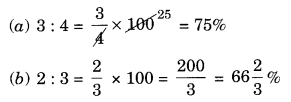
Ex 8.1 Class 8 Maths Question 3.
72% of 25 students are good in mathematics. How many are not good in mathematics?
Solution:
Number of students who are good in mathematics = 72% of 25
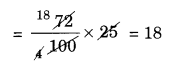
Number of students who are not good in mathematics = 25 – 18 = 7

For more click on the given links:

  • <a href="http://mycbseguide.com/blog/ncert-solutions-class-8-maths-exercise-8-1/">Comparing Quantities Exercise 8.1</a>
  • <a href="http://mycbseguide.com/blog/ncert-solutions-class-8-maths-exercise-8-2/">Comparing Quantities Exercise 8.2</a>
  • <a href="http://mycbseguide.com/blog/ncert-solutions-class-8-maths-exercise-8-3/">Comparing Quantities Exercise 8.3</a>
  • 1 answers
. Lake Superior is the largest freshwater lake in the world by surface area. Spanning nearly 32,000 square miles, Lake Superior is not only the largest freshwater lake in the world (by surface area) but it is also one of the largest lakes in the world, second only to the Caspian Sea.
  • 2 answers

Ayush Sharma 5 years ago

-16
Because, even though 2⋅0=02⋅0=0, a⋅0=0a⋅0=0 is also true, so maybe 0000 is all numbers aa? Or let’s take the limit: limx→00x=0limx→00x=0 So 00=000=0? Or maybe: limx→0x∈Rxx=1limx→0x∈Rxx=1 So 00=100=1 but only in the reals? If you took the limit for complex xxs you could get many different limits for xxxx as xx approaches 00 in the complex plane.
  • 2 answers

Namandeep Singh 5 years ago

T.me/MathsAndScienceFor8th
Bholaram chahta tha ki woh apna pump sarkar ki anumati le kr lagaye kyuki uski aakho pr toh sanskaro ka pani chadha hua tha lekin jab wo darkhwast le kr sarkari office gya toh unhone Bholaram ko idhar se udhar karwaya lekin kaam jaldi nhi ho rha tha aur Bholaram ko jaldi se pump lagawa kr kheto ki sicchai krni thi.
  • 1 answers

Gaurav Seth 5 years ago

Ex 8.1 Class 8 Maths Question 1.
Find the ratio of the following:
(a) speed of a cycle 15 km per hour to the speed of scooter 30 km per hour.
(b) 5 m to 10 km
(c) 50 paise to ₹ 5
Solution:
(a) Speed of cycle : Speed of Scooter = 15 km per hour : 30 km per hour
= 1530 = 12
Hence, the ratio = 1 : 2
(b) 5 m to 10 km
= 5 m : 10 × 1000 m [∵ 1 km = 1000 m]
= 5 m : 10000 m
= 1 : 2000
Hence, the ratio = 1 : 2000
(c) 50 paise to ₹ 5
= 50 paise : 5 × 100 paise
= 50 paise : 500 paise
ratio = 1 : 10

Ex 8.1 Class 8 Maths Question 2.
Convert the following ratios to percentages:
(a) 3 : 4
(b) 2 : 3
Solution:

Ex 8.1 Class 8 Maths Question 3.
72% of 25 students are good in mathematics. How many are not good in mathematics?
Solution:
Number of students who are good in mathematics = 72% of 25

Number of students who are not good in mathematics = 25 – 18 = 7

For more click on the given links:

  • <a href="http://mycbseguide.com/blog/ncert-solutions-class-8-maths-exercise-8-1/" style="box-sizing: border-box; -webkit-tap-highlight-color: transparent; user-select: initial !important; touch-action: manipulation; background-color: transparent; color: var(--ion-color-primary,#3880ff);">Comparing Quantities Exercise 8.1</a>
  • <a href="http://mycbseguide.com/blog/ncert-solutions-class-8-maths-exercise-8-2/" style="box-sizing: border-box; -webkit-tap-highlight-color: transparent; user-select: initial !important; touch-action: manipulation; background-color: transparent; color: var(--ion-color-primary,#3880ff);">Comparing Quantities Exercise 8.2</a>
  • <a href="http://mycbseguide.com/blog/ncert-solutions-class-8-maths-exercise-8-3/" style="box-sizing: border-box; -webkit-tap-highlight-color: transparent; user-select: initial !important; touch-action: manipulation; background-color: transparent; color: var(--ion-color-primary,#3880ff);">Comparing Quantities Exercise 8.3</a>
  •  
  • 3 answers
Shubham patil mara sa friendship karoge please
Hello gaurav Seth mara Friend bano ga tell me and my name is Diksha

Gaurav Seth 5 years ago

Don't post personal information, mobile numbers and other details.
Don't use this platform for chatting, social networking and making friends. This platform is meant only for asking subject specific and study related questions.
Be nice and polite and avoid rude and abusive language. Avoid inappropriate language and attention, vulgar terms and anything sexually suggestive. Avoid harassment and bullying.
Ask specific question which are clear and concise.

If content is found in violation, the user posting this content will be banned for 30 days from using Homework help section. Suspended users will receive error while adding question or answer. Question comments have also been disabled. Read community guidelines at https://mycbseguide.com/community-guidelines.html

  • 2 answers
Mara friend bano ga gaurav Seth tell me right now ok

Gaurav Seth 5 years ago

Ex 8.1 Class 8 Maths Question 1.
Find the ratio of the following:
(a) speed of a cycle 15 km per hour to the speed of scooter 30 km per hour.
(b) 5 m to 10 km
(c) 50 paise to ₹ 5
Solution:
(a) Speed of cycle : Speed of Scooter = 15 km per hour : 30 km per hour
= 1530 = 12
Hence, the ratio = 1 : 2
(b) 5 m to 10 km
= 5 m : 10 × 1000 m [∵ 1 km = 1000 m]
= 5 m : 10000 m
= 1 : 2000
Hence, the ratio = 1 : 2000
(c) 50 paise to ₹ 5
= 50 paise : 5 × 100 paise
= 50 paise : 500 paise
ratio = 1 : 10

Ex 8.1 Class 8 Maths Question 2.
Convert the following ratios to percentages:
(a) 3 : 4
(b) 2 : 3
Solution:

Ex 8.1 Class 8 Maths Question 3.
72% of 25 students are good in mathematics. How many are not good in mathematics?
Solution:
Number of students who are good in mathematics = 72% of 25

Number of students who are not good in mathematics = 25 – 18 = 7

For more click on the given links:

  • <a href="http://mycbseguide.com/blog/ncert-solutions-class-8-maths-exercise-8-1/">Comparing Quantities Exercise 8.1</a>
  • <a href="http://mycbseguide.com/blog/ncert-solutions-class-8-maths-exercise-8-2/">Comparing Quantities Exercise 8.2</a>
  • <a href="http://mycbseguide.com/blog/ncert-solutions-class-8-maths-exercise-8-3/">Comparing Quantities Exercise 8.3</a>
  • 1 answers

Gaurav Seth 5 years ago

Ex 8.1 Class 8 Maths Question 1.
Find the ratio of the following:
(a) speed of a cycle 15 km per hour to the speed of scooter 30 km per hour.
(b) 5 m to 10 km
(c) 50 paise to ₹ 5
Solution:
(a) Speed of cycle : Speed of Scooter = 15 km per hour : 30 km per hour
= 1530 = 12
Hence, the ratio = 1 : 2
(b) 5 m to 10 km
= 5 m : 10 × 1000 m [∵ 1 km = 1000 m]
= 5 m : 10000 m
= 1 : 2000
Hence, the ratio = 1 : 2000
(c) 50 paise to ₹ 5
= 50 paise : 5 × 100 paise
= 50 paise : 500 paise
ratio = 1 : 10

Ex 8.1 Class 8 Maths Question 2.
Convert the following ratios to percentages:
(a) 3 : 4
(b) 2 : 3
Solution:

Ex 8.1 Class 8 Maths Question 3.
72% of 25 students are good in mathematics. How many are not good in mathematics?
Solution:
Number of students who are good in mathematics = 72% of 25

Number of students who are not good in mathematics = 25 – 18 = 7

For more click on the given links:

  • <a href="http://mycbseguide.com/blog/ncert-solutions-class-8-maths-exercise-8-1/">Comparing Quantities Exercise 8.1</a>
  • <a href="http://mycbseguide.com/blog/ncert-solutions-class-8-maths-exercise-8-2/">Comparing Quantities Exercise 8.2</a>
  • <a href="http://mycbseguide.com/blog/ncert-solutions-class-8-maths-exercise-8-3/">Comparing Quantities Exercise 8.3</a>


  • 1 answers

Angel Malik 5 years ago

Ydbanajansmamsksk
  • 1 answers
JOIN NOW English > Honey Dew > The Ant and the Cricket Summary Class 8 English Honey Dew The Ant and the Cricket Summary Class 8 English Summary of The Ant and the Cricket The ant and the cricket is a fable in the form of poetry by Aesop. This poem is a story of a desperate and silly cricket and a miserly ant. The cricket would sing during the months of summer and spring. He never stored food for the winters. In the winter season, he finds that there is no food to eat at home. He was starving and thus, he went to the ant. He requested the ant to lend him some food and shelter. The ant refused to help him and told him to pass the winter also dancing. After saying this, the ant threw the Cricket out of his house. The Ant and the Cricket Summary in English This poem is a work of the famous Greek poet, Aesop. The two characters of the poem are cricket and an ant. There was a young cricket who used to sing and dance during the summers and springs. He was happy and enjoying but was silly. During the summers and spring, there is greenery everywhere. So, ample food and water are available. One does not need to store any of these. Thus, the cricket was busy enjoying and did not store any food for the winters. In winters, the ground is covered with snow and no flower or leaf could be seen. The cricket passed the time singing and dancing and soon the winter season came. Now, he was in trouble as there was not even a crumb in his house to eat and due to winter, he could not find any food outside also. He could thus eat nothing and was starving. He somehow gathered his courage and went to the ant asking for help. Due to the starvation, chilling cold and rains, the cricket got wet and was shivering.
  • 4 answers

Gaurav Seth 5 years ago

  • Don't post personal information, mobile numbers and other details.
  • Don't use this platform for chatting, social networking and making friends. This platform is meant only for asking subject specific and study related questions.
  • Be nice and polite and avoid rude and abusive language. Avoid inappropriate language and attention, vulgar terms and anything sexually suggestive. Avoid harassment and bullying.
  • Ask specific question which are clear and concise.

If content is found in violation, the user posting this content will be banned for 30 days from using Homework help section. Suspended users will receive error while adding question or answer. Question comments have also been disabled. Read community guidelines at https://mycbseguide.com/community-guidelines.html

Yes ncert hai par muja full chapter solve chaya OK can you send on whatapp no. Or cbse guide hello prakash Singh.

Prakash Yadav 5 years ago

NCERT ka hi chapter 8th na

Prakash Yadav 5 years ago

Whatsapp number toh do

myCBSEguide App

myCBSEguide

Trusted by 1 Crore+ Students

Test Generator

Test Generator

Create papers online. It's FREE.

CUET Mock Tests

CUET Mock Tests

75,000+ questions to practice only on myCBSEguide app

Download myCBSEguide App
