
Ask questions which are clear, concise and easy to understand.
Ask QuestionPosted by Diksha Laniya🐥 5 years ago
- 1 answers
Posted by Robin Dharni 5 years ago
- 1 answers
Ameen Ahmad 5 years ago
Posted by Ashwini Vinod 5 years ago
- 1 answers
Yogita Ingle 5 years ago
After the British were routed from Delhi, there was no uprising for almost a week. Then, a spurt of mutinies began in other parts of India.
(i)Regiment after regiment mutinied and took to join other troops at nodal points like Delhi, Kanpur and Lucknow. After them, the people of the towns and villages also rose up in rebellion. They rallied around local leaders, zamindars and chiefs who were prepared to establish their authority and fight the British.
(ii)Nana Saheb, the adopted son of the late Peshwa Baji Rao who lived near Kanpur, gathered armed forces and expelled the British Garrison from the city. He proclaimed himself Peshwa. He delcared that he was a Governor under emperor Bahadur Shah Zafar.
(iii)In Lucknow, Birjis Qadr, the son of the deposed Nawab Wajid Ali Shah, was proclaimed the new Nawab. He too acknowledged the suzerainty of Bahadur Shah Zafar. In Jhansi, Rani Lakshmibai joined the rebel sepoys and fought the British alongwith Tantia Tope, the General of Nana Saheb.
(iv)A situation of widespread rebellion also developed in the region of Awadh. Many new leaders also came up and joined the revolt. Ahmadullah Shah, a maulvi from Faizabad, raised a large force of supporters. He came to Lucknow to fight the British.
(v)In Delhi, a large number of religious warriors came together to wipe out the white people. Bakht Khan, a soldier from Bareilly, took charge of a large force of fighters who came to Delhi.
Posted by S Singh 5 years ago
- 2 answers
Gaurav Seth 5 years ago
Answer:
16 years
Step-by-step explanation:
Let the principle be x.
Then amount will be 2x.
Interest= Amount - Principal = 2x-x=x
Time = 8 yrs
R=?
Now Amount will be 3 times i.e. 3x
So, Interest=Amount - Principal = 3x-x=2x
So, It will take 16 years to be three times at the same rate
Posted by Bhavya Malik 5 years ago
- 2 answers
Posted by Anshul Jain, 5 years ago
- 3 answers
Posted by Roushan Tiwari 5 years ago
- 3 answers
Everything Here 5 years ago
Yogita Ingle 5 years ago
The Khilafat Non-Cooperation Movement was launched by the Indian national Congress in 1920 under the leadership of Gandhi. Main causes for launching the Non-cooperation Movement were:
- The treatment meted out by the British government to the Caliph of Turkey disturbed the Indian Muslims as he was seen as their religious head. As a result, they started the Khilafat Movement.
- Gandhi saw this as an opportunity to achieve the much desired Hindu-Muslim unity. He advised the Khilafat Committee to adopt a policy of non-cooperation with the British government. The Khilafat leaders agreed and campaigned accordingly. Thus, the Khilafat Movement furthered the cause of the Non-cooperation Movement.
- The Rowlatt Act of 1919 authorised the British government to arrest and imprison any person without trial and convict him in a court. Also, the Act implied severe restrictions on movements of individuals and suspension of the Right of Habeas Corpus. This was seen as a major breach of trust by Indians who were expecting the British to deliver on their promise of providing self-government. Gandhi appealed to the Viceroy to withhold his consent to the Act but his plea fell on deaf ears.
- The Jalianwala Bagh massacre and the subsequent British reaction to it was a watershed event in the Indian freedom struggle. It led to a huge furor all over the country and hardened the Congress resolve to attain self government.
- The Rowlatt satyagraha had been a widespread movement, it was still limited mostly to cities and towns. Gandhi now felt the need to launch a more broad-based movement in India which finally resulted in the launching of the Non Cooperation movement.
Posted by Vipin Verma 5 years ago
- 1 answers
Meghna Thapar 5 years ago
The pituitary gland sits below the brain in a midline pocket or fossa of the sphenoid bone known as the sella turcica, imaginatively named by anatomists because of its likeness to a Turkish horse saddle. Embryologically, anatomically and functionally the human gland is divided into two lobes. The anterior lobe constitutes two thirds of the volume of the gland and the posterior lobe one third. As with all other endocrine glands, symptoms arise as the result of either hypo- or hypersecretion of hormones.
Posted by Priyanshu Karnani 5 years ago
- 0 answers
Posted by Yash Saharan Saharan 5 years ago
- 4 answers
Dipal Khatri 5 years ago
Everything Here 5 years ago
Yogita Ingle 5 years ago
Plastic or rubber is an insulator which does not allow electric current to pass through it. The handles of the tools like screwdrivers and pliers used by electricians for repair have covering of plastic or rubber so that electric current may not pass through these tools to the body of the electrician to harm him.
Avani Rana 5 years ago
Posted by Suman Dennath 5 years ago
- 1 answers
Shruti ? 5 years ago
Posted by Ayush Sharma 5 years ago
- 0 answers
Posted by Rinku Srivastav 5 years ago
- 3 answers
Everything Here 5 years ago
Gaurav Seth 5 years ago
हाज़िर: उपस्थित
सफ़र: यात्रा
डाकिन: डराने वाली
श्रद्धा: किसी के प्रति आदरए सम्मान और प्यार का भावद्ध
उमड़: जमा होना
वयोवृद्ध: बूढ़ी या पुरानी
निशान: चिन्ह
वृद्धावस्था: बुढ़ापा
कष्ट: परेशानी
सवार: चढ़ा
हिस्सेदार: साझेदार
गज़ब: आश्चर्य
विदा: आखिरी सलाम
रकं: गरीब
कूच करने: जाना
निमित्त: कारण
सविनय अवज्ञा आंदोलनों: गाँधी जी द्वारा चलाया गया 1921 का आंदोलन
ट्रेनिग: सीख
दौर: ज़माने
गुजर: चल
क्षीण: कमज़ोर
वृक्षों: पेड़
दयनीय: बेचारी
वृद्धा: बूढी
ग्लानि: खेद
प्राणांत: मरना
बियाबान: सुनसान
अंत्येष्टि: अंतिम क्रिया
Posted by Diksha Laniya🐥 5 years ago
- 2 answers
Gaurav Seth 5 years ago
- Don't post personal information, mobile numbers and other details.
- Don't use this platform for chatting, social networking and making friends. This platform is meant only for asking subject specific and study related questions.
- Be nice and polite and avoid rude and abusive language. Avoid inappropriate language and attention, vulgar terms and anything sexually suggestive. Avoid harassment and bullying.
- Ask specific question which are clear and concise.
If content is found in violation, the user posting this content will be banned for 30 days from using Homework help section. Suspended users will receive error while adding question or answer. Question comments will be disabled. Read community guidelines at https://mycbseguide.com/community-guidelines.html
Posted by Preeti Khanikar 5 years ago
- 1 answers
Meghna Thapar 4 years, 11 months ago
From the small business owner to the student creating a class project, or even casual individuals working on a blog or personal project online, HTML knowledge is incredibly useful. Although the prospect of having to learn a programming language certainly does seem daunting, the good news is that HTML uses common words so that it is fairly simple to pick up.
HTML was invented by Tim Berners-Lee in the late 1980s and early 1990s. The first "public" release was in 1991. It was based on an earlier markup language, SGML (Standardized General Markup Language).
The major innovation of HTML was its use of the hyperlink. We are so used to this now that it is hard to understand how revolutionary this idea was at the time.
The hyperlink allows any document to reference any other document, and provides immediate access to that other document. Hyperlinks are what make the World Wide Web a web, and not just a library or database.
The IETF took up HTML as a standard and published the first HTML proposal in 1993. HTML 2.0, the first full official specification was released in 1995. By 1997, the W3C had taken over stewardship of the standard, and HTML 3.2 was released.
HTML 4.0 was released towards the end of 1997, and again the following year with a few updates. This version of the standard, with its three variations (strict, transitional, and frameset) defined HTML most of the next decade.
It was the version in force during the rise of the web's most iconic properties: Wikipedia, Google, Facebook, WordPress, Myspace, AOL. If you learned how to build web pages before 2008, you almost certainly learned this version.
Alongside HTML 4.0 was a related project called XHTML. This was first released in 2000 and 2001, as an XML-based implementation of HTML 4.0. Since XML had a stricter syntax than HTML, and could be easily validated by an XML parser, it was thought that introducing XHTML would force web content authors to create more precise documents.
For the most part, this did not happen. In practice, XHTML — along with the three varieties of HTML4, and the wild variation in browser rendering — contributed to the general confusion concerning what was and wasn't "standard" HTML.
One notable effect of XHTML is the idea that you must "close" empty tags with a trailing slash. If you are in the habit of typing <br /> instead of just <br>, you can thank XHTML — it was an XML syntax requirement that all tags must be closed.
Posted by Binita Dhakl 5 years ago
- 2 answers
Gaurav Seth 5 years ago
A n s w e r
(i) Seeing it scaled six inches to the mile.
(ii) On the ground had looked haphazard, unplanned and without style. (1st stanza)
(iii) Rivers ran why the valleys were populated. (2nd stanza)
Radha Rani 5 years ago
Posted by Radha Rani 5 years ago
- 0 answers
Posted by Nishant Ramji Patel 5 years ago
- 1 answers
Yogita Ingle 5 years ago
There are two types of cell references: relative and absolute. Relative and absolute references behave differently when copied and filled to other cells. Relative references change when a formula is copied to another cell. Absolute references, on the other hand, remain constant no matter where they are copied.
Posted by Srinidhi Ganesh 5 years ago
- 2 answers
Posted by Srinidhi Ganesh 5 years ago
- 1 answers
Posted by Noah Coutinho 5 years ago
- 1 answers
Gaurav Seth 5 years ago
tradition of Orientalism
- For this, it was necessary to study Indian history, philosophy, and law. William Jones, an expert in law and a linguist, took this task. He began to study ancient Indian texts on law, philosophy, religion, morality, arithmetic, medicine and the other sciences.
- Englishmen like Henry Thomas Colebrooke and Nathaniel Halhed were also busy discovering the ancient Indian heritage, mastering Indian languages and translating Sanskrit and Persian works into English.
- Together with them, Jones set up the Asiatic Society of Bengal, and started a journal called Asiatick Researches.
- Jones and Colebrooke shared a deep respect for the ancient culture. Both Indian and the West Indian civilisation, they felt, had attained glory in the ancient past but had subsequently declined.
- In order to understand India, it was necessary to discover the sacred and legal texts written in the ancient times.
- Jones and Colebrooke went about discovering ancient texts, understanding their meaning, translating them and making their findings known to others.
- Several company officials felt that Hindus and Muslims ought to be taught what they were already familiar with, and what they valued and treasured, instead of subjects that were alien to them.
- It was thought that this was the only way the British could win the hearts of the natives and could earn their respect.
- A madrasa was set up in Calcutta in 1781 to promote the study of Arabic, Persian and Islamic law; and the Hindu College was established in Benaras in 1791 to encourage the study of ancient Sanskrit texts that would be useful for the administration of the country.
- Not all officials shared these views. Many were very strong in their criticism of the Orientalists.
Posted by Manish Sharma 5 years ago
- 2 answers
Avani Rana 5 years ago
Gaurav Seth 5 years ago
The burning of a substance in the presence of oxygen is defined as combustion.
Conditions necessary for combustion are:
(i) Presence of a combustible substance.
(ii) Attainment of ignition temperature.
(iii) Proper supply of air to provide oxygen.
Structure of flame
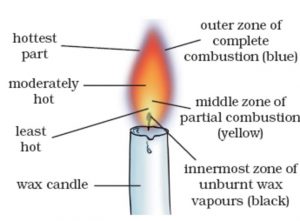
A flame consist of three zones.These are Innermost zone,middle zone,outer zone.The three zones of a flame have different colours and different temperature.
Posted by Mukul Chaudhary 5 years ago
- 4 answers
Posted by Ayush Sharma 5 years ago
- 1 answers
Diksha Laniya🐥 5 years ago
Posted by Ayush Sharma 5 years ago
- 1 answers
Gaurav Seth 5 years ago
| Area of a Square | (side)2 |
| Area of a Kite | (1 ⁄ 2) × Product of Diagonals |
| Area of a Parallelogram | Base × Height |
| Area of a Rectangle | Length × Breadth |
| Area of a Trapezoid | base1+base2 / 2 × height |
Posted by Preyasi Jain 5 years ago
- 1 answers
Gaurav Seth 5 years ago
a N S W E R :
a. contraction v) expanded sound waves
b. rarefaction iii) compressed sound waves
c. amplitude iv) loudness of sound waves
d. cochlea i) coiled organ of hearing
e. semi-circular canals ii) organs of balance

myCBSEguide
Trusted by 1 Crore+ Students

Test Generator
Create papers online. It's FREE.

CUET Mock Tests
75,000+ questions to practice only on myCBSEguide app

Gaurav Seth 5 years ago
Don't post personal information, mobile numbers and other details.
Don't use this platform for chatting, social networking and making friends. This platform is meant only for asking subject specific and study related questions.
Be nice and polite and avoid rude and abusive language. Avoid inappropriate language and attention, vulgar terms and anything sexually suggestive. Avoid harassment and bullying.
Ask specific question which are clear and concise.
If content is found in violation, the user posting this content will be banned for 30 days from using Homework help section. Suspended users will receive error while adding question or answer. Question comments will be disabled. Read community guidelines at https://mycbseguide.com/community-guidelines.html
2Thank You