
Ask questions which are clear, concise and easy to understand.
Ask QuestionPosted by Diksha Laniya🐥 5 years, 3 months ago
- 3 answers
Diksha Laniya🐥 5 years, 3 months ago
Gaurav Seth 5 years, 3 months ago
Don't post personal information, mobile numbers and other details.
Don't use this platform for chatting, social networking and making friends. This platform is meant only for asking subject specific and study related questions.
Be nice and polite and avoid rude and abusive language. Avoid inappropriate language and attention, vulgar terms and anything sexually suggestive. Avoid harassment and bullying.
Ask specific question which are clear and concise.
If content is found in violation, the user posting this content will be banned for 30 days from using Homework help section. Suspended users will receive error while adding question or answer. Question comments have also been disabled. Read community guidelines at https://mycbseguide.com/community-guidelines.html
Posted by Diksha Laniya🐥 5 years, 3 months ago
- 2 answers
Diksha Laniya🐥 5 years, 3 months ago
Gaurav Seth 5 years, 3 months ago
Ex 8.1 Class 8 Maths Question 1.
Find the ratio of the following:
(a) speed of a cycle 15 km per hour to the speed of scooter 30 km per hour.
(b) 5 m to 10 km
(c) 50 paise to ₹ 5
Solution:
(a) Speed of cycle : Speed of Scooter = 15 km per hour : 30 km per hour
= 1530 = 12
Hence, the ratio = 1 : 2
(b) 5 m to 10 km
= 5 m : 10 × 1000 m [∵ 1 km = 1000 m]
= 5 m : 10000 m
= 1 : 2000
Hence, the ratio = 1 : 2000
(c) 50 paise to ₹ 5
= 50 paise : 5 × 100 paise
= 50 paise : 500 paise
ratio = 1 : 10
Ex 8.1 Class 8 Maths Question 2.
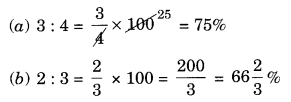
Convert the following ratios to percentages:
(a) 3 : 4
(b) 2 : 3
Solution:
Ex 8.1 Class 8 Maths Question 3.
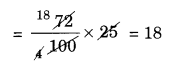
72% of 25 students are good in mathematics. How many are not good in mathematics?
Solution:
Number of students who are good in mathematics = 72% of 25
Number of students who are not good in mathematics = 25 – 18 = 7
For more click on the given links:
- <a href="http://mycbseguide.com/blog/ncert-solutions-class-8-maths-exercise-8-1/">Comparing Quantities Exercise 8.1</a>
- <a href="http://mycbseguide.com/blog/ncert-solutions-class-8-maths-exercise-8-2/">Comparing Quantities Exercise 8.2</a>
- <a href="http://mycbseguide.com/blog/ncert-solutions-class-8-maths-exercise-8-3/">Comparing Quantities Exercise 8.3</a>
Posted by Diksha Laniya🐥 5 years, 3 months ago
- 1 answers
Gaurav Seth 5 years, 3 months ago
Ex 8.1 Class 8 Maths Question 1.
Find the ratio of the following:
(a) speed of a cycle 15 km per hour to the speed of scooter 30 km per hour.
(b) 5 m to 10 km
(c) 50 paise to ₹ 5
Solution:
(a) Speed of cycle : Speed of Scooter = 15 km per hour : 30 km per hour
= 1530 = 12
Hence, the ratio = 1 : 2
(b) 5 m to 10 km
= 5 m : 10 × 1000 m [∵ 1 km = 1000 m]
= 5 m : 10000 m
= 1 : 2000
Hence, the ratio = 1 : 2000
(c) 50 paise to ₹ 5
= 50 paise : 5 × 100 paise
= 50 paise : 500 paise
ratio = 1 : 10
Ex 8.1 Class 8 Maths Question 2.
Convert the following ratios to percentages:
(a) 3 : 4
(b) 2 : 3
Solution:
Ex 8.1 Class 8 Maths Question 3.
72% of 25 students are good in mathematics. How many are not good in mathematics?
Solution:
Number of students who are good in mathematics = 72% of 25
Number of students who are not good in mathematics = 25 – 18 = 7
For more click on the given links:
- <a href="http://mycbseguide.com/blog/ncert-solutions-class-8-maths-exercise-8-1/">Comparing Quantities Exercise 8.1</a>
- <a href="http://mycbseguide.com/blog/ncert-solutions-class-8-maths-exercise-8-2/">Comparing Quantities Exercise 8.2</a>
- <a href="http://mycbseguide.com/blog/ncert-solutions-class-8-maths-exercise-8-3/">Comparing Quantities Exercise 8.3</a>
Posted by Diksha Laniya🐥 5 years, 3 months ago
- 4 answers
Gaurav Seth 5 years, 3 months ago
- Don't post personal information, mobile numbers and other details.
- Don't use this platform for chatting, social networking and making friends. This platform is meant only for asking subject specific and study related questions.
- Be nice and polite and avoid rude and abusive language. Avoid inappropriate language and attention, vulgar terms and anything sexually suggestive. Avoid harassment and bullying.
- Ask specific question which are clear and concise.
If content is found in violation, the user posting this content will be banned for 30 days from using Homework help section. Suspended users will receive error while adding question or answer. Question comments have also been disabled. Read community guidelines at https://mycbseguide.com/community-guidelines.html
Diksha Laniya🐥 5 years, 3 months ago
Posted by Kunal Krishna 5 years, 3 months ago
- 2 answers
Diksha Laniya🐥 5 years, 3 months ago
Posted by Aniket Dhiman 5 years, 3 months ago
- 5 answers
Posted by Rishi Raj 5 years, 3 months ago
- 3 answers
Gaurav Seth 5 years, 3 months ago
The arrangement of the given rational number is as per the rule of distributive law over subtraction.
Now take out 1/5 as common.
Then,
= 1/5 [(2/15) – (2/5)]
The LCM of the denominators 15 and 5 is 15
(2/15) = [(2×1)/ (15×1)] = (2/15)
and (2/5) = [(2×3)/ (5×3)] = (6/15)
= 1/5 [(2 – 6)/15]
= 1/5 [-4/15]
= (1/5) × (-4/15)
= -4/75
Posted by Malay Patra 5 years, 3 months ago
- 2 answers
Mohd Iqbal 5 years, 3 months ago
Yogita Ingle 5 years, 3 months ago
Collection of all positive and negative numbers including zero are called integers. ⇒ Numbers …, – 4, – 3, – 2, – 1, 0, 1, 2, 3, 4, … are integers.
Posted by Sundram Jha 5 years, 3 months ago
- 1 answers
Renuka Seiwal 5 years, 3 months ago
Posted by Sundram Jha 5 years, 3 months ago
- 1 answers
Diksha Laniya🐥 5 years, 3 months ago
Posted by Sundram Jha 5 years, 3 months ago
- 1 answers
Gaurav Seth 5 years, 3 months ago
Diagonal of rhombus = 12cm and 16cm
half of diagonal = 6cm and 8cm
by using Pythagoras theorem
at the point o where diangonals are meet at that point there are angle formed 90°
so,
a (side) of rhombus = √p² + b²
a = √6² + 8² = √36+64 =√ 100 = 10cm
now , as we know that Perimeter of rhombus
= 4a = 4×10 = 40cm Ans
Posted by Sundram Jha 5 years, 3 months ago
- 1 answers
Gaurav Seth 5 years, 3 months ago
Let one diagonal = 3X, then other diagonal will be= 4X
Area of Rhombus = d1*d2/2 = 54 cm2 (given)
or 3X * 4X /2= 54 cm2
or 6 X2 =54cm2
or X = Sqrt (54/6) =3 cm
Therefore d1 = 9 d2 =12
As diagonals are perpendicular bisector of each other
Side of a rhombus = Sqrt { (d1/2)2+(d2/2)2}
side of rhombus = sqrt{(9/2)2+(12/2)2} = Sqrt ( 81/4 + 144/4)= Sqrt(225/4)
or Side = 15 / 2 = 7.5 cm (Ans)
Posted by Sundram Jha 5 years, 3 months ago
- 1 answers
Gaurav Seth 5 years, 3 months ago
As diagonals of Rhombus are perpendicular bisector of each other
(Side of a rhombus )2= (d1/2)2+(d2/2)2
Here given d1 = 24 cm Side = 13 cm
Therefore 132= (24/2)2 + (d2/2)2
or d2/2 = Sqrt(169-144) = Sqrt (25) = 5
or d2 = 10 cm
Therefore Area of the Placard = d1*d2/2 = 24 * 10 /2 = 120 cm2
Cost of painting one side = 5.50 * 120 = Rs 660
Cost of painting both sides = Rs 660 x 2 = Rs 1320 (Answer)
Posted by Narendra Choudhary 5 years, 3 months ago
- 1 answers
Gaurav Seth 5 years, 3 months ago
In a parallelogram sum of the adjacent angles
equals supplementary.
opposite angles are equal.
Let the smaller angle = x°
larger angle = twice the smaller angle - 30°
=2x° - 30°
x° +2 x° - 30 = 180°
3x° = 180 + 30
3x = 210
x = 210 / 3
x = 70°
Therefore,
smaller angle = x = 70°
larger angle = 2x - 30
= 2 × 70 - 30
= 140 - 30
= 110°
Required parallelogram angles are 70° , 110° ,
70° , 110°
Posted by Sundram Jha 5 years, 3 months ago
- 1 answers
Gaurav Seth 5 years, 3 months ago
Radius of circle = 7cm
Circumference = 2πr = 2 x 22/7 x 7 = 44 cm
Circumference of circle = Perimeter of rhombus
Perimeter of rhombus = 44 cm
Let the side of rhombus be "a"
4a = 44
a = 11 cm
Hence, your answer is 11 cm (side of rhombus).
Posted by Narendra Choudhary 5 years, 3 months ago
- 2 answers
Diksha Laniya🐥 5 years, 3 months ago
Posted by Sundram Jha 5 years, 3 months ago
- 1 answers
Gaurav Seth 5 years, 3 months ago
In every rhombus, diagonal are perpendicular and bisect each other
Take rhombus as ABCD and bisecting point of diagonals as O
In every rhombus all sides are equal
So AB=BC=CD=DA=5cm
One diagonal is 6cm let AC
OA=OC=3cm
Since it is perpendicular so Pythagorean property applies
(OA)^2+(OB)^2=(AB)^2
=3^2+OB^2=5^2
=9+OB^2=25
=OB^2=25-9=16
=OB=4
Since OB+OD=BD
Then 4cm+4cm=8cm....OB and OD are equal
Area of rhombus=1/2×(d1×d2)
=1/2×(6×8)
=24cm2
Posted by Sundram Jha 5 years, 3 months ago
- 1 answers
Gaurav Seth 5 years, 3 months ago
GIVEN :-
- diagonal of rhombus (D1) = 40 m.
- Area of rhombus = 500 m².
- Cost of plugging the field = Rs. 2.50 /m².
TO FIND :-
- The other diagonal (D2) .
- Total cost of ploughing the field.
SOLUTION :-
___________________
Posted by Sundram Jha 5 years, 3 months ago
- 1 answers
Gaurav Seth 5 years, 3 months ago
Let the altitude be x.
Then base be 2x.
Area = 288 cm²
ATQ,
Area = Base × Height/Altitude
288 cm² = 2x × x
288 cm² = 2x²
2x² = 288 cm²
x² = 288 cm² ÷ 2
x = square root of 144 cm²
x = 12 cm
.°. Base = 2x
= 2 × 12 cm
= 24 cm
Altitude= x
= 12 cm
Posted by Narendra Choudhary 5 years, 3 months ago
- 1 answers
Gaurav Seth 5 years, 3 months ago
A n s w e r
Total sum of the pentagon is 540 degree
Three angles 90degree each
=3×90=270
Let Other two angles of same measure=x
Total sum=540
270+2x=540
2x=540-270
2x=270
X=135
Other two angles are 135 degree each
Posted by Aditya Ghate 5 years, 3 months ago
- 1 answers
Yogita Ingle 5 years, 3 months ago
Number = 1246.000000 Square Root = 35.298 |
Posted by Diksha Laniya🐥 5 years, 3 months ago
- 3 answers
Yogita Ingle 5 years, 3 months ago
Find the smallest number by which each of the following numbers must be multiplied to obtain a perfect cube.
(i) 243
(ii) 256
(iii) 72
(iv) 675
(v) 100
ANSWER:
(i) 243 = 3 × 3 × 3 × 3 × 3
Here, two 3s are left which are not in a triplet. To make 243 a cube, one more 3 is required.
In that case, 243 × 3 = 3 × 3 × 3 × 3 × 3 × 3 = 729 is a perfect cube.
Hence, the smallest natural number by which 243 should be multiplied to make it a perfect cube is 3.
(ii) 256 = 2 × 2 × 2 × 2 × 2 × 2 × 2 × 2
Here, two 2s are left which are not in a triplet. To make 256 a cube, one more 2 is required.
Then, we obtain
256 × 2 = 2 × 2 × 2 × 2 × 2 × 2 × 2 × 2 × 2 = 512 is a perfect cube.
Hence, the smallest natural number by which 256 should be multiplied to make it a perfect cube is 2.
(iii) 72 = 2 × 2 × 2 × 3 × 3
Here, two 3s are left which are not in a triplet. To make 72 a cube, one more 3 is required.
Then, we obtain
72 × 3 = 2 × 2 × 2 × 3 × 3 × 3 = 216 is a perfect cube.
Hence, the smallest natural number by which 72 should be multiplied to make it a perfect cube is 3.
(iv) 675 = 3 × 3 × 3 × 5 × 5
Here, two 5s are left which are not in a triplet. To make 675 a cube, one more 5 is required.
Then, we obtain
675 × 5 = 3 × 3 × 3 × 5 × 5 × 5 = 3375 is a perfect cube.
Hence, the smallest natural number by which 675 should be multiplied to make it a perfect cube is 5.
(v) 100 = 2 × 2 × 5 × 5
Here, two 2s and two 5s are left which are not in a triplet. To make 100 a cube, we require one more 2 and one more 5.
Then, we obtain
100 × 2 × 5 = 2 × 2 × 2 × 5 × 5 × 5 = 1000 is a perfect cube
Hence, the smallest natural number by which 100 should be multiplied to make it a perfect cube is 2 × 5 = 10.
Gaurav Seth 5 years, 3 months ago
Find out the smallest number multiplied by the following numbers to get the perfect cube?
(i) 5400
(ii) 10584
(i) 5400
Resolving 5400 into Prime factors as follows
Here, factor 5 is not ¡n group of three.
∴ To make 5400 a perfect cube, we have to multiply it by smallest number 5.
(ii) 10584
Resolving 10584 into Prime factors as follows
Here , factor 7 is not in group of three
∴ To make 10584 as a perfect cube, we have to multiply it by smallest number 7.
Posted by Sundram Jha 5 years, 3 months ago
- 1 answers
Gaurav Seth 5 years, 3 months ago
Step-by-step explanation:
let the shorter side be x cm
other side = x+1 cm
height = 4cm
Area of trapezium = (1/2)*sum of parallel side* height
= (1/2)*(x cm + x+1 cm)*4 cm
= 2x+1 cm * 2 cm
= 4x+2 cm square
ATQ
4x+2 = 10
=> 4x = 10 -2
=> x = 8/4
=> x = 2
side 1 = x cm
= 2 cm
side 2 = x+1 cm
= 2+1 cm
= 3 cm
Posted by Sundram Jha 5 years, 3 months ago
- 1 answers
Yogita Ingle 5 years, 3 months ago
Area of a trapezium = 1/2×height (sum of parallel sides
given:the other parallel side is double the other. height is5cm.Area is 45 cm square.
let the parallel sides be x and 2x
1/2×5 (x+2x)=45
5 (x+2x)=45×2
5x+10x=90
15x=90
x=90/15
x=6
2x=12
so the parallel sides are 6cm and 12cm.
Posted by Sundram Jha 5 years, 3 months ago
- 1 answers
Yogita Ingle 5 years, 3 months ago
area of trapezium=1/2×(sum of parallel sides)×height
area of trapezium=1/2×(4.1+10.9)×5
area of trapezium=1/2×75
area of trapezium=37.5
Posted by Anandika Chakraborty 5 years, 3 months ago
- 2 answers
Yogita Ingle 5 years, 3 months ago
B =x
L= x+7
Original Area =x×(x×7)=x^2+7x
New length =x+7-4=x+3
New breadth =x+3
New area =(x+3)(x+3)=x^2+6x+9
A2Q
=x^2+7x =x^2+6x+9
=x^2- x^2+7x=6x+9
=7x-6x=9
=x=9cm=Breadth
9+7=16cm=Length
Posted by Diksha Laniya🐥 5 years, 3 months ago
- 1 answers
Yogita Ingle 5 years, 3 months ago
let the lengths of two sides of the parallelogram be 4x cm and 3x cm respectively
⇒ its perimeter = 2(4x + 3x) cm = 8x + 6x = 14x cm.
∴ 14x = 210
⇔ x = 210/14 = 15
∴ one side = (4 × 15) cm = 60 cm and other side = (3 ×15) cm = 45 cm.
Posted by Diksha Laniya🐥 5 years, 3 months ago
- 1 answers
Yogita Ingle 5 years, 3 months ago
1 2/3+2 3/4+1 1/2
= 5/3 + 11/4 + 3/2
= [5(4) + 11(3) + 3(6)]/ 12
= (12 + 33 + 18)/ 12
= 63/12
Posted by Diksha Laniya🐥 5 years, 3 months ago
- 1 answers
Yogita Ingle 5 years, 3 months ago
let the lengths of two sides of the parallelogram be 4x cm and 13x cm respectively
⇒ its perimeter = 2(4x + 13x) cm = 8x + 26x = 34x cm.
∴ 34x = 210
⇔ x = 210/34 = 6.17
∴ one side = (4 × 6.17) cm = 24.68 cm and other side = (13 × 6.17) cm = 80.21 cm.

myCBSEguide
Trusted by 1 Crore+ Students

Test Generator
Create papers online. It's FREE.

CUET Mock Tests
75,000+ questions to practice only on myCBSEguide app

Diksha Laniya🐥 5 years, 3 months ago
0Thank You