
No products in the cart.

Ask questions which are clear, concise and easy to understand.

Ask Question
  • 1 answers
Maths Formulas For Class 8: Important Chapterwise Formulas For Class 8 Maths  Maths Formulas For Class 8: For a Class 8 student, it becomes difficult to understand the rise in difficulty level from his previous classes. Also, for a subject like Mathematics, you got to be attentive all the times. The subject holds a lot of importance in both your education as well as your personal life. For a good level of understanding, you need to conquer your Maths Formulas for Class 8 first and then move on to implement them to solve your questions. One may wonder where to find the exact Maths formulas for Class 8 for a specific set of problems. This is the reason why we are bringing this article right in front of you. We will be providing you with all Maths formulas for Class 8 under one page so that you don’t face any problem. Important Note: If you are facing any issues accessing the formulas on your mobile devices, try opening the Desktop site from your mobile’s web browser settings. SOLVE CLASS 8 MATHS PRACTICE QUESTIONS NOW Maths Formulas For Class 8 Many students argue about the fact that Maths formulas are hard to grasp. However, if you understand the meaning of the formulas, practice them regularly, and solve a sufficient number of questions, all the formulas will be at your fingertips. CBSE Class 8 Maths has the following chapters: Chapter-1: Rational Numbers Chapter-2: Linear Equation in One Variable Chapter-3: Understanding Quadrilaterals Chapter-4: Practical Geometry Chapter-5: Data Handling Chapter-6: Square and Square Roots Chapter-7: Cube and Cube Roots Chapter-8: Comparing Quantities Chapter-9: Algebraic Expressions and Identities Chapter-10: Mensuration Chapter-11: Exponents and Power Chapter-12: Direct and Inverse Proportion Chapter-13: Factorization Chapter-14: Introduction to Graphs Chapter-15: Playing with Numbers DOWNLOAD NCERT SOLUTIONS FOR CLASS 8 MATHS HERE Let’s take a look at some of the important chapter-wise list of Maths formulas for Class 8. Maths Class 8 Formulas: Rational Numbers Any number that can be written in the form of p ⁄ q where q ≠ 0 are rational numbers. It posses the properties of: Additive Identity: (a ⁄ b + 0) = (a ⁄ b) Multiplicative Identity: (a ⁄ b) × 1 = (a/b) Multiplicative Inverse: (a ⁄ b) × (b/a) = 1 Closure Property – Addition: For any two rational numbers a and b, a + b is also a rational number. Closure Property – Subtraction: For any two rational numbers a and b, a – b is also a rational number. Closure Property – Multiplication: For any two rational numbers a and b, a × b is also a rational number. Closure Property – Division: Rational numbers are not closed under division. Commutative Property – Addition: For any rational numbers a and b, a + b = b + a. Commutative Property – Subtraction: For any rational numbers a and b, a – b ≠ b – a. Commutative Property – Multiplication: For any rational numbers a and b, (a x b) = (b x a). Commutative Property – Division: For any rational numbers a and b, (a/b) ≠ (b/a). Associative Property – Addition: For any rational numbers a, b, and c, (a + b) + c = a + (b + c). Associative Property – Subtraction: For any rational numbers a, b, and c, (a – b) – c ≠ a – (b – c) Associative Property – Multiplication: For any rational number a, b, and c, (a x b) x c = a x (b x c). Associative Property – Division: For any rational numbers a, b, and c, (a / b) / c ≠ a / (b / c) . Distributive Property: For any three rational numbers a, b and c, a × ( b + c ) = (a × b) +( a × c). Number Formation A two-digit number ‘ab’ can be written in the form: ab = 10a + b A three-digit number ‘abc’ can be written as: abc = 100a+10b+c A four-digit number ‘abcd’ can be formed: abcd = 1000a+100b+10c+d Download also, Algebra Formulas For Class 8 Maths Formulas For Class 8: Laws of Exponents a0 = 1 a-m = 1/am (am)n = amn am / an = am-n am x bm = (ab)m am / bm = (a/b)m (a/b)-m =(b/a)m (1)n= 1 for infinite values of n. Maths Formulas For Class 8: Algebraic Identity Algebraic Identities comprises of several equality equations which consist of different variables. a) Linear Equations in One Variable: A linear equation in one variable has the maximum one variable of order 1. It is depicted in the form of ax + b = 0, where x is the variable. b) Linear Equations in Two Variables: A linear equation in two variables has the maximum of two variables of order 2. It is depicted in the form of ax2 + bx + c = 0. (a + b)2 = a2 + 2ab + b2 (a – b)2 = a2 – 2ab + b2 (a + b) (a – b) = a2 – b2 (x + a) (x + b) = x2 + (a + b)x + ab (x + a) (x – b) = x2 + (a – b)x – ab (x – a) (x + b) = x2 + (b – a)x – ab (x – a) (x – b) = x2 – (a + b)x + ab (a + b)3 = a3 + b3 + 3ab(a + b) (a – b)3 = a3 – b3 – 3ab(a – b) Maths Formulas For Class 8 Square & Square Roots If a natural number, m = n2 and n is a natural number, then m is said to be a square number. Every square number surely ends with 0, 1, 4, 5 6 and 9 at its units place. A square mysqladmin is the inverse operation of the square. Maths Formulas For Class 8 Cube & Cube Roots Numbers, when obtained while multiplied by itself three times, is known as cube numbers. If every number in the prime factorization appears three times, then the number is a perfect cube. The symbol of the cube mysqladmin is ∛. Cube and Cube mysqladmin: ∛27 = 3 and 33 = 27. Maths Formulas For Class 8 Comparing Quantities Discounts are the reduction value prevailed on the Marked Price (MP). Discount = Marked Price – Sale Price Discount = Discount % of the Marked Price Overhead expenses are the additional expenses made after purchasing an item. These are included in the Cost Price (CP) of that particular item. CP = Buying Price + Overhead Expenses GST (Goods and Service Tax) is calculated on the supply of the goods. Tax = Tax % of the Bill Amount Compound Interest (CI) is the interest which is compounded on the basis of the previous year’s amount. Formula of Amount (Compounded Annually): \(A = P \left (1 + \frac{R}{100} \right )^t\) P = Principal, r = Rate of Interest, and t = Time Period Formula of Amount (Compounded Half Yearly): \(A = P \left (1 + \frac{R}{200} \right )^{2t}\) R/2 = Half-yearly Rate, 2t = Number of Half-Years Maths Formulas For Class 8 Data Handling & Probability Any useful information that can be utilized for some specific use is known as Data. These data can be represented either graphically (Pictograph/Bar Graph/Pie Charts) or symmetrically (Tabular form). Find the important Class 8 Maths formulas for Data Handling and Probability. A class interval is the specific range of numbers such as 10-20, 20-30, 30-40, and so forth. For a Class Interval of 10-20, Lower Class Limit = 10 and Upper-Class Limit = 20 Frequency is the number of times a particular value occurs. Probability = Number of Favourable Outcomes / Total Number of Outcomes Maths Formulas For Class 8 Geometry Here, we will define the geometrical formulas consistently used in Mathematics Class 8. We will use the following abbreviations for convenience: 1. LSA – Lateral/Curved Surface Area 2. TSA – Total Surface Area Name of the Solid FigureFormulasCuboidLSA: 2h(l + b) TSA: 2(lb + bh + hl) Volume: l × b × h l = length, b = breadth, h = heightCubeLSA: 4a2 TSA: 6a2 Volume: a3 a = sides of a cubeRight PyramidLSA: ½ × p × l TSA: LSA + Area of the base Volume: ⅓ × Area of the base × h p = perimeter of the base, l = slant height, h = heightRight Circular CylinderLSA: 2(π × r × h) TSA: 2πr (r + h) Volume: π × r2 × h r = radius, h = heightRight Circular ConeLSA: πrl TSA: π × r × (r + l) Volume: ⅓ × (πr2h) r = radius, l = slant height, h = heightRight PrismLSA: p × h TSA: LSA × 2B Volume: B × h p = perimeter of the base, B = area of base, h = heightSphereLSA: 4 × π × r2 TSA: 4 × π × r2 Volume: 4/3 × (πr3) r = radiusHemisphereLSA: 2 × π × r2 TSA: 3 × π × r2 Volume: ⅔ × (πr3) r = radius CHECK THE DETAILED MATHS SYLLABUS FOR CLASS 8 Maths Formulas For Class 8: Important FAQs Here are some important frequently asked questions related to Class 8 Maths formulas. Q: Which book should I prefer for learning Class 8 maths formulas? A: I advise you to go for NCERT books if you want to know all the important Class 8 Maths formulas. Is there any website offers free Class 8 practice questions? A: Embibe offers you with free Class 8 practice questions to learn and score well in your examinations. Q: How to make the best use of these maths formulas? A: These Class 8 Maths formulas will help you at the time when you get stuck in some questions while practising the subject. The formulas and properties will help you go through a quick revision. This way you can prepare well and score better. Q: How will these Class 8 maths formulas help me? A: These Maths formulas are taken from the standard Class 8 NCERT book. Therefore, it’ll prove useful for you no matter what education board you are studying in. These formulas are present on a page so that you don’t have to go back and forth. Hence, this will come in handy at the time of revision. SOLVE CLASS 8 QUESTIONS HERE These are some of the important maths formulas for Class 8. These will prove to be helpful in making your journey a rather easy one. Solve the free Class 8 Maths Questions and refer to these formulas when necessary. With passing time, you will improve. If you have any queries, feel free to comment them down and we will get back to you. Embibe wishes you all the best!
  • 1 answers

Gaurav Seth 5 years ago

<th colspan="2">Quadrilateral Area Formulas</th>
Area of a Square (side)2
Area of a Kite (1 ⁄ 2) × Product of Diagonals
Area of a Parallelogram Base × Height
Area of a Rectangle Length × Breadth
Area of a Trapezoid  base1+base2 / 2 × height
  • 2 answers
Hi

Gaurav Seth 5 years ago

Mensuration is a branch of mathematics which mainly deals with the study of different kinds of Geometrical shapes along with its area, length, volume and perimeters. It is completely based on the application of both algebraic equations and geometric calculations. The results obtained by the Mensuration are considered very accurate. 

Click on the link for notes:

<a data-ved="2ahUKEwi1m7_1_L_tAhVpzTgGHXXUCvIQFjAAegQIAxAC" href="https://mycbseguide.com/blog/mensuration-class-8-notes-mathematics/" ping="/url?sa=t&source=web&rct=j&url=https://mycbseguide.com/blog/mensuration-class-8-notes-mathematics/&ved=2ahUKEwi1m7_1_L_tAhVpzTgGHXXUCvIQFjAAegQIAxAC" rel="noopener" target="_blank">Mensuration class 8 Notes Mathematics | myCBSEguide ...</a>

  • 1 answers

Yogita Ingle 5 years ago

Factorization by regrouping terms:

Let we want to factorize x2 + xy + 8x + 8y

Since there is no common factor among all terms. So, we form groups.

We form two groups (x2 + xy) and (8x + 8y) and then factorize

x2 + xy = x * x + x * y

             = x * (x + y)

8x + 8y = 8 * x + 8 * y

              = 8 * (x + y)

Now, x2 + xy + 8x + 8y = x * (x + y) + 8 * (x + y)

                                        = (x + y)(x + 8)                          

We can regroup the algebraic expressions in many ways.

  • 1 answers
ANSWER 1. Draw a diagonal AC=6 cm. 2. Draw a perpendicular bisector of AC, let the perpendicular bisector and AC intersects at O (∵ Diagonals of rhombus intersects at right angle) 3. Taking O as centre and half of the length of another diagonal (i.e 3.5 cm) as radius, mark arc on the perpendicular bisector at both sides of AC. Name these intersection points as B and D 4. Join AB,AD,BC,CD. 5. ABCD is the required rhombus. 6. Measure the ∠ABD which come out to be 40.7˚ 
  • 1 answers

Sia ? 4 years, 7 months ago

Selling price of the synthesizer = Rs 17280
Tax rate = r = 8%
Selling price without addiing VAT
of 8% = (100 × s.p of synthesizer )/( 100 + r )
= ( 100 × 17280 ) / ( 100 + 8 )
= ( 100 × 17280 ) / 108
= Rs 16000

  • 1 answers

Yogita Ingle 5 years ago

let digit at ones place=x and

digit at tens place=y

So, the number will be 10y+x

x+y=7 ....(1)

reverse digit will be represented as, 10x+y

So, (10x+y)-(10y-x)=27

9x-9y=27

x-y=3 ....(2)

Adding equation (1) and (2)

2x=10

x=5

substituting in equation (1)

y=7-5

=2

Thus, the number will be 25

  • 1 answers

Yogita Ingle 5 years ago

Amount = Rs. 18000

Time = 4 years

Principle = Rs. 16000

⠀⠀⠀⠀

⠀⠀⠀⠀

⠀⠀

⠀⠀⠀⠀

⠀⠀

⠀⠀

⠀⠀

⠀⠀

⠀⠀

  • 3 answers
Hi

Yogita Ingle 5 years ago

Since one of the numbers on the dial of a telephone is zero, so the product of all the numbers on it is 0.

What is the product of all the numbers in the dial of a telephone ? Explanation: Since one of the numbers on the dial of a telephone is zero, so the product of all the numbers on it is 0.
  • 2 answers

Vipan Kaur 5 years ago

2449 is answer
2449 ( ) % AC 7 8 9 ÷ 4 5 6 × 1 2 3 − 0 . = + Rad Deg x! Inv sin ln π cos log e tan √ Ans EXP xy = 123 Fx
  • 3 answers

Shruti ? 5 years ago

-20/3 and -40/3 is the answer
ANSWER Let the number be 4x and 5x. According to the question, ⇒5x+204x+20​=76​ ⇒28x+140=30x+120 2x=20 x=10 ⇒Sum=4x+5x=9x =9×10 =90.

Manya Aggarwal 5 years ago

Pls tell the answer
  • 0 answers
  • 1 answers
ANSWER x+y=5.......(1) x−y=7.........(2) Adding equations(1) and (2), we get x+y+x−y=5+7 2x=12⟹x=6 Now putting this value of x in equation (1), we get y=-1 So, x=6,y=−1(solution)
  • 3 answers

Ayush Sharma 5 years ago

Is ur school eng medium
Yes

Ayush Sharma 5 years ago

Hair not hai
  • 4 answers
Yes and this is my father phone
OK ayush

Ayush Sharma 5 years ago

But we r still friends

Ayush Sharma 5 years ago

That i cannot give u no.
  • 1 answers

Yogita Ingle 5 years ago

  7.465  +2.02 - 4

= 9.485 - 4 

= 5.485

  • 4 answers

Ayush Sharma 5 years ago

I mean that i cannot give u phone no. My mom not allow me but we r still friends
Its my mom no. I cannot give u U can ask question here only i m in bari brahmana jammu soo far frm u What is the meaning ayush sharma

Ayush Sharma 5 years ago

Its my mom no. I cannot give u U can ask question here only i m in bari brahmana jammu soo far frm u

Ayush Sharma 5 years ago

Is called hacker
  • 1 answers

Yogita Ingle 5 years ago

Ashu school is 30 kilometre for from his house.

He covers 12 km 200 distance by bus, 15 kilometre 700 distance by car  
Total distance cover by bus and car = 12.200 + 15.700 = 27 km 900 m

Distance cover on foot = 30.000 - 27.900 = 2 .100 = 2 km 100 m

  • 1 answers

Yogita Ingle 5 years ago

Given  C.P of first fan = Rs 1200
He sold the fan at a loss of 5%
⇒ Loss on first fan= 5% of 1200
             = 5/100*1200
             = Rs 60  
S.P of fan = C.P - loss
                 = 1200 -60
                 = Rs 1140

C.P of 2nd fan = Rs 1200
He sold at a profit of 10%
profit of second fan= 10% of 1200
          = 10/100*1200
          = Rs 120
S.P of 2nd fan = profit + C.P
                         = 1200+120
                         =   Rs 1320

Total cost price of two fans = 1200 + 1200 = Rs 2400
Total S.P of 2 fans = 1320+1140 = Rs 2460
Since S.P > C.P
He got profit on whole
profit = S.P - C.P
          = 2460 - 2400
          = Rs 60
Profit% = profit/C.P * 100
             = 60/2400 * 100
             = 2.5% profit on whole

  • 1 answers

Yogita Ingle 5 years ago

The marked price of the sofa = Rs. 6000

Discount% = 10%

We know the formula as:

Substituting the values in the formula above, we get

∴ S.P. of the sofa = 

Gain% = 8%

Also, we know the formula as:

Substituting the values in the formula above, we get

∴ C.P. of the sofa = 


Thus, the actual cost of the sofa is → Rs. 5000.

  • 1 answers

Yogita Ingle 5 years ago

Female percentage=15%

therefore ,

male percentage= 100-15

= 85%

85%=272. _________________ given

let total workers of factory be x

X. × 85/100 =272. ________85%=85/100

X=272×100/85

X=27200/85

therefore

X= 320

there are 320 workers in factory

  • 1 answers

Gaurav Seth 5 years ago

2025 plants are to be planted in a garden in such a way that each row contains as many plants as the number of rows. Find the number of rows and the number of plants in each row.

Solution

Let the number of rows be, x.

∴ the number of plants in each rows = x.

Total many contributed by all the students = x × x =x2

Given,

x2 = Rs.2025
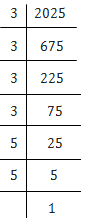
x2 = 3×3×3×3×5×5

⇒ x2 = (3×3)×(3×3)×(5×5)

⇒ x2 = (3×3×5)×(3×3×5)

⇒ x2 = 45×45

⇒ x = √45×45

⇒ x = 45

∴ The number of rows = 45 and the number of plants in each rows = 45.

  • 2 answers
Hii koi to mara sa friendship kar Lo please request hai
ANSWER First expand the term (1+2x)4 by binomial expansion. (1+2x)4=4C0​(1)4(2x)0+4C1​(1)3(2x)1+4C2​(1)2(2x)2+4C3​(1)1(2x)3+4C4​(1)0(2x)4 =1+8x+24x2+32x3+16x4                             (1) Now expand the term (2−x)5 by binomial expansion, (2−x)5=5C0​(2)5(x)0−5C1​(2)4(x)1+5C2​(2)3(x)2−5C3​(2)2(x)3+5C4​(2)1(x)4−5C5​(2)0(x)5 =32−80x+80x2−40x3+10x4−x5                    (2) Multiply the coefficients of those powers which can give the term x4 and then add from equation (1) and (2). =1×10+8(−40)+24(80)+32(−80)+16(32) =−438 Therefore, the coefficient of x4 is −438.
  • 3 answers
Hello gaurav Seth tum mara Friend bano ga tell me now right now gaurav Seth.
Tell me what is your problem gaurav Seth tell me now OK ??????????? and thanks for the answer OK tell me what is your problem

Gaurav Seth 5 years ago

Ex 8.1 Class 8 Maths Question 1.
Find the ratio of the following:
(a) speed of a cycle 15 km per hour to the speed of scooter 30 km per hour.
(b) 5 m to 10 km
(c) 50 paise to ₹ 5
Solution:
(a) Speed of cycle : Speed of Scooter = 15 km per hour : 30 km per hour
= 1530 = 12
Hence, the ratio = 1 : 2
(b) 5 m to 10 km
= 5 m : 10 × 1000 m [∵ 1 km = 1000 m]
= 5 m : 10000 m
= 1 : 2000
Hence, the ratio = 1 : 2000
(c) 50 paise to ₹ 5
= 50 paise : 5 × 100 paise
= 50 paise : 500 paise
ratio = 1 : 10

Ex 8.1 Class 8 Maths Question 2.
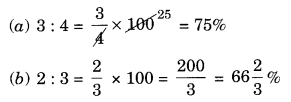
Convert the following ratios to percentages:
(a) 3 : 4
(b) 2 : 3
Solution:
Ex 8.1 Class 8 Maths Question 3.
72% of 25 students are good in mathematics. How many are not good in mathematics?
Solution:
Number of students who are good in mathematics = 72% of 25
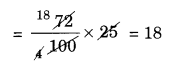
Number of students who are not good in mathematics = 25 – 18 = 7

For more click on the given links:

  • <a href="http://mycbseguide.com/blog/ncert-solutions-class-8-maths-exercise-8-1/">Comparing Quantities Exercise 8.1</a>
  • <a href="http://mycbseguide.com/blog/ncert-solutions-class-8-maths-exercise-8-2/">Comparing Quantities Exercise 8.2</a>
  • <a href="http://mycbseguide.com/blog/ncert-solutions-class-8-maths-exercise-8-3/">Comparing Quantities Exercise 8.3</a>
  • 2 answers

Ayush Sharma 5 years ago

-16
Because, even though 2⋅0=02⋅0=0, a⋅0=0a⋅0=0 is also true, so maybe 0000 is all numbers aa? Or let’s take the limit: limx→00x=0limx→00x=0 So 00=000=0? Or maybe: limx→0x∈Rxx=1limx→0x∈Rxx=1 So 00=100=1 but only in the reals? If you took the limit for complex xxs you could get many different limits for xxxx as xx approaches 00 in the complex plane.
  • 1 answers

Gaurav Seth 5 years ago

Ex 8.1 Class 8 Maths Question 1.
Find the ratio of the following:
(a) speed of a cycle 15 km per hour to the speed of scooter 30 km per hour.
(b) 5 m to 10 km
(c) 50 paise to ₹ 5
Solution:
(a) Speed of cycle : Speed of Scooter = 15 km per hour : 30 km per hour
= 1530 = 12
Hence, the ratio = 1 : 2
(b) 5 m to 10 km
= 5 m : 10 × 1000 m [∵ 1 km = 1000 m]
= 5 m : 10000 m
= 1 : 2000
Hence, the ratio = 1 : 2000
(c) 50 paise to ₹ 5
= 50 paise : 5 × 100 paise
= 50 paise : 500 paise
ratio = 1 : 10

Ex 8.1 Class 8 Maths Question 2.
Convert the following ratios to percentages:
(a) 3 : 4
(b) 2 : 3
Solution:

Ex 8.1 Class 8 Maths Question 3.
72% of 25 students are good in mathematics. How many are not good in mathematics?
Solution:
Number of students who are good in mathematics = 72% of 25

Number of students who are not good in mathematics = 25 – 18 = 7

For more click on the given links:

  • <a href="http://mycbseguide.com/blog/ncert-solutions-class-8-maths-exercise-8-1/" style="box-sizing: border-box; -webkit-tap-highlight-color: transparent; user-select: initial !important; touch-action: manipulation; background-color: transparent; color: var(--ion-color-primary,#3880ff);">Comparing Quantities Exercise 8.1</a>
  • <a href="http://mycbseguide.com/blog/ncert-solutions-class-8-maths-exercise-8-2/" style="box-sizing: border-box; -webkit-tap-highlight-color: transparent; user-select: initial !important; touch-action: manipulation; background-color: transparent; color: var(--ion-color-primary,#3880ff);">Comparing Quantities Exercise 8.2</a>
  • <a href="http://mycbseguide.com/blog/ncert-solutions-class-8-maths-exercise-8-3/" style="box-sizing: border-box; -webkit-tap-highlight-color: transparent; user-select: initial !important; touch-action: manipulation; background-color: transparent; color: var(--ion-color-primary,#3880ff);">Comparing Quantities Exercise 8.3</a>

  •  

myCBSEguide App

myCBSEguide

Trusted by 1 Crore+ Students

Test Generator

Test Generator

Create papers online. It's FREE.

CUET Mock Tests

CUET Mock Tests

75,000+ questions to practice only on myCBSEguide app

Download myCBSEguide App