
Ask questions which are clear, concise and easy to understand.
Ask QuestionPosted by Aishwarya Deshbhandari 6 years, 8 months ago
- 2 answers
Posted by Aishwarya Deshbhandari 6 years, 8 months ago
- 2 answers
Vaarin Vora 6 years, 8 months ago
Posted by Aishwarya Deshbhandari 6 years, 8 months ago
- 2 answers
Posted by Aishwarya Deshbhandari 6 years, 8 months ago
- 2 answers
Sia ? 6 years, 8 months ago
The Celsius scale, also known as the centigrade scale, is a temperature scale used by the International System of Units.
Posted by Suhani Sharma 6 years, 8 months ago
- 2 answers
Asiatic Clashers 6 years, 8 months ago
Posted by Dolker Youngser 6 years, 8 months ago
- 1 answers
Arpita Singh 6 years, 8 months ago
Posted by Ashish Kumar Singh Roll No.2 6 years, 8 months ago
- 1 answers
Meghna Thapar 6 years, 1 month ago
Acids: An acid is a substance which tastes sour. Acids are found in many sources like food stuffs, chemicals and in our body. Hydrochloric acid is present in our stomach which digests the food. There are many uses and harms of acids.
Most acids found in the laboratory are corrosive. They attack some substances and may even burn our skin.
Uses of acids:
- Some acids are required by our body for various chemical processes taking place inside the body cells.
- Hydrochloric acid present in our stomach kills microbes like bacteria that enter our body with food and water. It also helps in the digestion of food.
Posted by Ashish Kumar Singh Roll No.2 6 years, 8 months ago
- 1 answers
Meghna Thapar 6 years, 1 month ago
Acids: An acid is a substance which tastes sour. Acids are found in many sources like food stuffs, chemicals and in our body. Hydrochloric acid is present in our stomach which digests the food. There are many uses and harms of acids. Most acids found in the laboratory are corrosive. They attack some substances and may even burn our skin.
Posted by Sanbi Behera 6 years, 8 months ago
- 1 answers
Sadhana Madhavan 6 years, 8 months ago
Posted by Parth Devlal 6 years, 8 months ago
- 1 answers
Sia ? 6 years, 8 months ago
Distilled water is neutral in character, i.e. it is neither acidic nor basic.
Posted by Dolker Youngser 6 years, 8 months ago
- 2 answers
Sia ? 6 years, 8 months ago
Hydrochloric acid (HCl) is produced in our stomach. Excess acid inside the stomach causes indigestion which can cause pain and irritation. This effect can be cured by using antacids like milk of magnesia. Antacids (a group of mild bases) react with excess acid in the stomach and neutralises it.
{tex}2HCl\,+\,Mg(OH)_2\,\to\,MgCl_2\,+\,2H_2O{/tex}
{tex}HCl\,+\,NaHCO_3\,\to\,NaCl\,+\,H_2O\,+\,CO_2\uparrow{/tex}
Posted by Vijay Rajpurohit 6 years, 8 months ago
- 2 answers
Pratiksha Patil 6 years, 8 months ago
Posted by Rajni Sharma 6 years, 8 months ago
- 2 answers
Sia ? 6 years, 8 months ago
An amoeba is a type of cell or unicellular organism which has the ability to alter its shape, primarily by extending and retracting pseudopods.
Pratiksha Patil 6 years, 8 months ago
Posted by Kangna Khandelwal 6 years, 8 months ago
- 2 answers
Sia ? 6 years, 8 months ago
Digestion of food occurs in the following steps:
- Mouth (Buccal cavity): The mouth contains teeth, which crush the food into small particles. Salivary glands present in the mouth secrete saliva, which moistens the food. It also contains enzyme salivary amylase which gets mix with food and form bolus. From here, food travels to the esophagus or swallowing tube. The esophagus is a muscular tube extending from the pharynx to the stomach.
- Stomach- The stomach is a sac-like organ with strong muscular walls which acts like mixer and grinder. Gastric glands are present in the wall of the stomach which release following secretions:
- Hydrochloric acid To make the medium acidic for the action of enzyme pepsin.
- Mucus To protect the inner lining of the stomach from the action of an acid.
- Pepsin A protein-digesting enzyme.
- Small intestine is made up of three segments, the duodenum, jejunum, and ileum. The small intestine is a long tube loosely coiled in the abdomen It is the site of complete digestion of carbohydrates, proteins, and fats. It receives secretions from liver and pancreas.
- Bile juice It is secreted by the liver and performs the following functions:
It makes the medium alkaline for the pancreatic enzymes to act. It also breaks down large fat globules into smaller globules. - Pancreatic juice It is secreted by the pancreas. It contains enzymes like amylase for digesting starch, trypsin for digesting proteins and lipase for breaking down emulsified fats.
- Intestinal juice It is secreted by the walls of the small intestine. It contains a number of enzymes such as maltase, lipase etc., for complete digestion
- Bile juice It is secreted by the liver and performs the following functions:
Colon - The final stage of the digestive system is the colon (large intestine) which absorbs water and salts before the remains are passed out of the rectum as faeces. The colon can also help to absorb remaining carbohydrate and some fats.
Pratiksha Patil 6 years, 8 months ago
Posted by Geethanjali Ponnam 6 years, 8 months ago
- 1 answers
Shrey Sharma 6 years, 7 months ago
Red litmus will remain same if dipped in acidic solution
Red litmus will turn to blue if dipped in basic solution
Red litmus will remain same I dipped in neutral solution
Got right answer!
Posted by Anurag Kant 6 years, 8 months ago
- 1 answers
Meghna Thapar 6 years, 1 month ago
The mirror whose reflecting surface is the part of a hollow sphere of glass is called spherical glass.
There are two types of spherical mirrors i.e. concave and convex mirror.
Convex mirrors are used as rear view mirrors or side view mirrors in vehicles to see the traffic at the rear side on the road. The big convex mirrors are used as shop security mirrors.
Concave mirrors are used for many purposes. Some of them are:
- Doctors use concave mirrors for examining eyes, ears, nose and throat.
- Concave mirrors are also used by dentists to see an enlarged image of the teeth.
Posted by Sanjay Kumar 6 years, 8 months ago
- 1 answers
Posted by Aryan Jha 6 years, 8 months ago
- 1 answers
Sia ? 6 years, 8 months ago
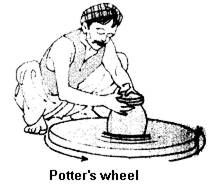
The motion in which a body moves along a circular path about a fixed point or axis without changing its position is called rotatory motion. Example: Potter's wheel and the spinning top.
Posted by Jacinta Cinta 6 years, 8 months ago
- 1 answers
Meghna Thapar 6 years ago
- Those changes in which no new substances are formed are called physical changes.
- Those changes in which new substances are formed are called chemical changes.
Posted by Vandana Rastogi 6 years, 8 months ago
- 1 answers
Meghna Thapar 6 years, 1 month ago
a. Aluminium nitrate - Al(NO3)3
b. Zinc chloride - ZnCl2
Posted by Priya Priyababu 6 years, 8 months ago
- 1 answers
Posted by Yash Singh 6 years, 8 months ago
- 1 answers
Yogita Ingle 6 years, 7 months ago
Heat is a form of energy which flows from a body at a higher temperature to a body at a lower temperature. It is the form of energy which causes in us the sensation of hotness or coldness. The amount of heat energy present in a body is the sum of the kinetic and potential energies of all its molecules.
Posted by Ritika Rajput 6 years, 8 months ago
- 1 answers
Yogita Ingle 6 years, 7 months ago
(i) When heat is supplied to a body its temperature rises: When a material body, solid, liquid or gas, is given heat energy, its temperature increases. When this hot body gives out heat energy its temperature decreases.
(ii) Heat energy may bring about chemical changes in a substance: When we heat substances, the heat energy breaks the original bonds between the elements and new products with new bonds are formed. For example, if marble (calcium carbonate) is heated, it turns into calcium oxide and carbon dioxide.
(iii) A body may catch fire if it is sufficiently heated and if it is flammable. The burning of substances in air or oxygen on heating, with the release of large amount of heat energy and light energy is called combustion. Substances that burn easily in air are called flammable or combustible substances, e.g., wood, coal, petrol, etc. Substances that do not burn easily in air are called incombustible substances, e.g., glass, stone, metals, etc.
(iv) On heating, change of state may occur, i.e. a solid may change into a liquid and a liquid may change into a gas. For example if ice (solid) is heated it changes its state to water (liquid) and if this water is further heated it becomes water vapour (gas). Conversely when a gas loses heat energy it changes into a liquid and on further cooling it freezes into a solid.
(v) When heat is supplied to a body it expands, i.e. its dimensions are changed. Material bodies expand on heating and contract on cooling. The process due to which a material in a given state of matter expands on the absorption of heat enegy is known as thermal expansion.
Posted by Pratik Bhamre 6 years, 8 months ago
- 2 answers
Srishti Kumari 6 years, 8 months ago
Yogita Ingle 6 years, 8 months ago
Stomach churns the food to mix digestive juices. The food in the stomach is churned into semi solid. The churned semi-solid food is called chime. Gastric juice is secreted from the wall of stomach and mixed with food. Gastric juice contains some enzymes and hydrochloric acid. The enzymes present in the gastric juices break down protein from food. The hydrochloric acid kills the harmful bacteria (if any) present in the food and helps the gastric enzymes to work.
Posted by Manash Mahalia 6 years, 8 months ago
- 1 answers
Grace Abraham 6 years, 8 months ago
Posted by Dolker Youngser 6 years, 8 months ago
- 1 answers
Yogita Ingle 6 years, 8 months ago
|
Saprotroph |
Parasite |
|
These are the organism that takes nutrients from the dead or decaying organic matter. |
These are the organism that grows and feeds on a living organism. |
|
Example: Fungi |
Example: Cuscuta |
Posted by Rakesh Singh 6 years, 8 months ago
- 1 answers
Aaryan Kashyap 6 years, 8 months ago
Posted by Hemant Mhatre 6 years, 8 months ago
- 2 answers
Sia ? 6 years, 8 months ago
Microorganisms are very small tiny organisms that are visible only under microscope. They are not visible to naked eye. They are both useful and harmful to us.
Sneha A. 6 years, 8 months ago
Posted by Abhishek Gupta 6 years, 8 months ago
- 2 answers
Tarush Rai 6 years, 8 months ago
Posted by Saksham Pal 6 years, 8 months ago
- 2 answers
Life'S Tune 6 years, 8 months ago

myCBSEguide
Trusted by 1 Crore+ Students

Test Generator
Create papers online. It's FREE.

CUET Mock Tests
75,000+ questions to practice only on myCBSEguide app

Vaarin Vora 6 years, 8 months ago
0Thank You