
Understanding the quadrilateral In that all …

CBSE, JEE, NEET, CUET
Question Bank, Mock Tests, Exam Papers
NCERT Solutions, Sample Papers, Notes, Videos
Posted by Aditya Thakur 5 years, 7 months ago
- 4 answers
Gaurav Seth 5 years, 7 months ago
- Parallelogram: A quadrilateral with each pair of opposite sides parallel.
(1) Opposite sides are equal.
(2) Opposite angles are equal.
(3) Diagonals bisect one another.
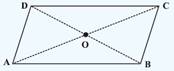
- Rhombus: A parallelogram with sides of equal length.
(1) All the properties of a parallelogram.
(2) Diagonals are perpendicular to each other.
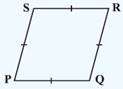
- Rectangle: A parallelogram with a right angle.
(1) All the properties of a parallelogram.
(2) Each of the angles is a right angle.
(3) Diagonals are equal. -
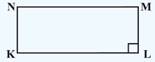
- Square: A rectangle with sides of equal length.
(1) All the properties of a parallelogram, rhombus and a rectangle.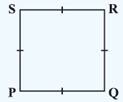
- Kite: A quadrilateral with exactly two pairs of equal consecutive sides
(1) The diagonals are perpendicular to one another
(2) One of the diagonals bisects the other.
(3) In the figure but
but  .
.
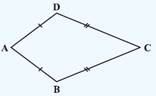
- Trapezium: A quadrilateral having exactly one pair of parallel sides.

- Diagonal: A simple closed curve made up of only line segments. A line segment connecting two non-consecutive vertices of a polygon is called diagonal.

- Convex: The measure of each angle is less than
 .
. - Concave: The measure of at least one angle is more than
- Quadrilateral: Polygon having four sides.
- Element of quadrilateral:
(i) Sides: Line segments joining the points.
(ii) Vertices: Point of intersection of two consecutive sides.
(iii) Opposite sides: Two sides of a quadrilateral having no common endpoint.
(iv) Opposite Angles: Two angles of a quadrilateral not having a common arm.
(v) Diagonals: Line segment obtained by joining the opposite vertices.
(vi) Adjacent Angles: Two angles of a quadrilateral having a common arm.
(vii) Adjacent Sides: Two sides of a quadrilateral having a common endpoint.
For ncert exercise copy the given link:
https://mycbseguide.com/blog/ncert-solutions-for-class-8-mathematics/
 Test
Test
Related Questions
Posted by Madhav Sharma 1 year, 1 month ago
- 2 answers
Posted by Ojus Dimen 1 year, 8 months ago
- 1 answers
Posted by Monika 8B 9 months ago
- 0 answers
Posted by Arya Jain 1 year, 8 months ago
- 0 answers
Posted by Jashan Preet 11 months, 1 week ago
- 1 answers
myCBSEguide
Trusted by 1 Crore+ Students

Test Generator
Create papers online. It's FREE.

CUET Mock Tests
75,000+ questions to practice only on myCBSEguide app

Ramji Goi 5 years, 7 months ago
0Thank You