<hr />
Functions of money. In general terms, main function of money in an economic system is “to facilitate the exchange of
goods and services and help in carrying out trade smoothly.” Its basic characteristic is general acceptability. Functions of
money are reflected in the well known following couplet:
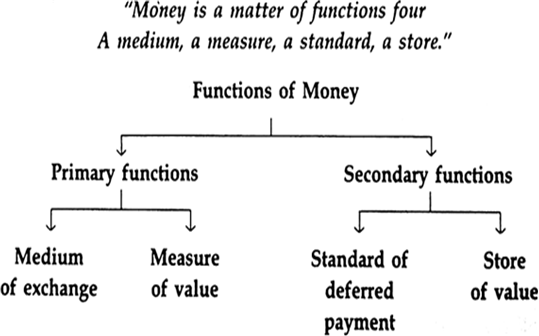
Thus conventionally money performs the following four functions (primary and secondary) each of which overcomes one
or the other difficulty of barter. Medium of exchange and measure of value are primary functions because they are of
prime importance whereas Standard of deferred payment and Store of value are called secondary functions as they are
derived from primary functions.
1. Money as the Medium of Exchange. Money came into use to remove the inconveniences of barter as money has
separated the act of purchase from sale. Medium of exchange is the basic or primary function of money. People exchange goods and services through the medium of money. Money acts as a medium of exchange or as a medium of
payments. Money by itself has no utility (except perhaps to the miser). It is only an intermediary. The use of money
facilitates exchange, exchange promotes specialisation, specialisation increases productivity and efficiency. A good
monetary system is, therefore, of immense utility to human society. Money is also called a bearer of options or
generalised purchasing power because it provides freedom of choice to buy things he wants most from those who offer
best bargain.
2. Money as a Unit of Account or Measure of Value. Money serves as unit of account or a measure of value. Money is
the measuring rod, i.e., it is the unit in which the values of other goods and services are measured in terms of money and
expressed accordingly. Different goods produced in the country are measured in different units, e.g., cloth in metres, milk
in litres, sugar in kilograms. Without a common unit of measure, exchange of goods and services becomes very difficult.
Values of all goods and services can be expressed in a single common unit called money. Again without a measure of
value, there can be no pricing process. Without a pricing process, organised marketing and production is not possible.
Thus, the use of money as a measure of value is the basis of specialised production. The measuring rod of money is also
indispensable to all forms of economic planning. Consumers compare the values of alternative purchases in terms of
money. Producers compare the relative costliness of the factors of production in terms of money and also plan their
output on the basis of the money yield. It is, therefore, highly important that the value of money should be stable.
3. Money as the Standard of Deferred Payments. Deferred payments are payments which are made sometime in future.
Debts are usually expressed in terms of the money of account. Loans are taken and repaid in terms of money. The use of
money as the standard of deferred or delayed payments immensely simplifies borrowing and lending operations because
money maintains a constant value through time. Thus money facilitates the formation of capital markets and the work of
financial intermediaries like Stock Exchange, Investment Trust and Banks. Money is the link which connects the values of
today with those of the future. It has become possible because value of money is stable and it has general acceptability
and durability.
4. Money as a Store of Value. Wealth can be stored in terms of money for future. It serves as a store value of goods in
liquid form. By spending it we can get any commodity in future. Keynes places great emphasis on this function of money.
Holding money is equivalent to keeping a reserve of liquid assets because it can be easily converted into other things.
People, therefore, normally wish to keep a part of their wealth in the form of money because savings (storing of value) in
terms of goods is very difficult. Wheat or any other product which will command a value cannot be stored for a long
period. The desire for money (cash) is known as liquidity preference. Clearly money is the best form of store of value.
Another Function ‘Liquidity of Money’ is added these days. Liquidity means ''convertibility in cash''. Thus the ability to
convert an asset into money/cash quickly and without loss of value is called liquidity of asset. An asset is highly liquid if it
can be exchanged promptly and without loss. Modern economists are laying stress on liquidity of money. Since by
definition, money is the most generally accepted commodity, it is also the most liquid of all resources. Possession of
money enables one to get hold of almost any commodity in any place and money never locks a buyer. It is this peculiarity
which distinguishes money from all other commodities. A preference for liquidity is preference for money.
Money, thus, acts as common medium of exchange, a common measure of value, as stamlard of deferred payments and
a store of value.


 Test
Test



Gaurav Seth 7 years, 2 months ago

<hr />Functions of money. In general terms, main function of money in an economic system is “to facilitate the exchange of
goods and services and help in carrying out trade smoothly.” Its basic characteristic is general acceptability. Functions of
money are reflected in the well known following couplet:
Thus conventionally money performs the following four functions (primary and secondary) each of which overcomes one
or the other difficulty of barter. Medium of exchange and measure of value are primary functions because they are of
prime importance whereas Standard of deferred payment and Store of value are called secondary functions as they are
derived from primary functions.
1. Money as the Medium of Exchange. Money came into use to remove the inconveniences of barter as money has
separated the act of purchase from sale. Medium of exchange is the basic or primary function of money. People exchange goods and services through the medium of money. Money acts as a medium of exchange or as a medium of
payments. Money by itself has no utility (except perhaps to the miser). It is only an intermediary. The use of money
facilitates exchange, exchange promotes specialisation, specialisation increases productivity and efficiency. A good
monetary system is, therefore, of immense utility to human society. Money is also called a bearer of options or
generalised purchasing power because it provides freedom of choice to buy things he wants most from those who offer
best bargain.
2. Money as a Unit of Account or Measure of Value. Money serves as unit of account or a measure of value. Money is
the measuring rod, i.e., it is the unit in which the values of other goods and services are measured in terms of money and
expressed accordingly. Different goods produced in the country are measured in different units, e.g., cloth in metres, milk
in litres, sugar in kilograms. Without a common unit of measure, exchange of goods and services becomes very difficult.
Values of all goods and services can be expressed in a single common unit called money. Again without a measure of
value, there can be no pricing process. Without a pricing process, organised marketing and production is not possible.
Thus, the use of money as a measure of value is the basis of specialised production. The measuring rod of money is also
indispensable to all forms of economic planning. Consumers compare the values of alternative purchases in terms of
money. Producers compare the relative costliness of the factors of production in terms of money and also plan their
output on the basis of the money yield. It is, therefore, highly important that the value of money should be stable.
3. Money as the Standard of Deferred Payments. Deferred payments are payments which are made sometime in future.
Debts are usually expressed in terms of the money of account. Loans are taken and repaid in terms of money. The use of
money as the standard of deferred or delayed payments immensely simplifies borrowing and lending operations because
money maintains a constant value through time. Thus money facilitates the formation of capital markets and the work of
financial intermediaries like Stock Exchange, Investment Trust and Banks. Money is the link which connects the values of
today with those of the future. It has become possible because value of money is stable and it has general acceptability
and durability.
4. Money as a Store of Value. Wealth can be stored in terms of money for future. It serves as a store value of goods in
liquid form. By spending it we can get any commodity in future. Keynes places great emphasis on this function of money.
Holding money is equivalent to keeping a reserve of liquid assets because it can be easily converted into other things.
People, therefore, normally wish to keep a part of their wealth in the form of money because savings (storing of value) in
terms of goods is very difficult. Wheat or any other product which will command a value cannot be stored for a long
period. The desire for money (cash) is known as liquidity preference. Clearly money is the best form of store of value.
Another Function ‘Liquidity of Money’ is added these days. Liquidity means ''convertibility in cash''. Thus the ability to
convert an asset into money/cash quickly and without loss of value is called liquidity of asset. An asset is highly liquid if it
can be exchanged promptly and without loss. Modern economists are laying stress on liquidity of money. Since by
definition, money is the most generally accepted commodity, it is also the most liquid of all resources. Possession of
money enables one to get hold of almost any commodity in any place and money never locks a buyer. It is this peculiarity
which distinguishes money from all other commodities. A preference for liquidity is preference for money.
Money, thus, acts as common medium of exchange, a common measure of value, as stamlard of deferred payments and
a store of value.
4Thank You