
Ask questions which are clear, concise and easy to understand.
Ask QuestionPosted by Alisha Saini 7 years ago
- 0 answers
Posted by Omkar Raushan 7 years ago
- 1 answers
Posted by Bharat Bothra 7 years ago
- 0 answers
Posted by Prinçe Çharming 7 years ago
- 1 answers
Suhani Rana? 7 years ago
Posted by Shriya Gautam 7 years ago
- 2 answers
Ram Kushwah 7 years ago
SLOPE हिंदी में 'झुकाब '
{tex}\begin{array}{l}\mathrm{In}\;\triangle\;\mathrm{OPQ}\\\tan\;\mathrm\alpha\;=\frac{\mathrm{OQ}}{\mathrm{OP}}=(\mathrm{this}\;\mathrm{value}\;\mathrm{is}\;0\;\mathrm{to}\;\;\mathrm{infinite}\;\mathrm{as}\;\mathrm{per}\;\mathrm{value}\;\mathrm{of}\;\mathrm{angle})\\\end{array}{/tex}
in physics and maths it is denoted by m
like y=mx +c
Posted by Swetha Swetha 7 years ago
- 0 answers
Posted by Mahesh Prajapati 7 years ago
- 1 answers
Anuj Sharma 7 years ago
Posted by Himanshu Mamgain 7 years ago
- 0 answers
Posted by Devendra Singh Yadav 7 years ago
- 1 answers
Posted by Khushboo Kumari 7 years ago
- 1 answers
Gaurav Seth 7 years ago
a)
By = 12 x 10-8 sin [1.20 x 10⁷ z + 3.60 x 10¹⁵t]
Now Bo = 12 x 10-8 T and c = 3 x 10 8 m/s
Since Eo = Bo c = 12 x 10-8 x 3 x 10 8 = 36 V/m
Energy Density = (1/2) ε0Eo2 = (1/2)(8.85 x 10-12) (36x36)
Energy Density = 5.74 x 10⁻¹⁵ J/m3
b)
By = 12 x 10-8 sin [1.20 x 10⁷ z + 3.60 x 10¹⁵t]
Now k= 1.2 x 10⁷ and w = 3.6 x 10¹⁵
Since, λ = (2π / k) and f = (w / 2π)
V = λ x f = kw = 3 x 10⁸ m/s (approx.)
Posted by Khushboo Kumari 7 years ago
- 1 answers
Gaurav Seth 7 years ago
What is the amount of work done in moving a point charge around a circular arc of radius r at the centre where another point charge is located?
<section data-topic-id="7363" id="topic"> <article data-post-id="8709" data-topic-id="7363" data-user-id="2" id="post_1">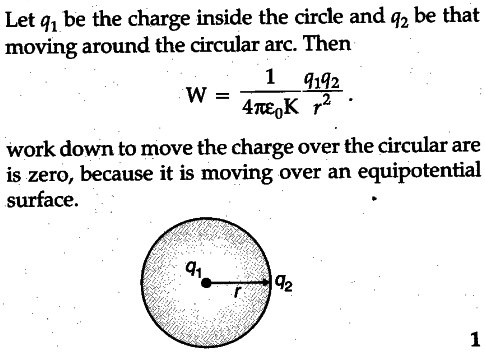
Posted by Raj Kumar 7 years ago
- 1 answers
Gaurav Seth 7 years ago
Energy band gap of the given photodiode, <i>E</i><i>g</i> = 2.8 eV
Wavelength, λ = 6000 nm = 6000 × 10−9 m
The energy of a signal is given by the relation:
<i>E</i> =
Where,
<i>h</i> = Planck’s constant
= 6.626 × 10⁻³⁴ Js
c = Speed of light
= 3 × 10⁸ m/s
<i>E</i>
= 3.313 × 10⁻²⁰ J
But 1.6 × 10⁻¹⁹ J = 1 eV
∴<i>E</i> = 3.313 × 10⁻²⁰ J

The energy of a signal of wavelength 6000 nm is 0.207 eV, which is less than 2.8 eV − the energy band gap of a photodiode. Hence, the photodiode cannot detect the signal.
Posted by Majid Majeed 7 years ago
- 0 answers
Posted by Sathvika Yenduri 7 years ago
- 1 answers
Kuldeep Singh 7 years ago
Posted by King Kumar 7 years ago
- 1 answers
Sinchana Malagond 7 years ago
Posted by Shirisa Singh 7 years ago
- 1 answers
Ranjeet Jacker 7 years ago
Posted by Kiran Dhaliwal 7 years ago
- 0 answers
Posted by Riya Yadav 7 years ago
- 1 answers
Gaurav Seth 7 years ago
(i) Difference: Field lines of a solenoid form continuous current loops, while in the case of an electric dipole the field lines begin from a positive charge and end on a negative charge or escape to infinity.
(ii) Two magnetic field lines cannot intersect because at the point of intersection, these will be two directions of magnetic field which is impossible.
Posted by Deepak Yadav 7 years ago
- 1 answers
Gaurav Seth 7 years ago
Q. To which part of the electromagnetic spectrum does a wave of frequency 5 x 10¹⁹ Hz belong?
<hr />A. The part of the electromagnetic spectrum is X-rays.
Posted by Shubkarman Badesha 7 years ago
- 1 answers
Tushar Goyal 7 years ago
Posted by Kumari Chandani 7 years ago
- 1 answers
Gaurav Seth 7 years ago
A virtual image is one that can be seen, and a real image can be projected. Although we usually use plane mirrors for the purpose of producting virtual images, that is being able to see an object in the mirror. It possible for a plane mirror to produce a real image in conjuction with another mirror. In order for a real image to be produced the mirror must bend the incident light rays in such a way that they converge to a single point. According to the law of reflection the angle of incidence of an incident ray equals the angle of reflection of a reflected ray, so parallel light rays are reflected back at the same angle producing a virtual image of a real object.
In order for a plane mirror to produce a real image ir must be reflecting the virtual image produced by another mirror or a lens. In this context we call the virtual image a virtual object. If the light rays coming from the virtual object converge at a point behind the plane mirror the reflected rays will converge in front of the mirror, forming a real image.
Posted by Ritu Raj 7 years ago
- 1 answers

myCBSEguide
Trusted by 1 Crore+ Students

Test Generator
Create papers online. It's FREE.

CUET Mock Tests
75,000+ questions to practice only on myCBSEguide app
