
Ask questions which are clear, concise and easy to understand.
Ask QuestionPosted by Arunima Devi 6 years, 6 months ago
- 4 answers
Priya Dharshini ? 6 years, 6 months ago
Khuskaran Sidhu 6 years, 6 months ago
Posted by Hemant Thakur 6 years, 6 months ago
- 2 answers
Uday Mann 6 years, 6 months ago
Posted by Divyansh Jain 6 years, 6 months ago
- 12 answers
K@Łp@N@ $Øđh!?? 6 years, 6 months ago
Priya Dharshini ? 6 years, 6 months ago
Nikola Tesla Albet 6 years, 6 months ago
Ankit Dubey 6 years, 6 months ago
Awdheshkumar Shing 6 years, 6 months ago
Posted by Shudhanshu Ranjan 6 years, 6 months ago
- 3 answers
K@Łp@N@ $Øđh!?? 6 years, 6 months ago
Harshita Sen 6 years, 6 months ago
Soumya Kumari 6 years, 6 months ago
Posted by Shubham Pandey 6 years, 6 months ago
- 2 answers
Gaurav Seth 6 years, 6 months ago
Assume that one cup holds 250 ml of water.
250 ml = 250 gram of water since its density is 1 in cgs.
number of moles of water in 250 gram = 250 / molar weight of water
n = 250/18 = 13.88 moles
1 mol has 6.022 x 10²³ number of water molecules
So 250 g water will have 13.88 x 6.022 x 1023 number of H2O molecules
= 8.36 x 1024 number of molecules
One molecule of water has 2 hydrogen atoms (2 protons) and one oxygen atom (8 protons).
Total protons = 10 = total electrons (since it is neutral)
So 250 g water will have 10 x 8.36 x 1024 = 8.36 x 1025 protons.
charge of proton = 1.6 x 10⁻¹⁹ C
So total positive charge of 250 g water = 1.6 x 10-19 x 8.36 x 1025 = 13.37 x 10⁶ C
which is equal to 13.3 MC (mega coulomb)
So one cup of water has 13.3 mega coulomb positive and negative charge, so that the overall charge is zero.
Posted by Anushka Sen?? 6 years, 6 months ago
- 1 answers
Sia ? 6 years, 6 months ago
You can check the syllabus here : https://mycbseguide.com/cbse-syllabus.html
Posted by Anshika Mishra 6 years, 6 months ago
- 2 answers
Posted by Parth Agrawal 6 years, 6 months ago
- 2 answers
꧁≪Mämƭå ℭℏᑌĎℎàℜÿ? 6 years, 6 months ago
Posted by Anil Kumr 6 years, 6 months ago
- 2 answers
Jk Verma 6 years, 6 months ago
Posted by Angel Shikha Xalxo 6 years, 6 months ago
- 1 answers
Rhydian Morris 5 years, 2 months ago
Posted by Anil Pal 6 years, 6 months ago
- 1 answers
Posted by Riya Tiwari 6 years, 6 months ago
- 0 answers
Posted by Sakshi Kumari Kumari 6 years, 6 months ago
- 0 answers
Posted by Sudiptyo Banik 6 years, 6 months ago
- 1 answers
Yogita Ingle 6 years, 6 months ago
Average life or mean life (τ) of a radioactive element is the ratio of total life time of all the atoms and total number of atoms present initially in the sample.
Relation between average life and decay constant τ = 1 / λ
Relation between half-life and average life τ = 1.44 T
The number of atoms left undecayed after n half-lifes is given by
N = No (1 / 2)n = No (1 / 2) t/T
where, n = t / T, here t = total time.
Posted by N.K Gaming 6 years, 6 months ago
- 1 answers
Gursharn Kaur 6 years, 6 months ago
Posted by Shoyab St 6 years, 6 months ago
- 2 answers
Posted by Harman Thind 6 years, 6 months ago
- 2 answers
Gursharn Kaur 6 years, 6 months ago
Hritwik Raj 6 years, 6 months ago
Posted by Satyam Baghel 6 years, 6 months ago
- 3 answers
Sia ? 6 years, 6 months ago
Lenz's law states that the direction of induced emf is such, that it produces a current which opposes the change in magnetic flux that produced it.
Mathematically,
e = -N{tex}\frac{d\varphi}{dt}{/tex}
Suppose a magnet is moved towards a closed coil. The direction of induced emf in it by Lenz’s law opposes its inward motion. As a result, the magnet will be moved towards the coil against this opposing force. In such a case work will have to be done. This work is converted into electrical energy in the form of induced emf. Thus, Lenz’s law is in accordance with the law of conservation of energy.
K@Łp@N@ $Øđh!?? 6 years, 6 months ago
K@Łp@N@ $Øđh!?? 6 years, 6 months ago
Posted by Gunjan Sharma 6 years, 6 months ago
- 2 answers
Sia ? 6 years, 6 months ago
You can check marking scheme in the syllabus here : https://mycbseguide.com/cbse-syllabus.html
Posted by Md Umar 6 years, 6 months ago
- 1 answers
Posted by Debu Sahu 6 years, 6 months ago
- 3 answers
Navneet . 6 years, 6 months ago
Posted by Řøhăň Řąjpůť ✌️✊ 6 years, 6 months ago
- 32 answers
꧁≪Mämƭå ℭℏᑌĎℎàℜÿ? 6 years, 6 months ago
Amol Gùpta 6 years, 6 months ago
Srishti Choudhary ✍⏳ 6 years, 6 months ago
Srishti Choudhary ✍⏳ 6 years, 6 months ago
Amol Gùpta 6 years, 6 months ago
Srishti Choudhary ✍⏳ 6 years, 6 months ago
Řøhăň Řąjpůť ✌️✊ 6 years, 6 months ago
Srishti Choudhary ✍⏳ 6 years, 6 months ago
Řøhăň Řąjpůť ✌️✊ 6 years, 6 months ago
Mukan Jangra????? 6 years, 6 months ago
Posted by Chandani Ali 6 years, 6 months ago
- 1 answers
Posted by Ajit Patel 6 years, 6 months ago
- 1 answers
Sia ? 6 years, 6 months ago
Two co-axial cylindrical shells A and B of radii a and b are possessed by a cylindrical capacitor. Assume l be length of the cylindrical shell. Due to the introduction of +q charge on the inner cylindrical shell A, equal but opposite charge -q is induced on the inner surface of the outer cylindrical shell B. The induced charge +q on its outer surface will flow to earth if the shell B is earthed.
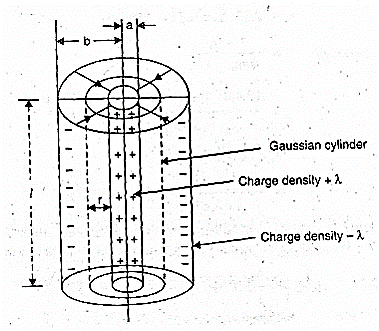
The capacitance of the cylindrical capacitor is given as follows if V is potential difference between the cylindrical shell A and B.
{tex}C = \frac{q}{V}{/tex}
By applying the Gaussian a theorem, we first need to find electric field E in the space between two shells to find out potential difference between the cylindrical shells A and B . Let a cylinder of radius r (such that b > r > a) and length l as the Gauss surface. Charge enclosed by the Gaussian surface is {tex}\lambda{/tex}1 and if {tex}\lambda{/tex} is charge per unit length on the shell A.
The electric flux will cross through only curved surface of the cylinder (Gauss surface). As the area of curved surface of cylinder is {tex}2\pi rl{/tex}, we have by Gaussian theorem.
{tex}\oint E \cdot ds = \frac{q}{{{\varepsilon _0}}}{/tex}
{tex}E \cdot 2\pi rl = \frac{{\lambda l}}{{{\varepsilon _0}}}{/tex}
{tex}E = \frac{\lambda }{{2\pi {\varepsilon _0}r}}{/tex}
The field lines are radial and normal to the axis of charged cylinder.
Posted by Shruti Manek 6 years, 6 months ago
- 2 answers
Posted by Navjot Sandhu 6 years, 6 months ago
- 1 answers

myCBSEguide
Trusted by 1 Crore+ Students

Test Generator
Create papers online. It's FREE.

CUET Mock Tests
75,000+ questions to practice only on myCBSEguide app

Kiran??? Gautam 6 years, 6 months ago
1Thank You