
Ask questions which are clear, concise and easy to understand.
Ask QuestionPosted by Parmod Hooda 6 years, 5 months ago
- 1 answers
Posted by Parmod Hooda 6 years, 5 months ago
- 1 answers
Sia ? 6 years, 5 months ago
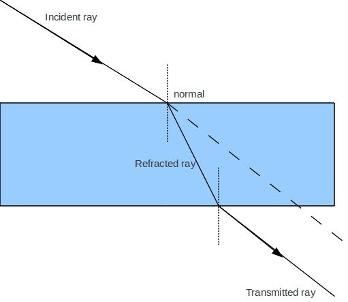
When a ray of light is incident on a rectangular glass slab, it gets refracted. After the refraction it comes out from glass slab. It gets a interface of a glass and the air (another medium). So it deviates away from normal. Since, the glass slab is rectangular and both sides of the glass slab have the same medium. The light refracts in such a way that incident and emergent rays are parallel.
Posted by Akash Akashrajput 6 years, 5 months ago
- 1 answers
Posted by Sahij Preet 6 years, 5 months ago
- 1 answers
Řøhăň Řąjpůť ✌️✊ 6 years, 5 months ago
Posted by Sakshi Singh 6 years, 5 months ago
- 2 answers
Řøhăň Řąjpůť ✌️✊ 6 years, 5 months ago
Posted by White Rat Hackers ? Ceo 6 years, 5 months ago
- 3 answers
Řøhăň Řąjpůť ✌️✊ 6 years, 5 months ago
꧁≪Mämƭå ℭℏᑌĎℎàℜÿ? 6 years, 5 months ago
Řøhăň Řąjpůť ✌️✊ 6 years, 5 months ago
Posted by Nona Shrivastav 6 years, 5 months ago
- 2 answers
Gaurav Seth 6 years, 5 months ago
Eddy currents are the currents induced in the body of a conductor due to change in magnetic flux linked with the conductor.
Applications of eddy currents are:
a) Electromagnetic damping - Designing dead beat galvanometer
b) Induction furnace
c) Magnetic brakes
d) Electric power meters
e) Induction motor
To minimise eddy currents, the metal core to be used in an appliances like motor is taken in the form of thin sheets. Such a core is called laminated core. The planes of these sheets are arranged parallel to the magnetic field so that they cut across eddy current paths.Large resistance between the thin sheets confines the eddy current to the individual sheets. Hence eddy currents can be reduced to a large extent.
Posted by Sunil Prasad 6 years, 5 months ago
- 3 answers
Tripti Rawat 6 years, 5 months ago
We know that volume V of gas is
- directly proportional to the quantity of gas i.e., number N of molecules contained in the gas. Mathematically,
{tex}V \propto N{/tex} (if P and T are constant) - inversely proportional to pressure P. Mathematically,
{tex}V \propto \frac{1}{P}{/tex} (if N and T are constant) - directly proportional to temperature T. Mathematically,
{tex}V \propto T{/tex} (if N and P are constant)
Combining all these, we have {tex}V \propto \frac{N T}{P}{/tex}
{tex}\therefore{/tex} {tex}\frac{P V}{N T}{/tex} = constant = kB = Boltzmann's constant
Generally, N is written as N = {tex}\mu N_A{/tex}, where NA is the number of molecules in one mole of gas and {tex}\mu{/tex} = quantity of gas in moles.
Hence, the above relation becomes
{tex}\frac{P V}{T}=N k_{B}{/tex} = {tex}\mu N_{A} k_{B}=\mu R{/tex}
Here R = {tex}\mu \cdot N_{A}{/tex} = gas constant for one mole of gas
or {tex}P V=\mu R T{/tex}
It is the ideal gas equation or equation of state for an ideal gas.
Yogita Ingle 6 years, 5 months ago
Ideal Gas Equation
- The gases following Boyle’s law, Charles’law and Avogadro law firmly are termed as anideal gas.
- From Boyle’s law we have V ∝ 1/p (Constant T, n)
- From Charles’ law we have V ∝ T (Constant p, n)
- From Avogadro’s law we have V ∝ n (Constant T, n)
- Combining them we get, V ∝ nT/p
- or V = nRT/p
pV = nRT ………………………… (IDEAL GAS EQUATION)
R =pV/nT
R= Gas Constant. It is same for all gases.
Posted by Nishant Sharma 6 years, 5 months ago
- 2 answers
Posted by Amanpreet Kaur Randhawa 6 years, 5 months ago
- 1 answers
Daksh Singh 6 years, 5 months ago
Posted by Aga Iqra 6 years, 5 months ago
- 1 answers
Jk Verma 6 years, 5 months ago
Posted by Ajay Singh Ajay Singh 6 years, 5 months ago
- 7 answers
Abhay Yadav 6 years, 5 months ago
Naitik Tayal 6 years, 5 months ago
Jk Verma 6 years, 5 months ago
S.... ????☺ 6 years, 5 months ago
Posted by Jk Verma 6 years, 5 months ago
- 0 answers
Posted by Surbhi Dabas 6 years, 5 months ago
- 1 answers
Posted by Hardik Singh 6 years, 5 months ago
- 1 answers
Pragati Saini 6 years, 5 months ago
Posted by Ilma Ansari 6 years, 5 months ago
- 2 answers
Pragati Saini 6 years, 5 months ago
Pragati Saini 6 years, 5 months ago
Posted by Shruti Gupta 6 years, 5 months ago
- 6 answers
Ɽøⱨł₮ ₲Ʉ₱₮₳ 6 years, 5 months ago
Posted by Yogesh Baghel 6 years, 5 months ago
- 1 answers
Sia ? 6 years, 5 months ago
Voltmeter is always connected in parallel to a circuit. Since Galvanometer is a very sensitive instrument, therefore it can not measure high potential difference. In order to convert a Galvanometer into voltmeter, a very high resistance known as "series resistance" is connected in series with the galvanometer.
Posted by Bina Devi 6 years, 5 months ago
- 2 answers
Posted by Manish Kumar 6 years, 5 months ago
- 3 answers
Posted by Ashish Dabas 6 years, 5 months ago
- 3 answers
Sia ? 6 years, 5 months ago
You can check formulaes here: https://mycbseguide.com/cbse-revision-notes.html
Posted by Aviral Saxena 6 years, 5 months ago
- 1 answers
Sia ? 6 years, 5 months ago
Magnetic field strength, B = 100 G = 100 × 10 - 4 T
Number of turns per unit length, n = 1000 turns m - 1
Current flowing in the coil, I = 15 A
Permeability of free space, {tex}\mu_{0}=4 \pi \times 10^{-7} T m A^{-1}{/tex}
Magnetic field is given by the relation, {tex}B=\mu_{0} n I{/tex}
{tex}\therefore n I=\frac{B}{\mu_{0}}{/tex}
{tex}=\frac{100 \times 10^{-4}}{4 \pi \times 10^{-7}}=7957.74{/tex}
{tex}\approx 8000 \mathrm{A} / \mathrm{m}{/tex}
If the length of the coil is taken as 50 cm, radius 4 cm, number of turns 400, and current 10 A, then these values are not unique for the given purpose. There is always a possibility of some adjustments with limits.
Posted by Dileep Maurya 6 years, 5 months ago
- 1 answers
Sia ? 6 years, 5 months ago
Where, the speed of conductor (PQ), v = -dx/dt and is the formula of induced emf. This induced emf due to the motion of an electric conductor in the presence of the magnetic field is called motional emf. SI unit is volts.
Posted by Sameera Kamboj 6 years, 5 months ago
- 2 answers
Vivekanand Yadav 6 years, 5 months ago
Posted by Sanjay Choudary 6 years, 5 months ago
- 2 answers
Sia ? 6 years, 5 months ago
Apply for Jee mains first and after clearing mains you will be qualified for advance.
Posted by Jk Verma 6 years, 5 months ago
- 1 answers
Sia ? 6 years, 5 months ago
No, the permeability of ferromagnetic material is not independent of the magnetic fields, Its value is greater for lower fields.
Posted by Demon King 6 years, 5 months ago
- 1 answers
Sia ? 6 years, 5 months ago
A solenoid is a long circular coil containing a large number of close turns of insulated copper wire. When a electric current is passed through the solenoid, it produces magnetic field around it as shown in fig. Magnetic field produced by a current carrying solenoid is similar to the magnetic field produced by a bar magnet. As is clear from the figure, the lines enter from the left side and leave out from the right side. If we look from left side, the current appears to be passing in the coil in clockwise direction and hence it acts as a south pole according to clock rule. If the coil is viewed from right side, the current appears to be in anticlockwise direction. Hence, left-hand side face behaves as if this were a north pole. If the coil is left free, it will point South and North.
Since the current in the turns of the solenoid flows in the same direction, the magnetic field produced by each turn of the solenoid adds up, giving a very strong resultant field inside the solenoid. Hence, a solenoid may be used in making electromagnets. 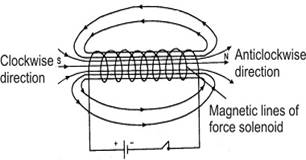
Posted by Prabhjot Kaur 6 years, 5 months ago
- 3 answers
Ďãřşháñăã Yadav ? ? ? 6 years, 5 months ago
Ďãřşháñăã Yadav ? ? ? 6 years, 5 months ago
Ďãřşháñăã Yadav ? ? ? 6 years, 5 months ago

myCBSEguide
Trusted by 1 Crore+ Students

Test Generator
Create papers online. It's FREE.

CUET Mock Tests
75,000+ questions to practice only on myCBSEguide app

Sajid Ali 6 years, 5 months ago
0Thank You