
Ask questions which are clear, concise and easy to understand.
Ask QuestionPosted by Rohit Singh 8 years, 1 month ago
- 1 answers
Posted by Shivani Rana 8 years, 1 month ago
- 0 answers
Posted by Sanjeev Kumar 8 years, 1 month ago
- 0 answers
Posted by Nishi Singh 8 years, 1 month ago
- 0 answers
Posted by Resham Dhawas 8 years, 1 month ago
- 1 answers
Posted by Jagmeet Sandhu 8 years, 1 month ago
- 2 answers
Anchal Negi 8 years, 1 month ago
Posted by Tejprakash Patwa 8 years, 1 month ago
- 1 answers
Posted by Sudha Kashyap 8 years, 1 month ago
- 0 answers
Posted by Abhay Gautam 6 years, 9 months ago
- 1 answers
Sia ? 6 years, 9 months ago
We have
a = 10, d = (7-10) = -3, l= -62 and n = 11.
{tex}\therefore{/tex}11th term from the end = [l - (n -1) {tex}\times{/tex} d]
= {-62 - (11 -1) {tex}\times{/tex} (-3)}
= (-62 + 30) = -32.
Hence, the 11th term from the end of the given AP is -32.
Posted by Anjali Rawat 8 years, 1 month ago
- 1 answers
Posted by Ankita Anki 8 years, 1 month ago
- 1 answers
Posted by Lukkar Ropuk 8 years, 1 month ago
- 1 answers
Sia ? 6 years, 9 months ago
Get NCERT solutions here : <a href="https://mycbseguide.com/ncert-solutions.html">https://mycbseguide.com/ncert-solutions.html</a>
Posted by Vineet Atrri 6 years, 9 months ago
- 1 answers
Sia ? 6 years, 9 months ago
Let ABC be the given isosceles triangle, with AB = AC.
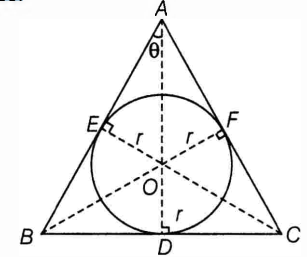
Clearly, {tex}O D \perp B C , O F \perp A C , O E \perp A B{/tex}
[{tex}\because{/tex}radius is perpendicular to the tangent at the point of contact]
and BD=BE, CD=CF, AE=AF
[{tex}\because{/tex}tangents from an external point to a circle are equal in length]
Since, AD is an altitude of isosceles {tex}\Delta{/tex}ABC,
Thus, BD=CD
[{tex}\because{/tex}in an isosceles triangle, altitude from common vertex of equal sides bisect the third side]
Thus,BD = BE = CF = CD
[{tex}\because{/tex}BE=BD and CD=CF]
Now, perimeter (P) of {tex}\Delta{/tex}ABC=AB+BC+AC
=AE+BE+BD+DC+AF+FC
=(AE+AF) + (BE+BD+DC+FC)
=2AE+4BD............(i)
Consider {tex}\Delta O E A{/tex}, we have ,
{tex}A E = \frac { O E } { \tan \theta } = \frac { r } { \tan \theta } \text { and } O A = \frac { r } { \sin \theta }{/tex}
and in {tex}\Delta A D B{/tex} ,we have BD=AD {tex}\tan \theta{/tex}
{tex}= ( A O + O D ) \tan \theta{/tex}
{tex}= \left( \frac { r } { \sin \theta } + r \right) \tan \theta{/tex}
Now, {tex}P = 2 \frac { r } { \tan \theta } + 4 \cdot \left( \frac { r } { \sin \theta } + r \right) \tan \theta{/tex}
[from Eq. (i)]
{tex}\Rightarrow P ( \theta ) = r ( 2 \cot \theta + 4 \sec \theta + 4 \tan \theta ){/tex}....(ii)
Therefore,on differentiating both sides w.r.t. {tex}\theta{/tex}, we get,
{tex}P ^ { \prime } ( \theta ) = r \left( - 2 cosec ^ { 2 } \theta + 4 \sec \theta \tan \theta + 4 \sec ^ { 2 } \theta \right){/tex}.....(iii)
{tex}= r \left( \frac { - 2 } { \sin ^ { 2 } \theta } + \frac { 4 \sin \theta } { \cos ^ { 2 } \theta } + \frac { 4 } { \cos ^ { 2 } \theta } \right){/tex}
{tex}= r \left( \frac { - 2 \cos ^ { 2 } \theta + 4 \sin ^ { 3 } \theta + 4 \sin ^ { 2 } \theta } { \sin ^ { 2 } \theta \cos ^ { 2 } \theta } \right){/tex}
Now, put {tex}P ^ { \prime } ( \theta ) = 0{/tex}
{tex}\Rightarrow \quad - 2 \cos ^ { 2 } \theta + 4 \sin ^ { 3 } \theta + 4 \sin ^ { 2 } \theta = 0{/tex}
{tex}\Rightarrow - 2 \left( 1 - \sin ^ { 2 } \theta \right) + 4 \sin ^ { 3 } \theta + 4 \sin ^ { 2 } \theta = 0{/tex}
{tex}\Rightarrow - 2 + 2 \sin ^ { 2 } \theta + 4 \sin ^ { 3 } \theta + 4 \sin ^ { 2 } \theta = 0{/tex}
{tex}\Rightarrow \quad 2 \sin ^ { 3 } \theta + 3 \sin ^ { 2 } \theta - 1 = 0{/tex}
{tex}\Rightarrow \quad ( \sin \theta + 1 ) \left( 2 \sin ^ { 2 } \theta + \sin \theta - 1 \right) = 0{/tex}
{tex}\Rightarrow \sin \theta = - 1 \text { or } 2 \sin ^ { 2 } \theta + \sin \theta - 1 = 0{/tex}
{tex}\Rightarrow \quad 2 \sin ^ { 2 } \theta + \sin \theta - 1 = 0{/tex}
{tex}\left[ \because \sin \theta \neq - 1 , \text { as } \theta \text { can't be more than } 90 ^ { \circ } \right]{/tex}
{tex}\Rightarrow \quad ( 2 \sin \theta - 1 ) ( \sin \theta + 1 ) = 0{/tex}
{tex}\Rightarrow \quad \sin \theta = \frac { 1 } { 2 }{/tex} {tex}[ \because \sin \theta \neq - 1 ]{/tex}
{tex}\Rightarrow{/tex} {tex}\theta = \frac { \pi } { 6 }{/tex}
Therefore,On differentiating both sides of Eq. (iii) w.r.t. {tex}\theta{/tex}
we get
{tex}P ^ { \prime \prime } ( \theta ) = r \left( 4 cosec ^ { 2 } \theta \cot \theta + 4 \sec ^ { 3 } \theta\right.{/tex}{tex}+ 4 \sec \theta \tan ^ { 2 } \theta + 8 \sec ^ { 2 } \theta \tan \theta ){/tex}
{tex}\Rightarrow \quad P ^ { \prime \prime } \left( \frac { \pi } { 6 } \right) > 0{/tex}
Therefore, {tex}P ( \theta ){/tex}is minimum, when {tex}\theta = \frac { \pi } { 6 }{/tex}
{tex}P(\frac{π}{6})= r \left[ 2 \cot \left( \frac { \pi } { 6 } \right) + 4 \sec \left( \frac { \pi } { 6 } \right) + 4 \tan \left( \frac { \pi } { 6 } \right) \right]{/tex}
{tex}= r \left( 2 \sqrt { 3 } + 4 \cdot \frac { 2 } { \sqrt { 3 } } + 4 \cdot \frac { 1 } { \sqrt { 3 } } \right){/tex}
{tex}= r \left( \frac { 6 + 8 + 4 } { \sqrt { 3 } } \right) = \frac { 18 } { \sqrt { 3 } } r = 6 \sqrt { 3 } r{/tex}
Posted by Gaurab Kumar 8 years, 1 month ago
- 2 answers
Posted by Akki Singh 8 years, 1 month ago
- 0 answers
Posted by Arun Patel 8 years, 1 month ago
- 0 answers
Posted by Shivam Mittal 8 years, 1 month ago
- 3 answers
Posted by Astha Dhiman 8 years, 1 month ago
- 2 answers
Daksh Chilkoti 8 years, 1 month ago
Posted by Anshul Sharma 8 years, 1 month ago
- 0 answers
Posted by Arun Sharma 8 years, 1 month ago
- 0 answers
Posted by Mohammad Talha 8 years, 1 month ago
- 4 answers
Posted by Ak Af 8 years, 1 month ago
- 0 answers
Posted by Avatar Gupta 8 years, 1 month ago
- 0 answers
Posted by Albert Eyestyne 8 years, 1 month ago
- 0 answers
Posted by Chahat Arora 8 years, 1 month ago
- 0 answers

myCBSEguide
Trusted by 1 Crore+ Students

Test Generator
Create papers online. It's FREE.

CUET Mock Tests
75,000+ questions to practice only on myCBSEguide app

Mimansha Rawat 8 years, 1 month ago
0Thank You