
Ask questions which are clear, concise and easy to understand.
Ask QuestionPosted by Prince Singh 7 years, 2 months ago
- 2 answers
Paramveer Singh 7 years, 2 months ago
Harman Singh 7 years, 2 months ago
Posted by Nitik Soni 7 years, 2 months ago
- 1 answers
Madhu Singh 7 years, 2 months ago
Posted by Sukhman Kaur 7 years, 2 months ago
- 0 answers
Posted by Jay Pratap Singh 7 years, 2 months ago
- 0 answers
Posted by Vijethgowda Vijeth 7 years, 2 months ago
- 1 answers
Yogita Ingle 7 years, 2 months ago
- Real GDP is the total value of goods and services calculated at ‘constant’ or base price level. Nominal . GDP is the total value of goods and services calculated at ‘current’ price level.
- Real GDP is a better index of welfare of the people. When Real GDP rises, flow of goods and services tends to rise, other factors remaining constant. This means greater availability of goods per person, implying higher level of welfare. Also real GDP facilitates periodic comparison of physical output.
Posted by Namgyal Lepcha 7 years, 2 months ago
- 1 answers
Posted by H!Mαη$Hμ Ұαδαυ ✔️ 7 years, 2 months ago
- 3 answers
Harvinder Ahlawat 7 years, 2 months ago
Tanaya Mandal 7 years, 2 months ago
Princi Singh 7 years, 2 months ago
Posted by Dayaram Saharan 7 years, 2 months ago
- 1 answers
Gaurav Seth 7 years, 2 months ago
Economics is a science that studies human behavior which aims at allocation of scarce resources in such a way that consumer can maximise their satisfaction, producers can maximise their profits and society can maximise its social welfare. It is about making choice in the presence of scarcity.
-
<hr />Central Problems of an Economy
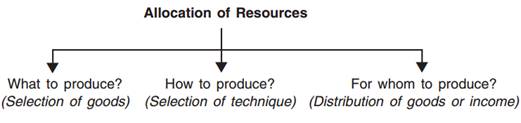
- The central problem of “what to produce” refers to which goods and services will be produced in an economy and in what quantities. An economy has to produce those goods and services where there will be maximum social utility. This problem is studies under price theory.The central problem of “how to produce” refers to what technique of production (i.e.., labour intensive or capital intensive) should be used to produce goods. An economy has to select that technique which maximizes the output at minimum cost. This problem is studies under theory of production.The central problem “for whom to produce” is related to distribution of produced goods and services(i.e.., income and wealth) among factors of production in the form of rent, wages, interest and profit.This is explained under the theory of distribution.
Posted by Antima Agarwal 7 years, 2 months ago
- 4 answers
Antima Agarwal 7 years, 2 months ago
Antima Agarwal 7 years, 2 months ago
Tanaya Mandal 7 years, 2 months ago
Prerna Goyal 7 years, 2 months ago
Posted by Nihal Bhut 7 years, 2 months ago
- 1 answers
Princi Singh 7 years, 2 months ago
Posted by Jyoti Sharma 7 years, 2 months ago
- 0 answers
Posted by Tanaya Mandal 7 years, 2 months ago
- 2 answers
Princi Singh 7 years, 2 months ago
Priyanka Sachdeva 7 years, 2 months ago
Posted by Aradhya Bohre 7 years, 2 months ago
- 2 answers
Harvinder Ahlawat 7 years, 2 months ago
Tanaya Mandal 7 years, 2 months ago
Posted by Fardeen Khan 7 years, 2 months ago
- 1 answers
H!Mαη$Hμ Ұαδαυ ✔️ 7 years, 2 months ago
Posted by Aditya Singh 7 years, 2 months ago
- 1 answers
Gaurav Seth 7 years, 2 months ago
With a simultaneous increase in both the demand and supply, it is possible that the equilibrium market price may not change. This happens under a situation where both demand and supply increase in the same proportion . In such a case, only the equilibrium quantity rises while, the equilibrium price remains unchanged.
_html_m231dc6f3.jpg)
In the above diagram, decrease in demand=decrease in supply. Equilibrium pint shifts from E1 to E2, but price remains constant.
Posted by Aditya Singh 7 years, 2 months ago
- 1 answers
Yogita Ingle 7 years, 2 months ago
Inflationary Gap-Inflationary gap is the excess of AD over and above its level required to maintain full employment equilibrium in the economy. Inflationary gap generates extra pressure on the existing flow of goods and services at the level of full employment. Accordingly, prices tend to rise. The output will not increase.
Repo rate is the rate at which the Central Bank lends money to the Commercial Banks. To correct the situation of Inflationary Cap, Repo Rate is increased. As a follow-up action, the Commercial banks raise the market rate of interest (the rate at which the Commercial Banks lends money to the consumers and the investors). This reduces demand for credit. Consequently, consumption expenditure and investment expenditure are reduced. Implying a reduction in Aggregate Demand, as required to correct Inflationary Gap.
Posted by Aditya Singh 7 years, 2 months ago
- 1 answers
Posted by Aditya Singh 7 years, 2 months ago
- 1 answers
Posted by Nav Dhillon 7 years, 2 months ago
- 4 answers
Madhu Singh 7 years, 2 months ago
Babita Sharma 7 years, 2 months ago
Posted by Pawan Grover 7 years, 2 months ago
- 3 answers
Prerna Goyal 7 years, 2 months ago
Posted by Atul Kr 7 years, 2 months ago
- 2 answers
Nav Dhillon 7 years, 2 months ago
Posted by Kaju Badam 7 years, 2 months ago
- 3 answers
Madan Batra 7 years, 2 months ago
Posted by Lovely Tiwari 7 years, 2 months ago
- 4 answers
Madan Batra 7 years, 2 months ago
Posted by Kunal Gautam 7 years, 2 months ago
- 2 answers
Ritu Manon 7 years, 2 months ago
Posted by Akash Singh 7 years, 2 months ago
- 4 answers
Babita Sharma 7 years, 2 months ago
Posted by Babita Sharma 7 years, 2 months ago
- 1 answers
Madan Batra 7 years, 2 months ago
Posted by Sagar Jotwani 7 years, 2 months ago
- 1 answers
Simran Khan 7 years, 2 months ago
Posted by Harneet Kaur 7 years, 2 months ago
- 1 answers
Riya Jain 7 years, 2 months ago

myCBSEguide
Trusted by 1 Crore+ Students

Test Generator
Create papers online. It's FREE.

CUET Mock Tests
75,000+ questions to practice only on myCBSEguide app

Riya Jain 7 years, 2 months ago
1Thank You