
Ask questions which are clear, concise and easy to understand.
Ask QuestionPosted by Prajjwal Patel 5 years, 5 months ago
- 5 answers
? Yang ? 5 years, 5 months ago
Posted by Harshil Patel 5 years, 5 months ago
- 0 answers
Posted by Chemistry Technical 5 years, 5 months ago
- 1 answers
Posted by Karla B 5 years, 5 months ago
- 1 answers
? Yang ? 5 years, 5 months ago
Posted by Shreyansh Yadav 5 years, 5 months ago
- 0 answers
Posted by Anushka Shrivastava 5 years, 5 months ago
- 2 answers
Divyansh Chauhan 5 years, 5 months ago
Maneesh Kumar 5 years, 5 months ago
Posted by Sumit Kumar 5 years, 5 months ago
- 2 answers
Posted by Sumit Kumar 5 years, 5 months ago
- 2 answers
Yogita Ingle 5 years, 5 months ago
Frenkel defect:- If an ion is missing, from its lattice site and is occupies the interstitial site, electrical neutrality as well as Stoichiometry of the compound are maintained this type of defect is called frenkel defect.
Ankit Kumar 5 years, 5 months ago
Posted by Ashish Gupta 5 years, 5 months ago
- 1 answers
Gaurav Seth 5 years, 5 months ago
tetramethylethylene
- Molecular FormulaC6H12
- Average mass84.160 Da
- Monoisotopic mass84.093903 Da
Posted by Ashutosh Bind 5 years, 5 months ago
- 1 answers
Posted by Nisha Yadav 5 years, 5 months ago
- 1 answers
Gaurav Seth 5 years, 5 months ago
Henry’s law states that the solubility of a gas in a liquid is directly proportional to pressure of the gas; temperature constant.
Mathematically, P = KH x
where
x=mole fraction of gas in solution
P is partial pressure of gas,
KH is Henry's constant.
Applications:
(1) Henry's law finds various applications in industry and enables us to explain and understand some biological phenomena. The some of important applications are : CO2 solubility in soft drinks, beverages, soda water etc. is increased by applying high pressure and bottles are sealed under high pressure.
(2) For deep divers, oxygen diluted with less soluble He gas is used as breathing gas and it minimises the painful effects due to higher solubility of N2 gas in blood.
(3) In lungs, where oxygen is present in air with high partial pressure, haemoglobin combines with O2 to form oxyhaemoglobin. In tissues where partial pressure of O2 is low, oxyhaemoglobin releases the oxygen for utilisation in cellular activities.
Posted by Aryan Giri 5 years, 5 months ago
- 1 answers
Lucky Singh 5 years, 5 months ago
Posted by Abhishek Maurya 5 years, 5 months ago
- 2 answers
Lucky Singh 5 years, 5 months ago
Maneesh Kumar 5 years, 5 months ago
Posted by Faizan Hussain 5 years, 5 months ago
- 1 answers
Gaurav Seth 5 years, 5 months ago
The methanol and ethanol torr is P = 119x + 135
Where x is the mole fraction of methyl alcohol, then the value of limit x tends to 1/x
P0−P/P0= X will be the mole fraction of solute.
If X=1, then vapor pressure of methanol P=P0
P=119(1)+135
⇒135+119=255torr
If X=0, then vapor pressure of methanol P=P0
P=119(0)+135
⇒P=135
Therefore the vapor pressure of pure ethanol is 135 torr.
Posted by Gitu Kaji 5 years, 5 months ago
- 1 answers
Gaurav Seth 5 years, 5 months ago
The rate of a reaction does not remain uniform throughout the reaction because it depends on concentration which changes with passage of time.
Rate of a reaction is a measure of rate of change of amount of reactant or product with time. Thus with time amount of reactant decreases and amount of product increases always. Thus rate of reaction can never be constant.
Posted by Rishabh Singh 5 years, 5 months ago
- 1 answers
Gaurav Seth 5 years, 5 months ago
Question : Classify the following solids in different categories based on the nature of intermolecular forces operating in them: Potassium sulphate, tin, benzene, urea, ammonia, water, zinc sulphide, graphite, rubidium, argon, silicon carbide.
Answer :
=> Ionic solid
=> Molecular solid (non-polar)
=> Polar molecular solid
=> Polar molecular solid
=> Hydrogen bonded molecular solid
=> Ionic solid
=> Covalent/ Network solid
=> Metallic solid
=> Molecular solid (non-polar)
=> Covalent/ Network solid
Posted by Shubhojit Karmakar 5 years, 5 months ago
- 1 answers
Posted by Somi Bharti 5 years, 5 months ago
- 1 answers
Yogita Ingle 5 years, 5 months ago
(i) C-1 is sp2 hybridised.
C-2 is sp hybridised.
(ii) C-1 is sp3 hybridised.
C-2 is sp2 hybridised.
C-3 is sp2 hybridised.
(iii) C -1 and C-3 are sp3 hybridised.
C-2 is sp2 hybridised.
(iv) C-1 is sp2 hybridised.
C-2 is sp2 hybridised.
C-3 is sp hybridised.
(v) C6H6 All the 6 carbon atoms in benzene are sp2 hybridised.
Posted by Pawan Dwivedi 5 years, 5 months ago
- 2 answers
Maneesh Kumar 5 years, 5 months ago
Yogita Ingle 5 years, 5 months ago
Aquatic species are more comfortable in cold water due to the presence of more oxygen. Solubility of oxygen in water increases with decrease in temperature as solubility of a gas in given liquid decreases with increase in temperature.
Posted by Ayush Vishwakarma?? 5 years, 5 months ago
- 5 answers
Suresh Sharma 5 years, 5 months ago
Maneesh Kumar 5 years, 5 months ago
? Yang ? 5 years, 5 months ago
Yogita Ingle 5 years, 5 months ago
GROUP 15 ELEMENTS
- Nitrogen family: The elements of group 15 – nitrogen (N), phosphorus (P), arsenic (As), antimony (Sb) and bismuth (Bi) belong to configuration is
.
Posted by Gulabhi Shetty 5 years, 5 months ago
- 1 answers
Bharti Yadav 5 years, 5 months ago
Posted by Anushka Shrivastava 5 years, 5 months ago
- 2 answers
Yogita Ingle 5 years, 5 months ago
Aldehydic group can be tested by using hydroxyl amine reagent which forms oxime. At C-l position, the cyclic hemiacetal form of glucose contains an — OH group which gets hydrolysed in the aqueous solution to form the open chain aldehydic form which then reacts to form the corresponding oxime.
Hence, glucose contains an aldehydic group. Pentaacetate of glucose does not contain a free —OH group at C-1 position.
Therefore, in aqueous solution it cannot get hydrolysed to form the open chain aldehydic form and thus it does not react to form glucose oxime. Hence, glucose pentaacetate does not contain the aldehyde group.
<a data-download-href="https://ask.learncbse.in/uploads/db3785/d8c8bcf1a38bac720277e3df7c5eeebbfb253a88" href="https://ask.learncbse.in/uploads/db3785/original/2X/d/d8c8bcf1a38bac720277e3df7c5eeebbfb253a88.png" title="How do you explain the absence of aldehyde group in the pentaacetate of D-glucose.png">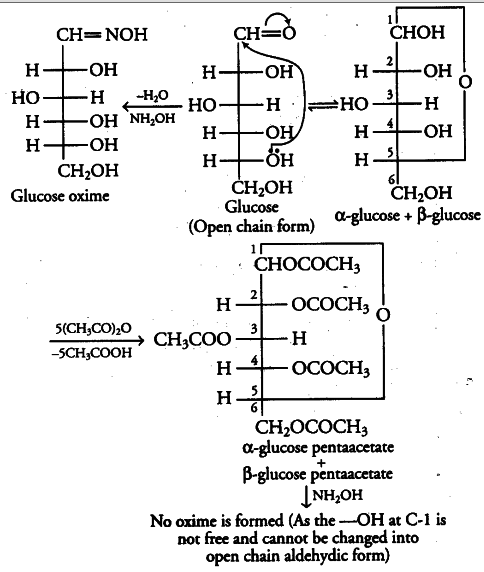 </a>
</a>
Posted by Zalak Desaii 5 years, 5 months ago
- 1 answers
Spurti . 5 years, 5 months ago
Posted by Naman Meena 5 years, 5 months ago
- 2 answers
Bhawna Sangwan 5 years, 5 months ago
Ashish Gupta 5 years, 5 months ago
Posted by Ashutosh Bind 5 years, 5 months ago
- 1 answers
Posted by Ashutosh Bind 5 years, 5 months ago
- 1 answers
Gautam Prajapati 5 years, 5 months ago
Posted by Ashutosh Bind 5 years, 5 months ago
- 1 answers
Yogita Ingle 5 years, 5 months ago
Antoine Lavoisier is French chemist and born in Paris on 26 August 1743. His significant contributions to the field of science (1743-1794) are oxygen and hydrogen identification, combustion and stoichiometry.

myCBSEguide
Trusted by 1 Crore+ Students

Test Generator
Create papers online. It's FREE.

CUET Mock Tests
75,000+ questions to practice only on myCBSEguide app

Ankita Anshika 5 years, 5 months ago
0Thank You