
Ask questions which are clear, concise and easy to understand.
Ask QuestionPosted by Santosh Maharana 8 years, 11 months ago
- 2 answers
Rajendra Singh 8 years, 11 months ago
Two or more compounds having same moleucular formula but different sturcture are called isomers. isomers shows different chemical and physical properites.
Posted by Dhirendra Kumar 8 years, 11 months ago
- 1 answers
Yakshith K 8 years, 11 months ago
HCl and HI do not give anti-Markovnikov addition to alkenes because some of the steps in the chain reaction are endothermic.
Explanation:
Reaction with HBr
The mechanism for anti-Markovnikov addition of HBr is:
Step 1. Abstraction of H from HBr (highly exothermic).
HO⋅+H-Br→HOH+⋅Br
Step 2
Addition of Br⋅ to the alkene (exothermic)
CH3CH=CH2+⋅Br→CH3⋅CH-CH2Br
Step 3. The carbon radical abstracts another H from HBr (exothermic)
CH3⋅CH-CH2Br+H-Br→CH3CH2-CH2Br+⋅Br
The reaction is favourable because all the steps are exothermic.
Reaction with HCl
The reaction with HCl is unfavourable because the H-Cl bond is much stronger than the H-Br bond.
Step 1 is endothermic, and the reaction becomes too slow to be useful.
Reaction with HI
Step 1 is favourable, because the H-I bond is relatively weak.
But Step 2, addition of I⋅ to the alkene, is unfavourable and endothermic because of the bulk of the iodine radical.
Posted by Anjana V 8 years, 11 months ago
- 0 answers
Posted by Bhargav Gomtipura 8 years, 11 months ago
- 1 answers
Payal Singh 8 years, 11 months ago
As transition metals have electrons in ns and (n-1)d orbitals
having almost comparable energy,thus easy to remove and hence show variable oxidation state such as when loose 1 or 2 electrons from ns subshell,valency becomes 1 or 2 respectively,when loose from ns as well as (n-1)d then depending on total no of electrons lost,variable valencies occurs.
Posted by Tanmoy Saha 9 years ago
- 1 answers
Bindu Agarwal 9 years ago
In SF6 , S is surrounded by 6 F- octahedrally, Therefore attack of water molecule on S is sterically hindered.
Posted by Tanmoy Saha 9 years ago
- 1 answers
Bindu Agarwal 9 years ago
Silica (SiO2 ) is added in the reverberatory furnace during the extraction of Cu to remove impurities of iron oxide (FeO) present in the ore. Silica here acts as a flux and reacts with iron oxide gangue to remove it as slag, iron silicate.
FeO + SiO2 --------> FeSiO3
Posted by Deepak Kumar 9 years ago
- 1 answers
Bindu Agarwal 8 years, 11 months ago
PH3 forms bubbles while NH3 dissolves in water due to the fact that NH3 readily forms H-bond with water while in PH3 no bonding is formed between PH3 and H2O. So due to extensive H-bonding between NH3 and H2O, it readily dissolves in water while PH3 only forms bubbles.
Posted by Deepak Kumar 9 years ago
- 1 answers
Bindu Agarwal 9 years ago
It is due to backbonding between empty 3d orbital of Si and filled 2p orbitals of N which is not possible in the case of (CH3)3N as no vacant d orbital is present.
Posted by Jyotika Singh 9 years ago
- 1 answers
Naveen Sharma 9 years ago
• Antibacterial acts against bacteria while antiseptics are effective against a wide variety of microorganisms.
• Antibiotics kill and stop the growth of bacteria while antiseptic prevents the growth and development of the microorganisms without necessarily killing them.
• Antibiotics are used internally as well as externally, but antiseptics most often used externally.
Posted by Ritik Khatri 9 years ago
- 3 answers
Shruti Dadhwal 8 years, 11 months ago
It is called alkaneamine .We will count the number of carbon atoms.
Naveen Sharma 9 years ago
AMINES Amines can be considered as derivatives of ammonia, obtained by replacement of one, two or all the three hydrogen atoms by alkyl and/or aryl groups.
Posted by Nikita Mishra 9 years ago
- 3 answers
Shruti Dadhwal 9 years ago
Coordination compounds are named in alphabetical order in order of action and anion.The oxidation state are written in Roman numerals in the bracket.So the name is Triamminetriaquachromium(III)chloride
Posted by Saumya Singh 9 years ago
- 1 answers
Shruti Dadhwal 9 years ago
Potassium bisulphite when dissolved in water, it forms a sulfurous acid.This acid lowers the pH of food and hence prevents the growth of microorganisms in the food.Thus it is used to preserve food.It is used in homemade wine, processed meats and dry fruits.It is not good for person having asthma , it can cause allergic reaction also.
Posted by Atreyee Shome 9 years, 1 month ago
- 2 answers
Yakshith K 9 years ago
The conversion of propanal to propane is a reduction reaction. This involves the reduction of an aldehyde into a hydrocarbon. There are two methods namely:
1.Clemmesen reduction:The carbonyl group of aldehyde or ketone is converted into CH2 group by treating with Zinc-Amalgam(Zn-Hg) and concentrated hydrochloric acid.

2.Wolf-Kishner reduction:The carbonyl group is converted by the action of hydrazine(NH2-NH2) with KOH or NaOH in high boiling solvent such as ethylene glycol.
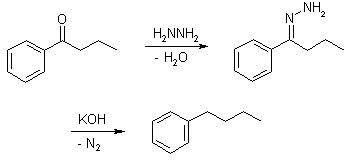
Conversion of propanal to propane can be done by any of the following steps.
CH3-CH2-CHO CH3-CH2-CH3.
Ashwin S 9 years, 1 month ago
You can get your doubt cleared with teachers from IIT and AIIMS on HashLearn. Download the HashLearn app here http://bit.ly/2fDYZtb
Posted by Anuranjan Vatsalya 9 years, 1 month ago
- 1 answers
Ashwin S 9 years, 1 month ago
You can get your doubts cleared instantly, 24/7 with IIT/AIIMS tutors on HashLearn. Download here: http://bit.ly/2fDYZtb
Posted by Akshay Kumar 9 years, 1 month ago
- 1 answers
Shruti Dadhwal 9 years ago
F centre is made up from Farbenzenter which means colour centre.It is responsible for colour in the ions having non stoichiometric defects having metal excess defect.For example,NaCl when heated in presence of Cl- , the Cl- combines with Na+ to form NaCl and thus it has now excess of sodium.theanionic sites occupied by unpaired electron is called F centres.
Posted by Ankush Rathee 9 years, 3 months ago
- 1 answers
Shruti Dadhwal 9 years ago
If a halogen group is attached to an aliphatic carbon chain, then it forms aliphatic halogen compound .For example, in methane one H is replaced by halogen Cl and it forms CH3Cl called methyl chloride and it is aliphatic halogen compound.

myCBSEguide
Trusted by 1 Crore+ Students

Test Generator
Create papers online. It's FREE.

CUET Mock Tests
75,000+ questions to practice only on myCBSEguide app

Shruti Dadhwal 8 years, 11 months ago
Isomers are compounds having same molecular formula but different structural formula.
0Thank You