
Ask questions which are clear, concise and easy to understand.
Ask QuestionPosted by Mohammad Danish Danish 8 years, 2 months ago
- 0 answers
Posted by Parish Budhvani 8 years, 2 months ago
- 0 answers
Posted by Ayush Rai 8 years, 2 months ago
- 0 answers
Posted by Dharti Damor 8 years, 2 months ago
- 0 answers
Posted by Shiwani Singh 8 years, 2 months ago
- 1 answers
Yash Arora 8 years, 2 months ago
Posted by Deepak Saini 8 years, 2 months ago
- 1 answers
Yash Arora 8 years, 2 months ago
Posted by Shivam Verma 8 years, 2 months ago
- 0 answers
Posted by Vikrant Salaria 8 years, 2 months ago
- 1 answers
Shraddha P 8 years, 2 months ago
Posted by Crystal Singh 4 years, 6 months ago
- 1 answers
Sia ? 4 years, 6 months ago
| Basis of difference | Formal organisation | Informal organisation |
| Meaning | 'Formal organisation' refers to the relationship between authorities as defined by the management. | Refers to the relationship based on personal and informal relationship among the employees. |
| Origin | The structure originates from the rules and policies of the management. | The structure originates from the social interactions among the employees. |
| Authority | Authority is defined by the profile and managerial positions. | Authority is defined by the personal qualities of the employees. |
| Flow of communication | Communication flows through the scalar chain. | No planned route of communication is followed. |
| Nature | Formal organisations are rigid | Informal organisations are flexible |
Posted by Laiba Zahir 8 years, 2 months ago
- 0 answers
Posted by Amanjot Kaur 8 years, 2 months ago
- 0 answers
Posted by Crystal Singh 8 years, 2 months ago
- 1 answers
Amar Kumar 8 years, 2 months ago
(i) Interpreting Policies: At this level, policies framed by top-level managers are interpreted. Like the marketing manager introduces his salesmen to the sales policy of the company that at no cost credit sales will be made.
(ii) Preparing Organisational Set-up: Every middle-level manager prepares outline of his respective department in accordance with the objectives of the organisation.
(iii) Appointing Employees: Every departmental manager appoints employees to fulfill the activities of his department.
(iv) Issuing Instructions: Departmental managers direct their subordinates about what to do and how they have to do it. Needful resources are made available to subordinates so that they can do the assigned jobs uninterrupted.
Posted by Ronak Jain 8 years, 2 months ago
- 2 answers
Durga Jain 8 years, 2 months ago
Shraddha P 8 years, 2 months ago
Posted by Kaushal Baraik 4 years, 6 months ago
- 1 answers
Sia ? 4 years, 6 months ago
| BASIS FOR COMPARISON | RULES | POLICIES |
| Meaning | Rules imply a set of clearly stated standards, which regulates the behavior of an individual, at the workplace. | Policies refer to the principle of action laid down by the top-level management, which acts as a guide for the decision making under various circumstances. |
| Represents | An order, which needs to be followed. | A framework within which the decisions are to be made. |
| Determines | What should be done and what should not be done by the employees. | What is to be done in different circumstances. |
| Sources | Policies and Procedures | Objectives |
| Rigidity | Highly Rigid | Comparatively less Rigid |
| Type of Statement | Specific Statement | General Statement |
| Objective | Rules are made to govern behavior and ensure compliance, to maintain discipline. | Policies are formulated by the management to guide the decision making, to ensure uniformity in decisions. |
Posted by Harpreet Kaur 8 years, 2 months ago
- 0 answers
Posted by Neelaksi Saini 8 years, 2 months ago
- 0 answers
Posted by Neelaksi Saini 8 years, 2 months ago
- 1 answers
Gaurav Seth 8 years, 2 months ago
Management comprises of three dimensions, viz:
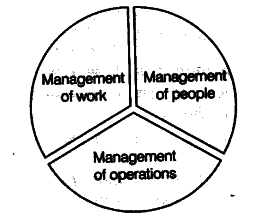
(i) Management of work It is concerned with performance of tasks in an organisation.
(ii) Management of people It implies dealing with employees as individuals and dealing with individuals as a group.
(iii) Management of operations It is interlinked with both management of work and management of people.
Posted by Sachin Saini 8 years, 2 months ago
- 0 answers
Posted by Shubhi Kataria 8 years, 2 months ago
- 1 answers
Posted by Sakshi Jaiswal 8 years, 2 months ago
- 0 answers
Posted by Sakshi Jaiswal 8 years, 2 months ago
- 1 answers
Posted by Himanshu Lohar 8 years, 2 months ago
- 3 answers
Tanmeet Randhawa 5 years, 5 months ago
Kr Vrm 8 years, 2 months ago
Posted by Neelaksi Saini 8 years, 2 months ago
- 1 answers
Posted by Dipak Rai 8 years, 2 months ago
- 2 answers
Kr Vrm 8 years, 2 months ago
Richa Aggarwal 8 years, 2 months ago
Posted by Navjot Kaur Boparai 8 years, 2 months ago
- 0 answers
Posted by Mani Bisht 8 years, 2 months ago
- 0 answers
Posted by Manas Vijay 8 years, 2 months ago
- 0 answers
Posted by Rohit Saluja 8 years, 2 months ago
- 0 answers

myCBSEguide
Trusted by 1 Crore+ Students

Test Generator
Create papers online. It's FREE.

CUET Mock Tests
75,000+ questions to practice only on myCBSEguide app
