
Ask questions which are clear, concise and easy to understand.
Ask QuestionPosted by Bhavana Hukkeri 7 years, 2 months ago
- 2 answers
Posted by Bhupendra Soni 5 years, 11 months ago
- 1 answers
Rishita Shishir ?✏ 7 years, 2 months ago
Posted by Shubham Sharma 5 years, 11 months ago
- 0 answers
Posted by Raju Kumar 7 years, 2 months ago
- 1 answers
Gaurav Seth 7 years, 2 months ago
The formula of moment inertia in terms of the radius of gyration is given as follows:
I = mk2 (1)
where I is the moment of inertia and m is the mass of the body
Accordingly, the radius of gyration is given as follows
k=√I/m (2)
The unit of radius of gyration is mm. By knowing the radius of gyration, one can find the moment of inertia of any complex body equation (1) without any hassle.
Consider a body having n number of particles each having a mass of m. Let the perpendicular distance from the axis of rotation be given by r1, r2, r3,…,rn. We know that the moment of inertia in terms of radius of gyration is given by the equation (1). Substituting the values in the equation, we get the moment of inertia of the body as follows

………… (3)
If all the particles have the same mass then equation (3) becomes
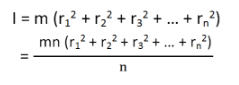
We can write mn as M which signifies the total mass of the body. Now the equation becomes
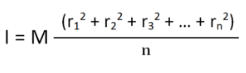
………… (4)
From equation (4), we get
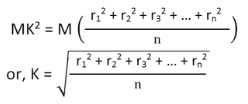
From the above equation, we can infer that the radius of gyration can also be defined as the root mean square distance of various particle of the body from the axis of rotation.
Posted by Abhinav Bhardwaj 7 years, 2 months ago
- 0 answers
Posted by Aaditya Rathore??? 7 years, 2 months ago
- 2 answers
Ayushi Ayushi 7 years, 2 months ago
Posted by Ravi Yadav 7 years, 2 months ago
- 1 answers
Veena Singh☺️? 7 years, 2 months ago
Posted by Preet Radadiya 7 years, 2 months ago
- 2 answers
Posted by Rahul Kumar 7 years, 2 months ago
- 2 answers
Tushar Aggarwal 7 years, 2 months ago
😜Arnav Arya🙃 7 years, 2 months ago
Posted by Ayu Sharma 7 years, 2 months ago
- 3 answers
Yuvraj Yadav 7 years, 2 months ago
Yuvraj Yadav 7 years, 2 months ago
😜Arnav Arya🙃 7 years, 2 months ago
Posted by 😜Arnav Arya🙃 7 years, 2 months ago
- 3 answers
Posted by Jahnvi Singh 7 years, 2 months ago
- 3 answers
Posted by Aman Kumar 7 years, 2 months ago
- 2 answers
Posted by Anand Mutnale Mutnale 7 years, 2 months ago
- 1 answers
Jahnvi Singh 7 years, 2 months ago
Posted by Yashas Bm 7 years, 2 months ago
- 1 answers
?????Geetanjali???? ? 7 years, 2 months ago
Posted by Madhav Chib 7 years, 2 months ago
- 1 answers
Hi Bju 7 years, 2 months ago
Posted by Rajeev Kumar 7 years, 2 months ago
- 1 answers
Yakshi Baliyan 7 years, 2 months ago
Posted by Rajeev Kumar 7 years, 2 months ago
- 2 answers
Posted by Narottam Kumar 7 years, 2 months ago
- 0 answers
Posted by Anuj Rohan 7 years, 2 months ago
- 2 answers
Vinay Gautam 7 years, 2 months ago
Lavanya ❤️? 7 years, 2 months ago
Posted by Anuj Rohan 7 years, 2 months ago
- 1 answers
Lavanya ❤️? 7 years, 2 months ago
Posted by Anuj Rohan 7 years, 2 months ago
- 1 answers
Simran Nahak 7 years, 2 months ago
Posted by Ashu Chauhan 7 years, 2 months ago
- 3 answers
Posted by Priyanshu Jalap 7 years, 2 months ago
- 1 answers
Gaurav Seth 7 years, 2 months ago
1)mN:
mN- milli Newton - smaller SI unit of Force which will be equal to thousandth of a newton
1mN=0.001N
2)Nm:
Nm-- Newton meter
Newton Meter is the SI unit of work Done.
3)nm:
nm - nanometer
1nm=10⁻⁹m
Posted by Anant Saxena 7 years, 2 months ago
- 0 answers
Posted by Priyanshu Jalap 7 years, 2 months ago
- 0 answers

myCBSEguide
Trusted by 1 Crore+ Students

Test Generator
Create papers online. It's FREE.

CUET Mock Tests
75,000+ questions to practice only on myCBSEguide app

Patel Salahuddin 7 years, 2 months ago
0Thank You