
Ask questions which are clear, concise and easy to understand.
Ask QuestionPosted by Surabhi Singh 7 years, 1 month ago
- 1 answers
Posted by Krishna Baghel 7 years, 1 month ago
- 0 answers
Posted by Roshan Jha 7 years, 1 month ago
- 1 answers
Posted by Puneet Rathore 7 years, 1 month ago
- 1 answers
Yogita Ingle 7 years, 1 month ago
The value of the force of gravity (g = 9.8m/s2) on hills is less than at the planes as g decreases with increase in height so the weight of tennis ball at hills is less than at plains. In other words, the force with which the earth attracts the ball on hills will be less than at plains.
Posted by Manish Mandavi 7 years, 1 month ago
- 0 answers
Posted by Patel Saurav 7 years, 1 month ago
- 1 answers
Hemant Tiwari 7 years, 1 month ago
Posted by Sunidhi Sharma 7 years, 1 month ago
- 1 answers
Hemant Tiwari 7 years, 1 month ago
Posted by Abhay Sanjay 7 years, 1 month ago
- 1 answers
Siddharth Kumar 7 years, 1 month ago
Posted by Siddharth Kumar 7 years, 1 month ago
- 4 answers
Anisha Sharma 7 years, 1 month ago
Anisha Sharma 7 years, 1 month ago
Posted by Aryan Singh 7 years, 1 month ago
- 0 answers
Posted by Md Faisal 7 years, 1 month ago
- 0 answers
Posted by Studys Yadav 7 years, 1 month ago
- 3 answers
Yogita Ingle 7 years, 1 month ago
- Calorimetry is defined as heat transfers from a body at a higher temperature to a body at a lower temperature provided there is no loss of heat to the atmosphere. Principle of Calorimetry is heat lost by one body is equal to the heat gained by another body.
- The Device which measures Calorimetry is known as Calorimeter.
- A calorimeter consists of metallic vessel and a stirrer both are made of same material (copper or aluminium) and the vessel is kept in a wooden jacket so that there is no heat loss .A mercury thermometer can be inserted through a small opening in the outer jacket.
Avinash Manikpuri 7 years, 1 month ago
Posted by Ishika Kashyap . Dodoli 7 years, 1 month ago
- 1 answers
Posted by Vishal Rana 7 years, 1 month ago
- 1 answers
Hemant Tiwari 7 years, 1 month ago
Posted by Lokesh V 7 years, 1 month ago
- 2 answers
Muskan Khan 7 years, 1 month ago
Yogita Ingle 7 years, 1 month ago
The elastic substances that can be subjected to large strain without breaking are called elastomers.
or
The substance which can be stretched to large values of strain are called elastomers, e.g., elastic tissue of aorta, the largest artery carrying blood from the heart.
Posted by Kriti Sharma 7 years, 1 month ago
- 5 answers
Sachin B 7 years, 1 month ago
Anisha Sharma 7 years, 1 month ago
Posted by Rajdeep Tripathi 7 years, 1 month ago
- 4 answers
Posted by Additri M 7 years, 1 month ago
- 1 answers
Yogita Ingle 7 years, 1 month ago
The number of degrees of freedom refers to the number of independent observations in a sample minus the number of population parameters that must be estimated from sample data.
Degrees of Freedom can be defined as independent displacements or rotations that specify the orientation of a body or system
Posted by Swaroopa Rose 7 years, 1 month ago
- 0 answers
Posted by Yukta Ratnaparkhi 7 years, 1 month ago
- 1 answers
Krittika Kar 7 years, 1 month ago
Posted by Ritik Bhardwaj 7 years, 1 month ago
- 1 answers
Posted by Sachin Raj 7 years, 1 month ago
- 1 answers
Posted by Nazrul Khan 7 years, 1 month ago
- 1 answers
Hemant Tiwari 7 years, 1 month ago
Posted by Likhitha Likhi 7 years, 1 month ago
- 1 answers
Posted by Shaurya Jain 7 years, 1 month ago
- 2 answers
Muskan Khan 7 years, 1 month ago
Posted by Mahak Jindal 7 years, 1 month ago
- 2 answers
Gautam Yadav 7 years, 1 month ago
Ritik Bhardwaj 7 years, 1 month ago
Posted by Sukhwinder Singh 7 years, 1 month ago
- 1 answers
Posted by Rishiraj Singh Sikarwar 7 years, 1 month ago
- 1 answers
Posted by Rishiraj Singh Sikarwar 7 years, 1 month ago
- 1 answers
Hemant Tiwari 7 years, 1 month ago
Posted by Rachit Patidar 7 years, 1 month ago
- 2 answers

myCBSEguide
Trusted by 1 Crore+ Students

Test Generator
Create papers online. It's FREE.

CUET Mock Tests
75,000+ questions to practice only on myCBSEguide app

Gaurav Seth 7 years, 1 month ago
It states that if gravity effect is neglected, the pressure at every point of liquid in equilibrium of rest is same.
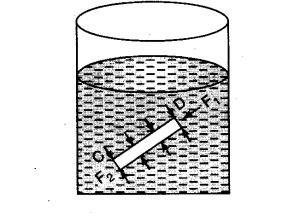
Proof : Consider two points C and D inside the liquid in a container which is in equilibrium of rest. Imagine a right circular cylinder with axis CD of uniform cross-sectional area A such that points C and D lie on float faces of the cylinder in figure
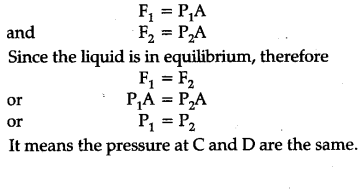
The liquid inside the cylinder is in equilibrium under the action of forces exerted by the liquid outside the cylinder. These forces are acting every where perpendicular to the surface of the cylinder. Thus force on the flat faces of the cylinder at C and D will perpendicular to the forces on the curved surface of the cylinder. Since the liquid is in equilibrium, therefore, the sum of forces acting on the curved surface of the cylinder must be zero. If P1 and P2 are the pressure at points C and D and F1 and F2 are the forces acting on the flat faces of the cylinder due to liquid,
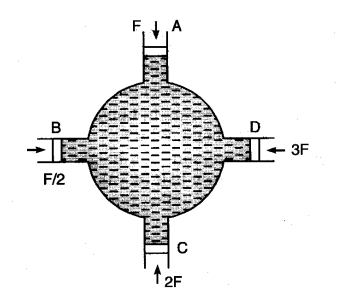
Experimental Proof. Consider a spherical vessel having for cylinderical tubes A, B, C and D each fitted with air tight frictioriless piston of area of corss-section a, a/2, 2a and 3a respectively.
Fill the vessel with an incompressible liquid so that no air gap is left inside the vessel and piston fitted in the various cylindrical tubes. Push the piston A with force F.
It is seen that all other pistons will be pushed outwards. To keep the pistons at their respective original positions, the force F/2, 2F and 3F respectively required to be applied on pistons of tubes B, C and D respectively to hold them. Now pressure developed on liquid in tubes, B, C and D are F/2, 2F/2a, 3F/3a i.e., such,equal to F/a. This indicates that the pressure applied is transmitted equally to all parts of liquid. This proves Pascal law
1Thank You