
Ask questions which are clear, concise and easy to understand.
Ask QuestionPosted by Anshika Pal 6 years, 8 months ago
- 2 answers
Khushboo Kamra 6 years, 8 months ago
Posted by Tilak Tilak 6 years, 8 months ago
- 2 answers
Ritu Raj Dadhich 6 years, 8 months ago
Nishaant Pandey 1 6 years, 8 months ago
Posted by Nisha Prabhakar 6 years, 8 months ago
- 1 answers
Prashant Shukla 6 years, 8 months ago
Posted by Dhaval Chouhan 6 years, 8 months ago
- 0 answers
Posted by Bishwamadhab Das 6 years, 8 months ago
- 1 answers
Sia ? 6 years, 8 months ago
Let length and area of rubber and steel rod = l and a respectively
Let Yr = Young’s modulus of elasticity for rubber
Ys = Young’s modulus of elasticity for steel when Stretching force F is applied, Let
{tex}\Delta l r{/tex} Extension in rubber
{tex}\Delta{/tex} ls = Extension in steel
Now, {tex}\Delta l r{/tex} will be greater that ∆ls.
Now {tex}Y = \frac { F l } { a \Delta l } = \frac { \text { Normal stress } } { \text { Longitudinal strain } }{/tex}
So, {tex}\mathrm { Yr } = \frac { F l } { a \Delta l r } ; \mathrm { Ys } = \frac { F l } { a \Delta {l} s }{/tex}
Since {tex}\Delta l r > \Delta l s{/tex}
So, Yr < Ys
Hence more the modulus of elasticity more elastic is the material, so, steel is more elastic than rubber.
Posted by I J 6 years, 8 months ago
- 1 answers
Khushboo Kamra 6 years, 8 months ago
Posted by Aditya Maurya 6 years, 8 months ago
- 0 answers
Posted by Anonymous * 6 years, 8 months ago
- 1 answers
Posted by Aryan Modi 6 years, 8 months ago
- 8 answers
Binita Biswas 6 years, 8 months ago
Posted by Gagan Singh 6 years, 8 months ago
- 2 answers
Navneet Singh 6 years, 8 months ago
Preeti Yadav 6 years, 8 months ago
Posted by Gaurav Kumar 6 years, 8 months ago
- 1 answers
Sia ? 6 years, 8 months ago
First Equation:
Acceleration is defined as the rate of change of velocity.
Let, V = final velocity; Vo = initial velocity, T= time, a =acceleration.
By definition of acceleration:
{tex}a = \frac{{V - {V_o}}}{T}{/tex}
{tex}at = V - {V_o}{/tex}
{tex}V = {V_o} + {\rm{ }}at{/tex}
Since, Vo =u = initial velocity
therefore V = u +at
Second Equation:
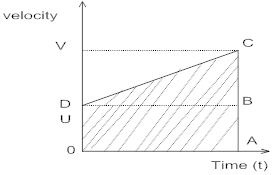
Let at time T=0, body moves with initial velocity u and at time ‘t’ body has final velocity ‘v’ and in time ‘t’ it covers a distance 'S'.
AC = v, AB = u, OA = t, DB = OA = t, BC = AC - AB = v - u
Area under a v-t curve gives displacement so,
S= Area of triangle DBC + Area of rectangle OABD .......(i)
Area of {tex}\Delta DBC = \frac{1}{2} \times Base \times Height{/tex}
= {tex}\frac{1}{2} \times DB \times BC{/tex}
= {tex}\frac{1}{2} \times t \times \left( {v - u} \right){/tex} ......... (ii)
Area of rectangle OABD {tex}= length \times breadth{/tex}
= {tex}OA \times BA{/tex}
= {tex}t \times u{/tex} ......... (iii)
From (i), (ii) and (iii)
S= ut+ {tex}\frac{1}{2} \times t \times \left( {v - u} \right){/tex}
S= ut + {tex}\frac{1}{2} \times t \times at{/tex}
S= ut + {tex}\frac{1}{2}a{t^2}{/tex}
Third Equation:
Let at time t=0, the body moves with an initial velocity u and time at ‘t’ has final velocity ‘v’ and in time ‘t’ covers a distance ‘s’
Area under v-t graph gives the displacement

S = Area of {tex}\Delta{/tex}DBC + Area of rectangle OABD
S = {tex}\frac{1}{2} \times base \times height + length \times breadth{/tex}
{tex}S = \frac{1}{2} \times DB \times BC + OA \times AB{/tex}
{tex}S = \frac{1}{2} \times t \times (v - u) + t \times u{/tex} ........(i)
Now, v - u = at
{tex}\frac{{v - u}}{a} = t{/tex}
put the value of 't' in equation (i)
{tex}S = \frac{1}{2} \times (v - u)\frac{{(v - u)}}{a} + u \times \left( {\frac{{(v - u)}}{a}} \right){/tex}
{tex}S = \frac{{{{(v - u)}^2}2u(v - u)}}{{2a}}{/tex}
{tex}S = \frac{{{v^2} + {u^2} - 2uv + 2uv - 2{u^2}}}{{2a}}{/tex}
{tex}S = \frac{{{v^2} - {u^2}}}{{2a}}{/tex}
{tex}2as = {v^2} - {u^2}{/tex}
Posted by Milutpal Borgohain 6 years, 8 months ago
- 1 answers
Anne Paul 6 years, 8 months ago
Posted by Bhanu Pratap Singh Rathore 6 years, 8 months ago
- 1 answers
Posted by Hrithika Esther 6 years, 8 months ago
- 1 answers
Aditya Maurya 6 years, 8 months ago
Posted by Veera Tushir 6 years, 8 months ago
- 2 answers
Posted by Anand Madhav 6 years, 8 months ago
- 1 answers
Posted by Reshu Saraswat 6 years, 8 months ago
- 4 answers
Posted by Yashika Gupta 6 years, 8 months ago
- 0 answers
Posted by Nupur Rawal 6 years, 8 months ago
- 0 answers
Posted by Abhishek Chauhan 6 years, 8 months ago
- 3 answers
Posted by Sunil Prajapat 6 years, 8 months ago
- 2 answers
Posted by Prakash Tripathi 6 years, 8 months ago
- 2 answers
Yogita Ingle 6 years, 8 months ago
{tex}\ {1.057 \times 10^{-16}}{/tex} light years are there in 1 meter.
The value of light years in terms of meter is based upon the conversion factor as both are the measure of distance being the fundamental quantity. There are 7 fundamental quantities of which length is the fundamental quantity and measure of length is known as distance. Light years and meter both are units of distance.
{tex} 1 \text { light year }=9.46 \times 10^{-15}.{/tex}
Thereby, {tex}1 \text { meter }=\frac{1}{9.46 \times 10^{-15}}\ \text{light year}{/tex}
{tex}\Rightarrow 1 \text { metre }=1.057 \times 10^{-16}\ \text{Light years}.{/tex}
Posted by Azhar Uddin 6 years, 8 months ago
- 1 answers
Sia ? 6 years, 8 months ago
A divisibility rule is a shorthand way of determining whether a given integer is divisible by a fixed divisor without performing the division, usually by examining its digits.

myCBSEguide
Trusted by 1 Crore+ Students

Test Generator
Create papers online. It's FREE.

CUET Mock Tests
75,000+ questions to practice only on myCBSEguide app

Rishab Jain 6 years, 8 months ago
0Thank You