
Ask questions which are clear, concise and easy to understand.
Ask QuestionPosted by Himanshu Singh 6 years, 3 months ago
- 4 answers
Shreya Parikh 6 years, 3 months ago
Posted by Kamlesh Vijay 6 years, 3 months ago
- 3 answers
Posted by Sunil Anil 6 years, 3 months ago
- 0 answers
Posted by Sunil Anil 6 years, 3 months ago
- 0 answers
Posted by Saksham Pareek 6 years, 3 months ago
- 0 answers
Posted by Nandha Kumar 6 years, 3 months ago
- 0 answers
Posted by Anup Singh Baghel 6 years, 3 months ago
- 0 answers
Posted by Anushka Shekhawat 6 years, 3 months ago
- 1 answers
Sia ? 6 years, 3 months ago
1, A1, A2, A3, ----- Am, 31 are in AP.
a = 1
an = 31
{tex}a _ { m + 2 } = 314{/tex}

an = a + (n - 1)d
31 = a + (m + 2 - 1)d
{tex}d = \frac { 30 } { m + 1 }{/tex}
{tex}\frac { A 7 } { A _ { n - 1 } } = \frac { 5 } { 9 }{/tex} (Given)
{tex}\frac { 1 + 7 \left( \frac { 30 } { m + 1 } \right) } { 1 + ( m - 1 ) \left( \frac { 30 } { m + 1 } \right) } = \frac { 5 } { 9 }{/tex}
m = 1
Posted by Jitendra Kumar 6 years, 3 months ago
- 0 answers
Posted by Sangeeta Gupta 6 years, 4 months ago
- 2 answers
Posted by Shilpa Kumari 6 years, 4 months ago
- 3 answers
Gaurav Seth 6 years, 4 months ago
uppose,
A={1,2,3,4,5,6}
B={2,4,6}
In this condition, every element in B is contained in A so,
B(A
But however, B is the set of even numbers and A is the set of natural numbers and thus they are very different in terms of n.
We write even number as 2n whereas natural number just n.
So, B doesn't belong to A.
Rahul Raj 6 years, 4 months ago
Posted by Birendar Kumar 6 years, 4 months ago
- 4 answers
Iram Hasan Hasan 6 years, 3 months ago
Gaurav Seth 6 years, 4 months ago
Any of the ways we can arrange things, where the order is important.
Example: You want to visit the homes of three friends ("a"), ("b") and ("c"), but haven't decided in what order. What choices do you have?
Answer: {a,b,c} {a,c,b} {b,a,c} {b,c,a} {c,a,b} {c,b,a}
Posted by Isha Suryan 6 years, 4 months ago
- 1 answers
Sia ? 6 years, 4 months ago
Let P(n) = a + ar + ar2 + ..... + arn-1{tex} = \frac{{a({r^n} - 1)}}{{r - 1}}{/tex}.
For n = 1
{tex}P(1) = a{r^{1 - 1}} = \frac{{a({r^1} - 1)}}{{r - 1}} \Rightarrow a = a{/tex}
{tex}\therefore {/tex} P(1) is true
Let P(n) be true for n = k
{tex}\therefore P(k) = a + ar + a{r^2} + .... + a{r^{k - 1}}{/tex}{tex} = \frac{{a({r^k} - 1)}}{{r - 1}}{/tex} .... (i)
For n = k + 1
R.H.S. {tex} = \frac{{a({r^{k + 1}} - 1)}}{{r - 1}}{/tex}
L.H.S. {tex} = \frac{{a({r^k} - 1)}}{{r - 1}} + a{r^k}{/tex} [ Using (i)]
{tex} = \frac{{a{r^k}}}{{r - 1}} - \frac{a}{{r - 1}} + a{r^k}{/tex}
{tex} = a{r^k} \cdot \left( {\frac{1}{{r - 1}}+1} \right) - \frac{a}{{r - 1}} = \frac{{a{r^{k + 1}}}}{{r - 1}} - \frac{a}{{r - 1}}{/tex}{tex} = \frac{{a{r^{k + 1}} - a}}{{r - 1}}{/tex}
{tex} = \frac{{a({r^{k + 1}} - 1)}}{{r - 1}}{/tex}
{tex}\therefore {/tex} P(k + 1) is true
Thus P(k) is true {tex} \Rightarrow {/tex} P(k + 1) is true
Hence by principle of mathematical induction, P(n) is true for all {tex}n \in N{/tex}.
Posted by Tripti Verma 6 years, 4 months ago
- 3 answers
Nitin Tiwari 6 years, 4 months ago
Posted by Yamuna Shree Karpagarajan 6 years, 4 months ago
- 0 answers
Posted by Shobha Negi 6 years, 4 months ago
- 0 answers
Posted by Ghanshyam Shukla 6 years, 4 months ago
- 1 answers
Yash Goswami????? 6 years, 4 months ago
Posted by Prabhat Sahrawat 6 years, 4 months ago
- 0 answers
Posted by Pal Murugan 6 years, 4 months ago
- 0 answers
Posted by Abhi Mehta 6 years, 4 months ago
- 0 answers
Posted by Manisha Dhangar 6 years, 4 months ago
- 0 answers
Posted by Aditi Thakare 6 years, 4 months ago
- 0 answers
Posted by Kéśhřî Kíñğ 6 years, 4 months ago
- 2 answers
Posted by Ajay Rawat 6 years, 4 months ago
- 1 answers
Gaurav Seth 6 years, 4 months ago
NCERT Solutions class-11 Maths Exercise 2.3
Question :
2. Find the domain and range of the following real functions:
(ii) 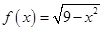
Explanation is given below:
(ii) Given: .
The function is not defined when 
 Domain of function =
=  =
= 
Range of function = 
Posted by Chitra Verma 6 years, 4 months ago
- 1 answers
Gaurav Seth 6 years, 4 months ago
Let x be the third reading of the pH level.
The acidity of the pool is normal when the average pH reading measurements is between 7.2 and 7.8
The first two measurements are 7.48 and 7.85
The average

Similarly,
The average

Thus the range third reading of the acidity of the pool should be
Posted by Lata Verma 6 years, 4 months ago
- 0 answers

myCBSEguide
Trusted by 1 Crore+ Students

Test Generator
Create papers online. It's FREE.

CUET Mock Tests
75,000+ questions to practice only on myCBSEguide app

Sia ? 6 years, 3 months ago
The velocity of an object is the rate of change of its position with respect to a frame of reference, and is a function of time.
2Thank You