
Ask questions which are clear, concise and easy to understand.
Ask QuestionPosted by Grover Saab 7 years ago
- 1 answers
Posted by Sonam Sharma 7 years ago
- 2 answers
Ishika Jain 7 years ago
Yaser Siddiquee 7 years ago
Posted by Vanshika Aggarwal 7 years ago
- 1 answers
Posted by Fun Time Fun Zone 7 years ago
- 1 answers
Yaser Siddiquee 7 years ago
Posted by Ayush Raj 4 years, 9 months ago
- 1 answers
Sia ? 4 years, 9 months ago
No. the consumer can't be indifferent between the two.
If the consumer's preferences are monotonic, she cannot be indifferent between the combinations (10, 8) and (8, 6). Because, the first combination (10, 8) allows more of both the goods as compared to the second combination (8, 6). Implying that first combination offers higher level of satisfaction, and the consumer must prefer it to the other.
Posted by Chams Riddi 7 years ago
- 1 answers
Gaurav Seth 7 years ago
- Production possibility frontier or production possibility curve shows all possible combinations of two set of goods that an economy can produce with available resources and given technology, assuming that all resources are fully and efficiently utilized.
- Economizing of resources means utilisation of resources in best possible manner to maximize output.
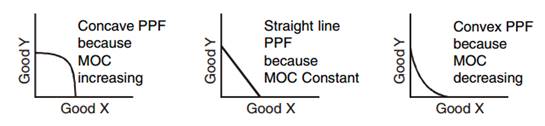
- Production Possibility Frontier or Curve Features(a) Slopes downward from left to right because if production of one commodity is to be increased then production of other commodity has to be sacrificed as there is scarcity of resources.(b) Concave to the origin because of increasing marginal opportunity cost or (MRT)
- The Production possibility curve will shift under following two condition:(a) change in resources, (b) Change in technology of production for both the goods.
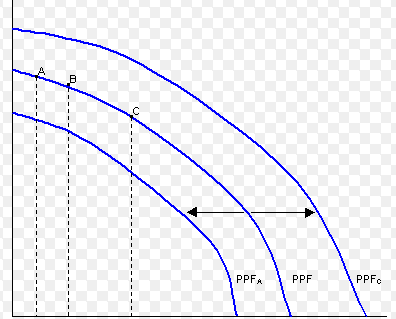
- Rightward shift of PPF shows increase in resources or improvement in technology.Ex- Labour becoming more skilled, improvement in technology, increase in productivity of land.
- Leftward shift of PPF shows the decrease in resources or degradation of technology in the economy.
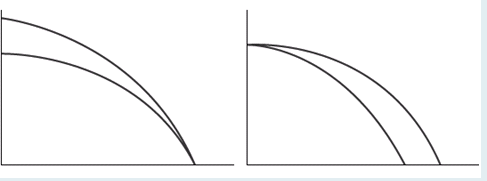
- The Production possibility curve will rotate outward under following two condition: (a) Improvement in technology in favour of one commodity (b) Growth of resources for the production of one commodity
Posted by Riya Jain 7 years ago
- 1 answers
Posted by Krishna Krishna 7 years ago
- 1 answers
Yaser Siddiquee 7 years ago
Posted by Nilendra Dev Singh Parihar 7 years ago
- 1 answers
Yaser Siddiquee 7 years ago
Posted by Neha Dhami Dhami 7 years ago
- 1 answers
Posted by Rajesh Yadav 7 years ago
- 1 answers
Posted by Rajender Joshi 7 years ago
- 2 answers
Rishad Ali 7 years ago
Yogita Ingle 7 years ago
Revenue is creation of wealth by the process of doing business. It is the reward for doing business while expense is the sacrifice.
Revenue represents what the company charges its customers for the goods and services it provides. Revenue is generated from production, trade and service.
Posted by Nimpu Tana 7 years ago
- 1 answers
Posted by Pranjal Tyagi 7 years ago
- 2 answers
Pranjal Tripathi 7 years ago
Yaser Siddiquee 7 years ago
Posted by Nazrin Rahman 7 years ago
- 1 answers
Baby Mishra 7 years ago
Posted by Sanskar Yadav 4 years, 9 months ago
- 1 answers
Sia ? 4 years, 9 months ago
Price Discrimination: Price discrimination is a situation when a monopolist charges different price from different buyers of the same product. This is generally done to maximise profits.
Product Differentiation: Product differentiation is a situation when different producers under monopolistic competition, try to differentiate their product in terms of its shape, size, packaging, trademark or brand name. This is done to attract buyers from the rival firms in the market.
Posted by Ravindra Khadka 7 years ago
- 1 answers
Posted by Dhanu Sridhar 7 years ago
- 0 answers
Posted by Gursimranjeet Kaur 7 years ago
- 2 answers
Gursimranjeet Kaur 7 years ago
Posted by Ankush Sharma 7 years ago
- 2 answers
Posted by Lakshit Gupta 7 years ago
- 2 answers
Baby Mishra 7 years ago
Posted by Nilesh Kumar 7 years ago
- 1 answers
Gill Jasmeet 7 years ago
Posted by Neetu Yadav 7 years ago
- 1 answers
Yogita Ingle 7 years ago
A price ceiling is a government-imposed price control or limit on how high a price is charged for a product. Governments intend price ceilings to protect consumers from conditions that could make necessary commodities unattainable. It is the legislated or government imposed maximum level of price that can be charged by the seller. Since price ceiling is lower than the equilibrium price thus the imposition of the price ceiling leads to excess demand.
The following are the consequences and effects of price ceiling:
1) An effective price ceiling will lower the price of a good, which decreases the producer surplus. The effective price ceiling will also decrease the price for consumers,but any benefit gained from that will be minimized by the decreased sales due to the drop in supply caused by the lower price.
2) If a ceiling is to be imposed for a long period of time, a government may need to ration the good to ensure availability for the greatest number of consumers.
3) Prolonged shortages caused by price ceilings can create black markets for that good.
4) Due to artificially lowering the price, the demand becomes comparatively higher than the supply. This leads to the emergence of the problem of excess demand.
Posted by Gurleen Kaur 7 years ago
- 0 answers
Posted by Brijesh Kumar 7 years ago
- 1 answers
Harsh Panchal 7 years ago
Posted by Devanshi Agarwal 7 years ago
- 1 answers
Pulkit Singh 7 years ago
Posted by Ashu Goyal 7 years ago
- 1 answers
Pulkit Singh 7 years ago
Posted by Nimpu Tana 7 years ago
- 1 answers

myCBSEguide
Trusted by 1 Crore+ Students

Test Generator
Create papers online. It's FREE.

CUET Mock Tests
75,000+ questions to practice only on myCBSEguide app

Yaser Siddiquee 7 years ago
0Thank You