
Ask questions which are clear, concise and easy to understand.
Ask QuestionPosted by Namrta Namrta 8 years, 7 months ago
- 1 answers
Payal Singh 8 years, 7 months ago
It is defined as the mass of an element/compound/ion which combines or displaces 1 part of hydrogen or 8 parts of oxygen or 35.5 parts of chlorine by mass.
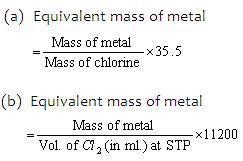
It is not always possible to apply this classic definition to determine equivalent weights of chemical entities.
Posted by Surya Pra 8 years, 7 months ago
- 0 answers
Posted by Unique R 8 years, 7 months ago
- 1 answers
Naveen Sharma 8 years, 7 months ago
Ans.
- Pure Substance has the same composition and properties throughout Whereas Mixture is the combination of two or more pure substances where each substance retains its own identity.
- Pure substances cannot be separated into any other kinds of matter, while a mixture is a combination of two or more pure substances.
- A pure substance has constant physical and chemical properties, while mixtures have varying physical and chemical properties (i.e., boiling point and melting point).
- A pure substance is pure, while a mixture is impure.
- e.g: Pure water is a pure substance. It consist of only water molecules While e.g: Alcohol-water mixture, both co-exist together.
Posted by Nikhil Malik 8 years, 7 months ago
- 1 answers
Payal Singh 8 years, 7 months ago
At STP, one mole of gas has a volume of 22.4 liters.
Given that there are 44.8 liters in this problem, which is twice as much as 22.4, there must be 2.00 moles of Carbon Dioxide CO2 gas.
Posted by Nikhil Malik 8 years, 7 months ago
- 1 answers
Payal Singh 8 years, 7 months ago
Molecular mass of Na2CO3 = ( 2 × 23 ) + 12 + (3 × 16) = 46 + 12 + 48 = 106
Given mass of Na2CO3 = 53 g
106 g of Na2CO3 Contain = 1 mol
53 g of Na2CO3 Contain = {tex}{53\over 106} = {1\over 2}{/tex} mol
No of atoms of Na = {tex}{1\over 2}\times 2 \times 6.022 \times 10^{23}{/tex}= {tex} 6.022 \times 10^{23}{/tex}
No of atoms of C = {tex}{1\over 2}\times 6.022 \times 10^{23}{/tex}
= {tex}3.011 \times 10^{23}{/tex}
No of atoms of O = {tex}{1\over 2}\times 3 \times 6.022 \times 10^{23}{/tex}= {tex}9.033\times 10^{23}{/tex}
Posted by Vanshika Kalra 8 years, 7 months ago
- 1 answers
Payal Singh 8 years, 7 months ago
Metals are malleable and ductile because they are made of hexagonal and cubic packed structures that can be moved by applying force to them. When force is applied, the atoms slide from one plane past atoms in a different plane.
Posted by Unique R 4 years, 6 months ago
- 1 answers
Sia ? 4 years, 6 months ago
| Properties | Pure Substance | Mixture |
| Define | The substances that are made of a single element or compound are called pure substances | Several elements & compounds together form a mixture |
| Categorization | Solid, liquid, gas | Heterogeneous, homogeneous |
| Physical properties | Constant | Vary |
| Purity | Pure | Impure |
| Separation by a physical process | Not possible | Possible to separate by evaporation, magnetic separation, etc. |
| Chemical properties | Constant | Vary |
| Example | Gold, pure water, hydrogen gas | Oil & water, sand & sugar |
Posted by Unique R 4 years, 6 months ago
- 1 answers
Sia ? 4 years, 6 months ago
| Properties | Pure Substance | Mixture |
| Define | The substances that are made of a single element or compound are called pure substances | Several elements & compounds together form a mixture |
| Categorization | Solid, liquid, gas | Heterogeneous, homogeneous |
| Physical properties | Constant | Vary |
| Purity | Pure | Impure |
| Separation by a physical process | Not possible | Possible to separate by evaporation, magnetic separation, etc. |
| Chemical properties | Constant | Vary |
| Example | Gold, pure water, hydrogen gas | Oil & water, sand & sugar |
Posted by Surya Pra 8 years, 7 months ago
- 0 answers
Posted by Surya Pra 8 years, 7 months ago
- 1 answers
Payal Singh 8 years, 7 months ago
Molar mass NH3 = 14+3 = 17g/mol
4.25g = 4.25/17 = 0.25 mol
NH3 1mol = 6.022 {tex}\times {/tex}1023 molecules
0.25 mol = 0.25 {tex}\times{/tex}6.022 {tex}\times {/tex}1023
Number of molecules = 1.51 {tex}\times{/tex}1023
Posted by Surya Pra 8 years, 7 months ago
- 0 answers
Posted by Surya Pra 8 years, 7 months ago
- 1 answers
Naveen Sharma 8 years, 7 months ago
Ans. Molecular mass if Magensium = 24.3
So No of Atoms in 24.3 g of Magnesium = {tex}6.022 \times 10^{23}{/tex}
No of Atoms in 1 g of Magnesium = {tex}6.022\times 10^{23}\over 24.3{/tex}
No of Atoms in 3 g of Magnesium = {tex}{6.022\times 10^{23}\over 24.3}\times 3{/tex}
= {tex}0.743 \times 10^{23}{/tex}
Posted by Surya Pra 8 years, 7 months ago
- 1 answers
Payal Singh 8 years, 7 months ago
Molecular Mass of 12C = 12
No of Atoms in 12g of 12C = 6.022 × 10²³
No of Atoms in 1g of 12C =
{tex}{1\over 12 }\times {/tex} 6.022 × 10²³
No of Atoms in 20g of 12C =
{tex}{20\over 12}\times {/tex}6.022 × 1023 = {tex}10.036 \times 10^{23}{/tex}
Posted by Rk Kashyap 8 years, 7 months ago
- 2 answers
Naveen Sharma 8 years, 7 months ago
Ans. 1 liter water =1 Kg
or 1000 ml water = 1 Kg
Given density of Water (d) =1g/ml = 1kg/L
Mass of 1 Litre of water = Density of water * Volume = 1 * 1 = 1 Kg = 1000g
Moles of water present in 1L = {tex}1000\over 18{/tex} = 55.55
Hence Molarity of water = 55.55 M
Posted by Saba Karim 8 years, 7 months ago
- 1 answers
Posted by Garvit Khurana 8 years, 7 months ago
- 1 answers
Payal Singh 8 years, 7 months ago
Solution
Concentration of glucose in blood = 0.9g/L Number of moles of glucose = {tex}{0.9\over 180 } = 0.005\space moles{/tex}
Volume of solution = 1 litre
Hence, Molarity = {tex}Number \space of \space moles \over Volume \space of \space solution \space in\space litres{/tex} = {tex}0.005 \over 1 {/tex}= 0.005M
Posted by Sapna Singh 8 years, 7 months ago
- 1 answers
Payal Singh 8 years, 7 months ago
Ans. 1 mole of CuSO4 provides 1 mole Of Cu.
Hence 159.5 g of CuSO4 {tex}\to {/tex} 63.5 g of Cu
( molar mass of CuSO4 is 159.5 and cu is 63.5)
So 100 g of CuSO4 ll produce {tex} {63.5\times 100 \over 159.5}{/tex}
= 39.8g
Posted by Sapna Singh 8 years, 7 months ago
- 1 answers
Payal Singh 8 years, 7 months ago
Here 0.50 mol of sodium carbonate refers to the number of moles whereas 0.50 M refers to the molarity of sodium carbonate.
Posted by Twinkle Jha 8 years, 7 months ago
- 0 answers
Posted by Twinkle Jha 8 years, 7 months ago
- 0 answers
Posted by Bimla Singh 8 years, 8 months ago
- 1 answers
Arun Soni 8 years, 4 months ago
- Electromagnetic waves are propagated by oscillating electric and magnetic fields oscillating at right angles to each other.
- Electromagnetic waves travel with a constant velocity of 3 x 10⁸ ms-1 in vacuum.
- Electromagneticwaves are not deflected by electric or magnetic field.
- Electromagneticwaves can show interference or diffraction.
- Electromagneticwaves are transverse waves.
Posted by Prashant Kumar 8 years, 8 months ago
- 0 answers
Posted by Shivam Jaiswal 8 years, 9 months ago
- 0 answers
Posted by Fazil Khan 8 years, 9 months ago
- 0 answers
Posted by Khizer Ansari 8 years, 9 months ago
- 1 answers
Naveen Sharma 8 years, 9 months ago
Ans. Green chemistry, also called sustainable chemistry, is an area of chemistry and chemical engineering focused on the designing of products and processes that minimize the use and generation of hazardous substances.

myCBSEguide
Trusted by 1 Crore+ Students

Test Generator
Create papers online. It's FREE.

CUET Mock Tests
75,000+ questions to practice only on myCBSEguide app
