
Ask questions which are clear, concise and easy to understand.
Ask QuestionPosted by Prince Maurya 6 years, 10 months ago
- 2 answers
Barinderjit Singh 6 years, 10 months ago
Posted by Maryam Noor 6 years, 10 months ago
- 1 answers
Gaurav Seth 6 years, 10 months ago
Molecular orbital diagram of N2 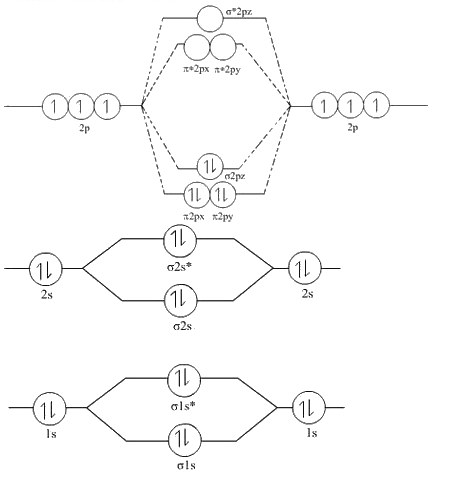 BO =  [Nb-Na] =[10-4] = 3 [Nb-Na] =[10-4] = 3Since all the electrons in nitrogen are paired, it is diamagnetic molecule. |
Posted by Amar Lal 6 years, 10 months ago
- 1 answers
Palak Bhinder 6 years, 10 months ago
Posted by Singh Rajput 6 years, 10 months ago
- 1 answers
Mithun Kumar 6 years, 10 months ago
Posted by Singh Rajput 6 years, 10 months ago
- 1 answers
Posted by Muskan Sekho 6 years, 10 months ago
- 1 answers
Posted by Muskan Sekho 6 years, 10 months ago
- 3 answers
Sugam Sharma 6 years, 10 months ago
Posted by Kantilal Patel Kantilal Patel 6 years, 10 months ago
- 0 answers
Posted by Kartik Gupta 6 years, 10 months ago
- 2 answers
Yogita Ingle 6 years, 10 months ago
A compound may have excess metal ion. When negative ion is absent from its lattice side and compound have excess metal ion and leaving a hole which occupied by electron to maintain electrical neutrality , the ionic sites are called F center .Colour in these crystals are impart by unpaired electrons.
These types of defects are found in crystals which have electric neutrality and Schoottky defects .The hole occupied by electron is called F–center. This F center is responsible for most of the interstitial properties of compound .
For example We observe this effect when Crystals of NaCl heated in an atmosphere of sodium vapour.
Yogita Ingle 6 years, 10 months ago
An F-Center or Farbe (German for colour) center is a type of crystallographic defect in which an anionic vacancy in a crystal is filled by one or more electrons, depending on the charge of the missing ion in the crystal or mainly due to the reason that when a compound is heated to a high temperature (mainly metallic oxides) the ions get excited and get displaced from their respective positions in their crystal structure but while doing so these ions leave behind some electrons in the vacated spaces. This leads to the phenomenon of colouring of compounds. This is used to identify many compounds, especially zinc oxide (yellow). Electrons in such a vacancy tend to absorb light in the visible spectrum such that a material that is usually transparent becomes colored. Thus the origin of the name, F-center, which originates from the German Farbzentrum. The translation of this term also provides the synonym color center, which can also refer to such defects. F-centers are often paramagnetic and can then be studied by electron paramagnetic resonance techniques. The greater the number of F-centers, the more intense is the color of the compound. A way of producing F centers is to heat a crystal in the presence of an atmosphere of the metal that constitutes the material, e.g.: NaCl heated in a metallic Na atmosphere.
Posted by Kartik Gupta 6 years, 10 months ago
- 1 answers
Yogita Ingle 6 years, 10 months ago
Schottky Defect: It is basically a vacancy defect in ionic solids. In order to maintain electrical neutrality, the number of missing cations and anions are equal. Like simple vacancy defect, Schottky defect also decreases the density of the substance. Number of such defects in ionic solids is quite significant.
For example, in NaCl there are approximately 106 Schottky pairs per cm3 at room temperature. In 1 cm3 there are about 1022 ions. Thus, there is one Schottky defect per 1016 ions. Schottky defect is shown by ionic substances in which the cation and anion are of almost similar sizes. For example, NaCl, KCl, CsCl and AgBr. It may be noted that AgBr shows both, Frenkel as well as Schottky defects.<
Posted by Garama Garam Indian 6 years, 10 months ago
- 2 answers
Prakhar J 6 years, 10 months ago
Yogita Ingle 6 years, 10 months ago
In the elements of 4th, 5th and 6th period of the p-block the electrons present in the intervening d and f-orbitals do not shield the r-electrons of the valence shell effectively.
As a result, {ns}2 -electrons remain more tightly held by the nucleus and hence, do not participate in bonding. This is called inert pair effect.
Posted by Shakshi Rana 6 years, 10 months ago
- 1 answers
Posted by Shakshi Rana 6 years, 10 months ago
- 1 answers
Yogita Ingle 6 years, 10 months ago
Surface tension and viscosity both are due to intermolecular forces. As the temperature increases the kinetic energy of molecule increases this leads to the decrease in intermolecular forces and therefore decrease in surface tension and viscosity. So we can say that temperature inversely affect the surface tension and viscosity.
Posted by Prakhar J 6 years, 10 months ago
- 2 answers
Harshita Verma 6 years, 10 months ago
Posted by Prakhar J 4 years, 6 months ago
- 1 answers
Sia ? 4 years, 6 months ago
Baking soda contains one ingredient, sodium bicarbonate. However, Baking powder contains sodium bicarbonate, monocalcium phosphate and either sodium acid pyrophosphate or sodium aluminum sulfate.
Posted by [email protected] [email protected] 6 years, 10 months ago
- 2 answers
[email protected] [email protected] 6 years, 10 months ago
Sanidhya Jadaun? 6 years, 10 months ago
Posted by Makyr Rynth'S 6 years, 10 months ago
- 0 answers
Posted by Rahul Singh 6 years, 10 months ago
- 0 answers
Posted by Jayapragash M 6 years, 10 months ago
- 0 answers
Posted by Nousin Ahamed 6 years, 10 months ago
- 1 answers
Posted by Muskan Sekho 6 years, 10 months ago
- 2 answers
Sheeja Menon 6 years, 10 months ago
Sugam Sharma 6 years, 10 months ago
Posted by Muskan Sekho 6 years, 10 months ago
- 1 answers
Advait Gaur 6 years, 10 months ago
Posted by [email protected] [email protected] 6 years, 10 months ago
- 1 answers
Sheeja Menon 6 years, 10 months ago
Posted by Prakhar J 6 years, 10 months ago
- 0 answers
Posted by Yash Raj 6 years, 10 months ago
- 1 answers
Sanidhya Jadaun? 6 years, 10 months ago
Posted by Sahil Gupta 6 years, 10 months ago
- 1 answers
Avantika Tayal 6 years, 10 months ago
Posted by Aaditya Rathore??? 6 years, 10 months ago
- 1 answers
Avantika Tayal 6 years, 10 months ago
Posted by Aaditya Rathore??? 6 years, 10 months ago
- 1 answers

myCBSEguide
Trusted by 1 Crore+ Students

Test Generator
Create papers online. It's FREE.

CUET Mock Tests
75,000+ questions to practice only on myCBSEguide app

Avantika Tayal 6 years, 10 months ago
2Thank You