
Ask questions which are clear, concise and easy to understand.
Ask QuestionPosted by Anandha Raj.K 6 years, 7 months ago
- 0 answers
Posted by Honey Sharma 6 years, 7 months ago
- 1 answers
Sia ? 6 years, 7 months ago
We know that, Pressure at the surface of earth = 76 cm = 76 {tex}\times{/tex} 13.6 cm Hg
= 1033.6 cm of Hg
= 10.3 m of Hg
Now, Presssure at 100 m depth = 100 m + 10.3 m = 110.3 m of Hg
So, {tex}p_1 = 10.3,p_2 = 110.3,V_1 = V, V_2=?{/tex}
At constant temperature,
{tex}p_{1} V_{1}(\text { at surface }) = p_2 V_2 (\text{at 100 m depth}){/tex}
{tex}\Rightarrow 10.3\times V= 110.3\times V_2{/tex}
{tex}\Rightarrow V_{2}=0.093 \mathrm{V}\\ \Rightarrow V_{2}=9.3 \% \text { of } V{/tex}
Posted by Chandra Prakash 6 years, 7 months ago
- 0 answers
Posted by Shweta Dhama? 6 years, 7 months ago
- 1 answers
Sia ? 6 years, 7 months ago
Van der Waals equation:
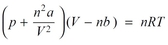
The value of parameters a and b depend upon the characteristics of a gas. Here, a is the measure of the magnitude of intermolecular forces of attraction and b is the measure of the effective volume of the gas molecules.
Posted by Dayanand Sharma 6 years, 7 months ago
- 1 answers
Shweta Dhama? 6 years, 7 months ago
Posted by Zahid Ahsan 6 years, 7 months ago
- 0 answers
Posted by Zahid Ahsan 6 years, 7 months ago
- 0 answers
Posted by Anmol Singh 6 years, 7 months ago
- 6 answers
Posted by Robinpreet Kaur 6 years, 7 months ago
- 4 answers
Gurwinder Singh 6 years, 7 months ago
Harender Singh 6 years, 7 months ago
Posted by Pintu Kumar Yadav 6 years, 7 months ago
- 1 answers
Posted by Rohit Kumar 6 years, 7 months ago
- 2 answers
Posted by Anuj Baghel 6 years, 7 months ago
- 3 answers
Posted by Sarita Chawla 6 years, 7 months ago
- 2 answers
Posted by Swati Nidhi 6 years, 7 months ago
- 0 answers
Posted by Anjali Kumari??? 6 years, 7 months ago
- 6 answers
Anjali Kumari??? 6 years, 7 months ago
Harsh Mishra 6 years, 7 months ago
Wahi toh hum Bhee poonch rahe hain, kya poonchna hai Aapko...????
Posted by Purnima Sarkar 6 years, 7 months ago
- 1 answers
Posted by Purnima Sarkar 6 years, 7 months ago
- 0 answers
Posted by Satyam Prajapati 6 years, 7 months ago
- 0 answers
Posted by Ranarshi Saha 6 years, 7 months ago
- 2 answers
Sia ? 6 years, 7 months ago
The mass of electron is about {tex}\frac{1}{{1840}}{/tex} of the mass of hydrogen. The absolute mass of an electron is {tex}9 \times {10^{ - 28}}{/tex} gram. The absolute charge on an electron is coulomb of negative charge which is smallest, carried by any particle. Thus, it is taken as unit of negative charge.
Posted by Priyan Tiwari 6 years, 7 months ago
- 1 answers
Sia ? 6 years, 7 months ago
Molal elevation constant is defined as increase in boiling point of the solvent, when one mole of solute is dissolved in 1000g of solvent. The elevation is proportional to the number of particles dissolved and given by {tex}\style{font-family:'Times New Roman'}\triangle T_b {/tex} = Kb m, where m is the molal concentration of solute. The constant Kb is the ebullioscopic constant of the solvent.
Posted by Ramprasad Solanki 6 years, 7 months ago
- 1 answers
Shree ?? 6 years, 7 months ago
Posted by Pk Prajapati 6 years, 7 months ago
- 1 answers
Anjali Kumari??? 6 years, 7 months ago
Posted by Rohit Singh 6 years, 7 months ago
- 1 answers
Mehak Gautam 6 years, 7 months ago
Posted by Samaksh Rastogi 6 years, 7 months ago
- 2 answers
Mehak Gautam 6 years, 7 months ago
Posted by Samaksh Rastogi 6 years, 7 months ago
- 0 answers
Posted by Disha Goutam 6 years, 7 months ago
- 1 answers
Mehak Gautam 6 years, 7 months ago
Posted by Ajeenkya Das 6 years, 7 months ago
- 1 answers
Posted by Avirat Singh 6 years, 7 months ago
- 0 answers
Posted by Khushi Tandi 6 years, 7 months ago
- 2 answers
Mehak Gautam 6 years, 7 months ago

myCBSEguide
Trusted by 1 Crore+ Students

Test Generator
Create papers online. It's FREE.

CUET Mock Tests
75,000+ questions to practice only on myCBSEguide app
