
Ask questions which are clear, concise and easy to understand.
Ask QuestionPosted by Binu Kumar 8 years, 5 months ago
- 0 answers
Posted by Nikhil Chaudhary 8 years, 5 months ago
- 0 answers
Posted by Ajay Bhatt 8 years, 5 months ago
- 0 answers
Posted by Ayush Semwal 8 years, 5 months ago
- 0 answers
Posted by Ankur Sharma 8 years, 5 months ago
- 0 answers
Posted by Mr Sachin Saini Sahab 8 years, 5 months ago
- 1 answers
Kritika Trehan 8 years, 5 months ago
Histology is the study of the microscopic anatomy of cells and tissues of plants and animals. It is commonly performed by examining cells and tissues under a light microscope or electron microscope,r electron microscope, the specimen having been sectioned (cut into a thin cross section with a microtome), stained, and mounted on a microscope slide.
Posted by Tanmay Shukla 8 years, 5 months ago
- 1 answers
Kritika Trehan 8 years, 5 months ago
Anemia is a condition that develops when your blood lacks enough healthy red blood cells or hemoglobin. Hemoglobin is a main part of red blood cells and binds oxygen. If you have too few or abnormal red blood cells, or your hemoglobin is abnormal or low, the cells in your body will not get enough oxygen. Symptoms of anemia -- like fatigue -- occur because organs aren't getting what they need to function properly.
Posted by Dhalendra Sahu 8 years, 5 months ago
- 1 answers
Yash Vardhan 8 years, 5 months ago
it mean a perticular animal have a species means like tiger and cats belong to a species
Posted by Ravindra Charan 8 years, 5 months ago
- 1 answers
Varun Banda 8 years, 5 months ago
The Octet rule is a general rule of thumb that applies to most atoms. Basically, it states that every atom wants to have eight valence electrons in its outermost electron shell.
In the ionic case they achieve the noble gas shell configuration by either a gain or loss of electrons. When atoms other than hydrogen form covalent bonds, an octet is accomplished by sharing.
Posted by Rushda Ansari 8 years, 5 months ago
- 0 answers
Posted by Rushda Ansari 8 years, 5 months ago
- 1 answers
Posted by Aniket Deshpande 8 years, 5 months ago
- 1 answers
Ashish Soni 8 years, 5 months ago
Posted by Ashish Soni 8 years, 5 months ago
- 0 answers
Posted by Purva Ujjainwal 8 years, 5 months ago
- 1 answers
Varun Banda 8 years, 5 months ago
Facilitated diffusion (also known as facilitated transport or passive-mediated transport) is the process of spontaneous passive transport (as opposed to active transport) of molecules or ions across a biological membrane via specific transmembrane integral proteins
Posted by Madiha Fatima 4 years, 9 months ago
- 1 answers
Sia ? 4 years, 9 months ago
Posted by Arsh Preet 8 years, 5 months ago
- 1 answers
Varun Banda 8 years, 5 months ago
Hydroponics is a subset of hydroculture, the method of growing plants without soil, using mineral nutrient solutions in a water solvent.
Posted by Abhay Shaji 8 years, 5 months ago
- 1 answers
Posted by Abhay Shaji 8 years, 5 months ago
- 1 answers
Varun Banda 8 years, 5 months ago
The main body of most fungi is made up of fine, branching, usually colourless threads called hyphae.
Posted by Ritik Chawariya 8 years, 5 months ago
- 1 answers
Ashish Soni 8 years, 5 months ago
Posted by J Mondal 8 years, 5 months ago
- 3 answers
Hitender Kumar 8 years, 5 months ago
Posted by Abhimanyu Singh 8 years, 5 months ago
- 1 answers
Kritika Trehan 8 years, 5 months ago
Muscle contraction is the activation of tension-generating sites within muscle fibers. In physiology, muscle contraction does not necessarily mean muscle shortening because muscle tension can be produced without changes in muscle length such as holding a heavy book or a dumbbell at the same position.
Posted by Bipasha Bhowmick 8 years, 5 months ago
- 0 answers
Posted by Vijay Rawat 8 years, 5 months ago
- 2 answers
Varun Banda 8 years, 5 months ago
The integumentary system is the organ system that protects the body from various kinds of damage, such as loss of water or abrasion from outside. The system comprises the skin and its appendages (including hair, scales, feathers, hooves, and nails).
Posted by Pratham Verma 8 years, 5 months ago
- 1 answers
Kritika Trehan 8 years, 5 months ago
Stomata are small pores present in the epidermis of leaves. They regulate the process of transpiration and gaseous exchange. The stomatal pore is enclosed between two bean-shaped guard cells. ... The pores, the guard cells, and the subsidiary cells together constitute the stomatal apparatus.
Posted by Sachin Kumar 8 years, 5 months ago
- 1 answers
Varun Banda 8 years, 5 months ago
Enzymes are biological catalysts which speed up the the rate of biochemical reactions without undergoing any change. ... A hormone, on the other hand , enzymes are biological catalysts released by glands where as hormones are chemicals released by glands.
<th>Character</th> <th>Enzymes</th> <th>Hormones</th>| Chemistry | They are only proteins in nature and may have a metallic group. | They are proteins, amino-acids, steroids etc. |
| Prosthetic group | Enzymes have vitamins and inorganic element are prosthetic groups. Without which, they do not act. | They have no prosthetic groups. |
| Size | Relatively large in size | Small in size. |
| Role | Catalysts to enhance rate of reactions | Signal passers from one cell to other or between organs. |
| Chemical stability | They stay as such after their function. | They are damage during the process and hence cannot be reused |
| Regulation | They function under strict conditions of temperature and pH in body. | They are not limited by temperature or pH but controlled by brain or external factors. |
| Formation and action | They are formed and also act at the site of action | They are formed and act at a distant site |
| Contribution to life | They have limited but essential functions | They have diverse functions to control body growth, reproduction and physiology |
| Examples | Hydrolases, oxidases, isomerase etc. in both plants and animals | Oxytocin, testosterone, cortisol in animals. Absicic acid, cytokines, gibberlins in plants. |
Posted by Sachin Kumar 8 years, 5 months ago
- 0 answers
Posted by Sachin Kumar 8 years, 5 months ago
- 1 answers
Priya Goswami 8 years, 5 months ago
Posted by Sachin Kumar 8 years, 5 months ago
- 1 answers
Varun Banda 8 years, 5 months ago
<a href="https://owlcation.com/stem/">STEM</a><a href="https://owlcation.com/academia/">ACADEMIA</a><a href="https://owlcation.com/agriculture/">AGRICULTURE & FARMING</a><a href="https://owlcation.com/humanities/">HUMANITIES</a><a href="https://owlcation.com/social-sciences/">SOCIAL SCIENCES</a>
<iframe data-is-safeframe="true" frameborder="0" height="50" id="google_ads_iframe_/1027454/hub_responsive_mobile_sticky_refresh_owlcation_down_0" marginheight="0" marginwidth="0" name="" scrolling="no" src="https://tpc.googlesyndication.com/safeframe/1-0-13/html/container.html#eid=21060375" title="3rd party ad content" width="320"></iframe>
<article>- <a href="https://owlcation.com/" itemprop="url">Owlcation</a>»
- <a href="https://owlcation.com/stem/" itemprop="url">STEM</a>»
- <a href="https://owlcation.com/stem/medical-science/" itemprop="url">Medical Science</a>
Reflex Action and Reflex Arc: What Happens When You Accidentally Touch a Hot Pot
Updated on August 6, 2017

<a href="https://owlcation.com/stem/Here-is-what-happens-when-you-accidentally-touch-a-hot-pot#"> more</a>
<a href="https://owlcation.com/stem/Here-is-what-happens-when-you-accidentally-touch-a-hot-pot#">Contact Author</a>

Reflex action and reflex arc when a cook touched a hot pot by accident | Source
<iframe data-is-safeframe="true" frameborder="0" height="250" id="google_ads_iframe_/1027454/hub_responsive_mobile_content_1_owlcation_middle_0" marginheight="0" marginwidth="0" name="" scrolling="no" src="https://tpc.googlesyndication.com/safeframe/1-0-13/html/container.html#eid=21060375" title="3rd party ad content" width="300"></iframe>
Reflex Action and Reflex Arc
Reflex is a special ability that evolution gifted us to facilitate our survival. Whenever part of your body comes in contact with an object capable of causing you harm, you tend to quickly withdraw that part of the body. This happens before your brain gets the time it needs to process the threat.
Reflex Action
If you accidentally touch a hot pot on your stove while cooking, you would involuntarily (and nearly instantaneously) snatch your hand away from the pot. This response is called a ‘reflex action'.
Reflex Arc
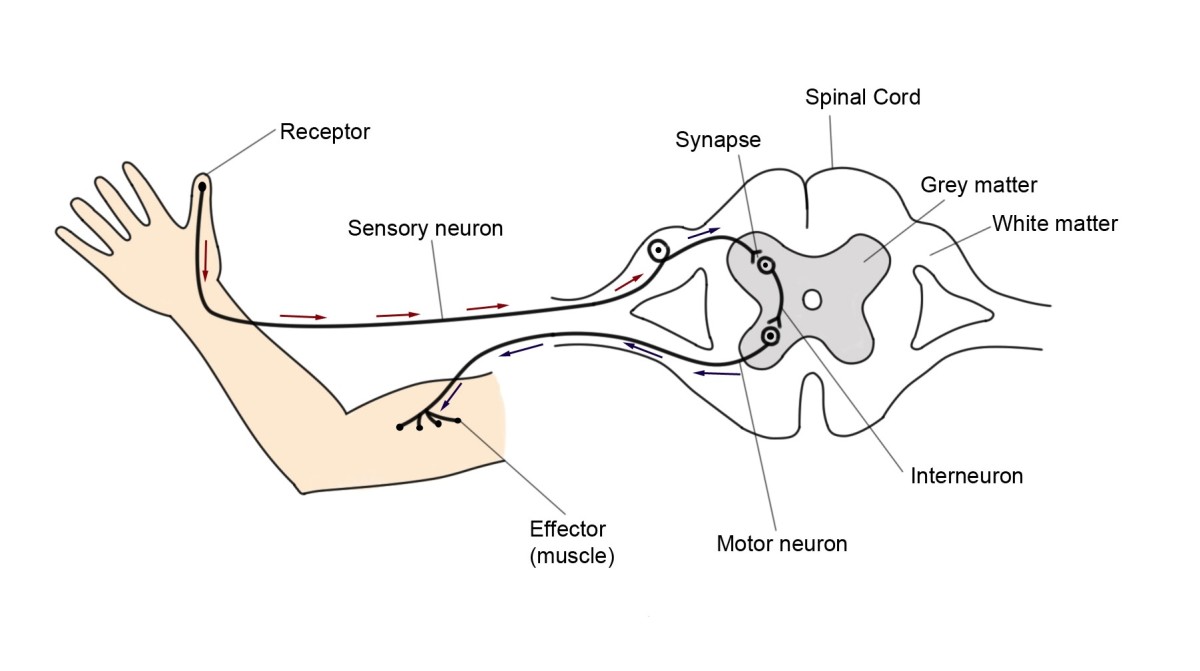
Contact with the hot pot triggers the start of a series of events in the body to evoke a response.
At the point of contact with the hot pot, skin receptors quickly send nerve impulses (electrical) to the spinal cord (central nervous system) via sensory neurons. In the spinal cord, the impulses are processed and a response is relayed back.
In the spinal cord, the interneurons (also known as relay neurons) make the connections between the sensory neurons (bringing the message from hand) and the correct motor neurons (taking the response back to the hand). It would be not be useful if the response was sent to the wrong part of the body—in this case, a response sent to the leg wouldn't be too helpful as the stimulus is coming from the hand.
From the interneurons, the response is relayed to the motor neurons which project out of the spinal cord to stimulate your muscles (effector) to contract, causing you to snatch your hand away from the hot pot. This pathway taken by nerve impulses to elicit a response is known as a ‘reflex arc’.
This process happens so fast that the response occurs before the message reaches the brain. This results to a quicker time-to-response as the thinking process of the brain may be relatively time consuming.
Posted by Sachin Kumar 8 years, 5 months ago
- 1 answers
Ashish Soni 8 years, 5 months ago
Posted by Sachin Kumar 8 years, 5 months ago
- 0 answers

myCBSEguide
Trusted by 1 Crore+ Students

Test Generator
Create papers online. It's FREE.

CUET Mock Tests
75,000+ questions to practice only on myCBSEguide app
