
Ask questions which are clear, concise and easy to understand.
Ask QuestionPosted by Garima Jain 6 years, 3 months ago
- 2 answers
Posted by Annie Nie 6 years, 3 months ago
- 6 answers
Lokesh Choudhary 6 years, 3 months ago
Miss. 1234 6 years, 3 months ago
Posted by K P Yadav 6 years, 3 months ago
- 0 answers
Posted by Pakhi Jadaun 6 years, 3 months ago
- 1 answers
Posted by Pakhi Jadaun 6 years, 3 months ago
- 1 answers
Miss. 1234 6 years, 3 months ago
Posted by Tanish Chimaniya 6 years, 3 months ago
- 3 answers
Chhaya Sharma 6 years, 3 months ago
Yogita Ingle 6 years, 3 months ago
The acids do not show acidic behavior in the absence of water because there is no production of H^+ ions.
Acids are any inorganic or organic compounds with hydrogen atoms. Generally, all the acids are considered to be weak. So, they dissociate into ions easily in the "polar solvents" such as water.
The concept of acidic behavior arises due to the presence of {tex}H^+{/tex} ions. The acids when dissolves in water only produce {tex}H^+{/tex} ions. So, acid does not have any acidic behavior in "absence of water".
Mruhir Datar 6 years, 3 months ago
Posted by Gurveer Bhullar 6 years, 3 months ago
- 2 answers
Tanish Chimaniya 6 years, 3 months ago
Posted by Vidit Shukla 6 years, 3 months ago
- 6 answers
Amrut Dani 6 years, 3 months ago
Posted by Amrut Dani 6 years, 3 months ago
- 1 answers
Gaurav Seth 6 years, 3 months ago
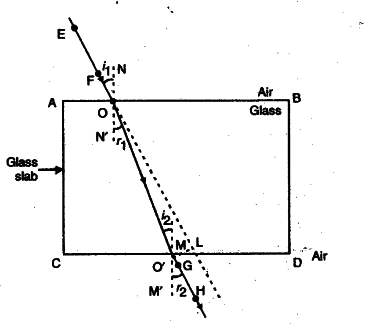
In Fig, EO is the incident ray, OO’ is the refracted ray and O’H is the emergent ray. The extent of bending of the ray of light at the opposite parallel faces AB (air-glass interface) and CD (glass-air interface) of the rectangular glass slab is equal and opposite. This is why the ray emerges parallel to the incident ray. However, the light ray is shifted sideward slightly.<button aria-label="like this post" title="like this post">
</button>
Posted by Ashish Kumar 6 years, 3 months ago
- 4 answers
Gaurav Seth 6 years, 3 months ago
Monohybrid Cross: The cross in which just two contrasting characters are studied is called monohybrid cross. Mendel did monohybrid cross for his first experiment. He selected a pair of contrasting characters for that experiment.
Abhinav ? 6 years, 3 months ago
Amrut Dani 6 years, 3 months ago
Posted by Sushma Bansal 6 years, 3 months ago
- 1 answers
Yogita Ingle 6 years, 3 months ago
Vestigial organs are those particular organs that are present as reduced structures and they do not perform any functions in the body. As the organs are developed and functional in lower organisms, they act as the proof of evolution. For example, appendix, ear muscles, nictitating membrane of eye, mammary gland in man are some of the vestigial organs present in human body.
Posted by Goutam Rajput 6 years, 3 months ago
- 1 answers
Yogita Ingle 6 years, 3 months ago
Basal metabolic rate (BMR) is the energy released when the subject is at complete mental and physical rest i.e. in a room with comfortable temperature and humidity, awake and sitting in a reclining position, 10-12 hours after the last meal. It is essentially the minimum energy required to maintain the heart rate, respiration, kidney function etc.
Posted by Ilma Munawar 6 years, 3 months ago
- 7 answers
Shiv Meera 6 years, 3 months ago
Posted by Jitu Yadav 6 years, 3 months ago
- 8 answers
Gaurav Seth 6 years, 3 months ago
A gradual increase in the overall temperature of the earth's atmosphere generally attributed to the greenhouse effect caused by increased levels of carbon dioxide, CFCs, and other pollutants is called global warming.Effects of global warming are :-
- Ice is melting worldwide, especially at the Earth’s poles. This includes mountain glaciers, ice sheets covering West Antarctica and Greenland, and Arctic sea ice.
- Sea level rise became faster over the last century.
- Some butterflies, foxes, and alpine plants have moved farther north or to higher, cooler areas.
- Precipitation (rain and snowfall) has increased across the globe, on average.
Other effects could happen later this century, if warming continues.
- Sea levels are expected to rise between 7 and 23 inches (18 and 59 centimeters) by the end of the century, and continued melting at the poles could add between 4 and 8 inches (10 to 20 centimeters).
- Hurricanes and other storms are likely to become stronger.
- Species that depend on one another may become out of sync. For example, plants could bloom earlier than their pollinating insects become active.
- Floods and droughts will become more common. Rainfall in Ethiopia, where droughts are already common, could decline by 10 percent over the next 50 years.
- Less fresh water will be available.
- Some diseases will spread, such as malaria carried by mosquitoes.
- Ecosystems will change—some species will move farther north or become more successful; others won’t be able to move and could become extinct.
Miss. 1234 6 years, 3 months ago
Shreya ... 6 years, 3 months ago
Posted by Ilma Munawar 6 years, 3 months ago
- 9 answers
Gaurav Seth 6 years, 3 months ago
The 3 Rs of environmental conservation are Reduce, Reuse and Recycle.
- Reduce: Reduce the amount of Earth's resources which we use. Use of less paper and plastic carry bags.
- Reuse: Reuse means not to throw old goods away, but to use the same goods again so that the demand for new goods is reduced. Plastic jars can be reused for storing salt, food grains etc.
- Recycle: Recycle means rather than throwing materials away, they can be recycled. Used and discarded plastic, glass, paper and metal are sent to the respective industries where they can be converted into other useful products such as lampshades, handbags etc.
Shreya ... 6 years, 3 months ago
Shreya ... 6 years, 3 months ago
Posted by Ilma Munawar 6 years, 3 months ago
- 3 answers
Tanish Chimaniya 6 years, 3 months ago
Yogita Ingle 6 years, 3 months ago
The blind spot is the area on the retina without receptors that respond to light. Therefore an image that falls on this region will NOT be seen. It is in this region that the optic nerve exits the eye on its way to the brain.
Posted by Unnati Agarwal 6 years, 3 months ago
- 1 answers
Posted by Mohit Kochar 6 years, 3 months ago
- 4 answers
Kavitha Karthikeyan 6 years, 3 months ago
Krish Singh 6 years, 3 months ago
Mohit Kochar 6 years, 3 months ago
Posted by Deepak Anand 6 years, 3 months ago
- 2 answers
Aadya Singh ? 6 years, 3 months ago
Posted by Prem Kishor Mahto 6 years, 3 months ago
- 3 answers
Gaurav Seth 6 years, 3 months ago
- It is a four chambered structure consisting - the right auricle , the left auricle , right ventricle and left ventricle.
- The Auricles are smaller and placed above the ventricles. Auricles are partitioned by a muscular called septum.
- The right auricle receives the deoxygenated blood from all parts of the body except the lungs. It pumps this blood into the right ventricle. Then , the right ventricle pumps the deoxygenated blood to the lungs. The left auricle receives oxygenated blood from the lungs through pulmonary veins. It pumps this blood into the left ventricle. The left ventricle pumps the oxygenated blood to the distant organs in the body.
- Each auricle communicates with the ventricle of its side by a pore which is guarded by valves. These valves allow the blood to flow from the auricles to the ventricles but check its return to the auricles. Thus , the heart there is a complete separation of oxygenated and deoxygenated blood. The heart is enclosed in a double membrane called pericardium. It contains fluid which protects the heart from any shock or mechanical injury.
- The heart collects blood through both the auricles and then distributes it through ventricles. The action of heart includes contraction and relaxation of the auricles and ventricles.
- A contraction of heart is called systole and diastole. The contraction and relaxation occur in an automatic rhythmic fashion. The auricles and ventricles contract alternately. The rhythmic contraction and relaxation of heart is called a heart beat.
Aadya Singh ? 6 years, 3 months ago
Posted by Challsingh Deora 6 years, 3 months ago
- 1 answers
Posted by Ravi Gupta 6 years, 3 months ago
- 0 answers
Posted by Tashi Lepcha 6 years, 3 months ago
- 1 answers
Gaurav Seth 6 years, 3 months ago

Use of esters:
Esters are used in synthetic flavours, perfumes, cosmetics, lacquers, paints and varnishes.
Use of saponification reaction:
It is used in the preparation of soaps on a commercial basis.
Posted by Rakesh Pandat 6 years, 3 months ago
- 5 answers
Gaurav Seth 6 years, 3 months ago
Soaps :
- Soaps are sodium or potassium salts of long chain carboxylic acids.
- Soaps have lesser cleansing action or quality as compared to detergents.
- Soaps are made from animal or plant fats.
- Soaps are more biodegradable.
Detergents :
- Detergents are ammonium or solphonate salts of long chain carboxylic acids.
- Detergents have better cleansing action as compared to soaps.
- Detergents are made from petrochemicals. Detergents are less biodegradable.
Aadya Singh ? 6 years, 3 months ago
Aadya Singh ? 6 years, 3 months ago
Aadya Singh ? 6 years, 3 months ago
Aadya Singh ? 6 years, 3 months ago
Posted by Biyas Longjam 6 years, 3 months ago
- 3 answers
Yogita Ingle 6 years, 3 months ago
Esters are sweet smelling compounds.
They are formed by the reaction of a carboxylic acid with an alcohol in the presence of conc. sulphuric acid.
For example, ethyl ethanoate is prepared by reacting ethanoic acid and ethanol in the presence of conc.sulphuric acid.
C2H5OH + CH3COOH → CH3COOC2H5 +H2O
Vaishnavi Prabhu 6 years, 3 months ago
Posted by Biyas Longjam 6 years, 3 months ago
- 1 answers
Anjali Anil 6 years, 3 months ago
Posted by Surender Singh 6 years, 3 months ago
- 2 answers
Kavitha Karthikeyan 6 years, 3 months ago
Yogita Ingle 6 years, 3 months ago
Saliva is a fluid secreted by the salivary glands. It contains an enzyme called salivary amylase.
Salivary amylase catalyses the breakdown of starch into sugar, maltose. The food is mixed thoroughly with saliva and moved around the mouth while chewing.
Posted by Surender Singh 6 years, 3 months ago
- 2 answers
Anjali Anil 6 years, 3 months ago
Posted by Yash Vashisht 6 years, 3 months ago
- 1 answers
Yogita Ingle 6 years, 3 months ago
A ray of light changes its direction when it enters from one medium to another medium. This happens because speed of light is different in different media. For example; the speed of light is 3 x 10⁸ m/s (2.99x10⁸ m/s) in vacuum and it is 2.98 x 10⁸ m/s in air.
Refractive Index is the extent of change of direction of light in a given pair of media. The refractive index is a relative value of speed of light in the given pair of media. Thus, to calculate the refractive Index the speed of light in two media is taken.
Let the speed of light in medium 1 is v1 and in medium 2 is v2
Therefore; refractive index of medium 2 with respect to medium 1 (n21)
n21=Speed of light in medium 1/Speed of light in medium 2
Or, n21=v1/v2
Posted by Shreyas Samarth 6 years, 3 months ago
- 22 answers
Shreyas Samarth 6 years, 3 months ago
Shreya ... 6 years, 3 months ago
Shreya ... 6 years, 3 months ago

myCBSEguide
Trusted by 1 Crore+ Students

Test Generator
Create papers online. It's FREE.

CUET Mock Tests
75,000+ questions to practice only on myCBSEguide app

Vikas Saini 6 years, 3 months ago
2Thank You