
Ask questions which are clear, concise and easy to understand.
Ask QuestionPosted by Sunidhi Singh 5 years, 6 months ago
- 1 answers
Posted by S Viswanath 5 years, 6 months ago
- 4 answers
Mith Jain 5 years, 6 months ago
Rajnish Kalita 5 years, 6 months ago
Menka Kumari 5 years, 6 months ago
Posted by S Viswanath 5 years, 6 months ago
- 2 answers
Chandresh Tiwari 5 years, 6 months ago
Menka Kumari 5 years, 6 months ago
Posted by Manjay Kumar Sharma 5 years, 6 months ago
- 1 answers
Disha Agarwal 5 years, 6 months ago
Posted by Sumit Singh 5 years, 6 months ago
- 1 answers
Yogita Ingle 5 years, 6 months ago
- Menstruation is the cyclic process in female of age from 12 - 45 .
- In this process Overy releases mature egg in each 28 days.
- If fertilization does not take place then the blood vessels along with egg comes out of the ****** , this flow is know as menstrual flow or simply menstruation.
- In general language menstruation is also known as period.
Posted by Sunidhi Singh 5 years, 6 months ago
- 1 answers
Yogita Ingle 5 years, 6 months ago
When the movement of minerals and water via xylem is driven mostly by negative pressure and movement via phloem is driven by hydrostatic pressure. This process is called as translocation and accompanied by a process known as phloem loading and unloading.
Posted by Suresh Gupta 5 years, 6 months ago
- 0 answers
Posted by Tanishk Radadiya 5 years, 6 months ago
- 3 answers
Kajal Pal 5 years, 6 months ago
Avatar ? 5 years, 6 months ago
Gaurav Seth 5 years, 6 months ago
Respiration is a process where the body uses the oxygen to break down glucose and release energy, so that the cells in the body can use it. Carbon dioxide and water are produced during respiration.
Posted by Singisetty Lipika 5 years, 6 months ago
- 3 answers
Yogita Ingle 5 years, 6 months ago
Steps to test the presence of starch in leaves :
Step 1: A fresh leaf is taken.
Step 2: The leaf is boiled in water for few minutes to soften the cells in the leaf.
Step 3: Now, dip this leaf in iodine solution.
Step 4: The color of the leaf will changes into blue black color when iodine is added to it which shows the presence of starch in it.
Itz Raman Here ☺ 5 years, 6 months ago
Itz Raman Here ☺ 5 years, 6 months ago
Posted by Anupama ?? 5 years, 6 months ago
- 3 answers
Gaurav Seth 5 years, 6 months ago
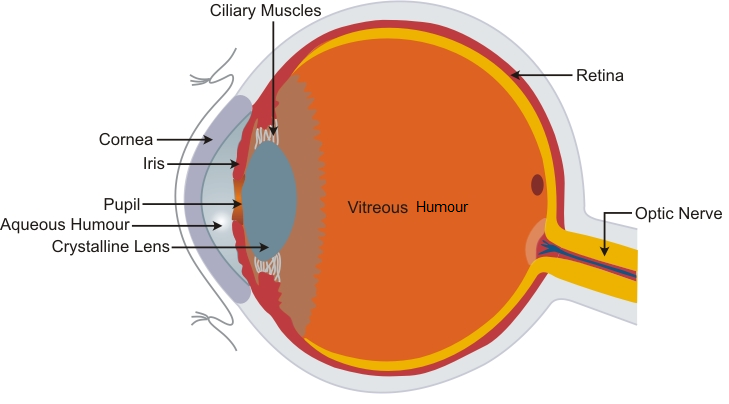
|
Main parts |
Functions |
|
Cornea |
Light enters the eyes through cornea. |
|
Iris |
It controls the amount of light entering the eyes. |
|
Pupil |
It dilates and contracts and thus enables us to in bright and dark light. |
|
Eye-lens |
It is a convex lens and focuses the light entering the eyes. |
|
Ciliary muscles |
Holds the eye lens and helps it to change its focal length. |
|
Retina |
Part of the eyes where image is formed |
|
Optic nerve |
It helps to carry the signals from the retina to the brain. |
Yogita Ingle 5 years, 6 months ago
|
Main parts |
Functions |
|
Cornea |
Light enters the eyes through cornea. |
|
Iris |
It controls the amount of light entering the eyes. |
|
Pupil |
It dilates and contracts and thus enables us to in bright and dark light. |
|
Eye-lens |
It is a convex lens and focuses the light entering the eyes. |
|
Ciliary muscles |
Holds the eye lens and helps it to change its focal length. |
|
Retina |
Part of the eyes where image is formed |
|
Optic nerve |
It helps to carry the signals from the retina to the brain. |
Posted by Itz Raman Here ☺ 5 years, 6 months ago
- 2 answers
Posted by Kazi Shahimoon Hossain 5 years, 6 months ago
- 1 answers
Gaurav Seth 5 years, 6 months ago
<font size="2"><font style="user-select: initial !important;">As we pass from one trophic level to the next, only 10% of energy is transferred from the first trophic level to the next. This is because a lot of energy is lost to the surroundings and rest is utilised by the organism.</font></font>
<font size="2"><font style="user-select: initial !important;">We can understand this better using an example.</font></font>
<font size="2"><font style="user-select: initial !important;">When green plants are eaten by primary consumers, lot of energy is lost as heat to the environment. Some energy is used by the consumer into doing work and digestion whereas rest is used for growth and reproduction. About 10% of the eaten food is turned into its body and made available to the next level of consumers. So the actual energy passing to the next trophic level is only 10%.</font></font>
Grass -> Grasshopper -> Frog -> snake -> hawk
Here, a part of the solar energy is captured by grass which uses it to produce food. About 10% of this captured energy is passed on to grasshoppers. Here, large amount of energy is lost as heat, some goes into digestion and doing work and rest towards growth. Again 10% of the food eaten by the grasshopper is made available to the next trophic level, comprising of frogs. In this way energy flows further from frog to snake and from snakes to the final trophic level, made up of hawks..
Another example would be
Dead organic matter -> Microrganisms like bacteria, fungi etc. -> Detritivores like earthworms, nematodes etc. -> Predators like snakes, frogs e
Posted by Charvi Sangwan 5 years, 6 months ago
- 1 answers
Gaurav Seth 5 years, 6 months ago
- Variation can be defined as the difference between the cells, organisms or group of organisms belonging to a particular species by environmental factors (phenotypic variation) or genetic differences (genotypic variations).
- It is caused by gene mutations due to certain environmental factors and various combinations of genetic material.
- Variation is important because it causes evolution and is the basis of heredity.
- It is advantageous to a population as it enables few individuals to adapt to the environment changes thus, enabling the survival of the population.
Posted by Itz Raman Here ☺ 5 years, 6 months ago
- 0 answers
Posted by Itz Raman Here ☺ 5 years, 6 months ago
- 1 answers
Anupama ?? 5 years, 6 months ago
Posted by Sumaila Ali Choudhary??? 5 years, 6 months ago
- 3 answers
Sumaila Ali Choudhary??? 5 years, 6 months ago
Posted by Itz Raman Here ☺ 5 years, 6 months ago
- 2 answers
Yogita Ingle 5 years, 6 months ago
Each alveolus is made up of highly-permeable and thin layers of squamous epithelial cells. Similarly, the blood capillaries have layers of squamous epithelial cells. Oxygen-rich air enters the body through the nose and reaches the alveoli. The deoxygenated (carbon dioxide-rich) blood from the body is brought to the heart by the veins. The heart pumps it to the lungs for oxygenation. The exchange of O2 and CO2 takes place between the blood capillaries surrounding the alveoli and the gases present in the alveoli.
Thus, the alveoli are the sites for gaseous exchange. The exchange of gases takes place by simple diffusion because of pressure or concentration differences. The barrier between the alveoli and the capillaries is thin and the diffusion of gases takes place from higher partial pressure to lower partial pressure. The venous blood that reaches the alveoli has lower partial pressure of O2 and higher partial pressure of CO2 as compared to alveolar air. Hence, oxygen diffuses into blood. Simultaneously, carbon dioxide diffuses out of blood and into the alveoli.
Posted by Justin Biber 5 years, 6 months ago
- 1 answers
Meghna Thapar 5 years, 4 months ago
- The diseases which are spread by sexual contact with an infected person are called Sexually Transmitted Diseases. Some of the common sexually transmitted diseases are Gonorrhoea, Syphilis and AIDS.
- Sexually transmitted diseases (STDs) — or sexually transmitted infections (STIs) — are generally acquired by sexual contact. The organisms (bacteria, viruses or parasites) that cause sexually transmitted diseases may pass from person to person in blood, semen, or vaginal and other bodily fluids.
Posted by Anshul Paradkar 5 years, 6 months ago
- 2 answers
Yogita Ingle 5 years, 6 months ago
Following are the basic properties of magnet:
- When a magnet is dipped in iron filings, we can observe that the iron filings cling to the end of the magnet as the attraction is maximum at the ends of the magnet. These ends are known as poles of the magnets.
- Magnetic poles always exist in pairs.
- Whenever a magnet is suspended freely in mid-air, it always points towards north-south direction. Pole pointing towards geographic north is known as the North Pole and the pole pointing towards geographic south is known as the South Pole.
- Like poles repel while unlike poles attract.
- The magnetic force between the two magnets is greater when the distance between these magnets are lesser.
Justin Biber 5 years, 6 months ago
Posted by Aaditri Kumari 5 years, 6 months ago
- 4 answers
Gargi Nawghade 5 years, 6 months ago
Posted by Ridhima Sharma 5 years, 6 months ago
- 5 answers
Rajnish Kalita 5 years, 6 months ago
Posted by Sunidhi Singh 5 years, 6 months ago
- 1 answers
Aaditri Kumari 5 years, 6 months ago
Posted by Sunidhi Singh 5 years, 6 months ago
- 1 answers
Meghna Thapar 5 years, 4 months ago
Translocation of organic solutes such as sucrose (i.e., photosynthetic) takes place through sieve tube elements of phloem from supply end (or source) to consumption end (or sink). But, before this translocation of sugars could proceed, the soluble sugars must be transferred from mesophyll cells to sieve tube elements of the respective leaves.
This transfer of sugars (photosynthetic) from mesophyll cells to sieve tube elements in the leaf is called as phloem loading. On the other hand, the transfer of sugars (photosynthetic) from sieve tube elements to the receiver cells of consumption end (i.e., sink organs) is called as phloem unloading. Both are energy requiring processes.
Posted by Sunidhi Singh 5 years, 6 months ago
- 2 answers
Yogita Ingle 5 years, 6 months ago
Micturition is the release of urine from urinary bladder through urethra. It is also termed as ‘Urination’. This occurs involuntarily in children upto 4-5 years; thereafter regulated voluntarily.
Posted by Sunidhi Singh 5 years, 6 months ago
- 1 answers
Posted by Sunidhi Singh 5 years, 6 months ago
- 3 answers
Posted by Charvi Sangwan 5 years, 6 months ago
- 2 answers
Gargi Nawghade 5 years, 6 months ago
Bishwajeet Kumar 5 years, 6 months ago
Posted by Charvi Sangwan 5 years, 6 months ago
- 2 answers
Gargi Nawghade 5 years, 6 months ago
Ashna S 5 years, 6 months ago

myCBSEguide
Trusted by 1 Crore+ Students

Test Generator
Create papers online. It's FREE.

CUET Mock Tests
75,000+ questions to practice only on myCBSEguide app

Gaurav Seth 5 years, 6 months ago
Both the IV and VI graph shows the relation between potential V, and current I.
In VI graph, we take potential at y-axis and current at x-axis.
The slope of VI graph give us the resistance.
In IV graph, Current is at y-axis and potential is at x-axis.
The reciprocal of the slope of IV graph shows the resistance.
0Thank You