
Ask questions which are clear, concise and easy to understand.
Ask QuestionPosted by Puchakayala Prasannanjali 5 years, 5 months ago
- 1 answers
Posted by Triloki Majhi 5 years, 5 months ago
- 1 answers
Rohit Das 5 years, 5 months ago
Posted by Shubham Saxena ???? 5 years, 5 months ago
- 4 answers
Malaika Sharma 5 years, 5 months ago
Shubham Saxena ???? 5 years, 5 months ago
Posted by Lavesh Sahu 5 years, 5 months ago
- 3 answers
Shubham Saxena ???? 5 years, 5 months ago
Posted by Diksha Joshi 5 years, 5 months ago
- 1 answers
Yogita Ingle 5 years, 5 months ago
The principle of the electric motor is based on the fact that a current carrying conductor produces a magnetic field around it. A current carrying conductor placed perpendicular to magnetic field experiences a force.
Posted by Ankit Kumar 5 years, 5 months ago
- 2 answers
Yogita Ingle 5 years, 5 months ago
The mode of nutrition in Amoeba is holozoic.
<a data-download-href="https://ask.learncbse.in/uploads/db3785/1bdc443fbba9bc4dcefbbbe4769321e896e88baf" href="https://ask.learncbse.in/uploads/db3785/original/2X/1/1bdc443fbba9bc4dcefbbbe4769321e896e88baf.jpg" title="image.jpg">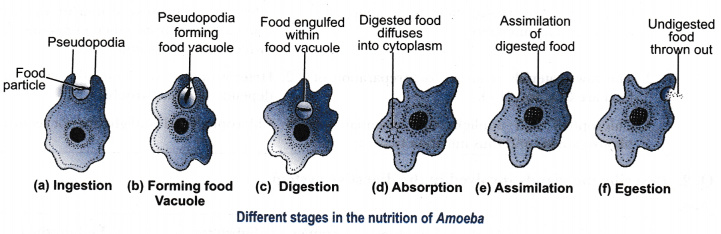 </a>
</a>
The various steps involved in the process of nutrition are:
Ingestion: Amoeba ingests food with the help of its finger-like extensions, called pseudopodia. When a food particle approaches Amoeba, it forms pseudopodia around it and forms a food vacuole inside the Amoeba.
Digestion: Various enzymes from the cytoplasm enter into the food vacuole and break them down into simple soluble molecules.
Absorption: The simple soluble food is absorbed by cytoplasm of Amoeba from food vacuoles through the process of diffusion.
Assimilation: Amoeba cell obtains energy from the absorbed food through respiration. This energy is utilised by Amoeba for its growth and repair of the body.
Egestion: When a considerable amount of undigested food gets collected inside Amoeba, its cell membrane ruptures and throws out the undigested food.
Posted by Gunjan Gupta 5 years, 5 months ago
- 0 answers
Posted by Abc Xyz 5 years, 5 months ago
- 1 answers
Priya ✧*。٩(๑˙╰╯˙๑)و✧*。 5 years, 5 months ago
Posted by Priya ✧*。٩(๑˙╰╯˙๑)و✧*。 5 years, 5 months ago
- 5 answers
Priya ✧*。٩(๑˙╰╯˙๑)و✧*。 5 years, 5 months ago
Shubham Saxena ???? 5 years, 5 months ago
Priya ✧*。٩(๑˙╰╯˙๑)و✧*。 5 years, 5 months ago
Shubham Saxena ???? 5 years, 5 months ago
Posted by Maahi ......♾ 5 years, 5 months ago
- 2 answers
Shubham Saxena ???? 5 years, 5 months ago
Posted by Maahi ......♾ 5 years, 5 months ago
- 1 answers
Shubham Saxena ???? 5 years, 5 months ago
Posted by Roushan Kumar 5 years, 5 months ago
- 1 answers
Shubham Saxena ???? 5 years, 5 months ago
Posted by Shubham Saxena ???? 5 years, 5 months ago
- 1 answers
Prashant Tiwari 5 years, 5 months ago
Posted by Riya Yadav 5 years, 5 months ago
- 4 answers
Prashant Tiwari 5 years, 5 months ago
Meghna Thapar 5 years, 5 months ago
Globalization means the speedup of movements and exchanges (of human beings, goods, and services, capital, technologies or cultural practices) all over the planet. One of the effects of globalization is that it promotes and increases interactions between different regions and populations around the globe. Globalization is the word used to describe the growing interdependence of the world's economies, cultures, and populations, brought about by cross-border trade in goods and services, technology, and flows of investment, people, and information.
Posted by Siva Nesan 5 years, 5 months ago
- 5 answers
Yogita Ingle 5 years, 5 months ago
Resistivity is defined as the resistance offered by the material per unit length for unit cross-section. The SI unit of resistivity is Ohm.meter. Resistivity increases linearly with temperature.
Posted by Taniya 5 years, 5 months ago
- 5 answers
Posted by Pragna Pragna 5 years, 5 months ago
- 1 answers
Meghna Thapar 5 years, 5 months ago
Factors that lead to speciation include genetic drift, natural selection, geographical isolation, mutation. Geographical isolation is not a major factor in the speciation of a self-pollinating plant species as pollination occurs between the reproductive organs of the same flower. No, geographical isolation is not a major factor in the formation of new species of self-pollinated plants. This is because self-pollinated plants receive pollen grains from the same flower or another flower on the same plant and its distance from other plants hardly affects its reproduction.
Posted by Niharika Raj 5 years, 5 months ago
- 2 answers
Meghna Thapar 5 years, 5 months ago
Genetic variationis advantageous to a population because it enables some individuals to adapt to the environment while maintaining the survival of the population. Genetic variation creates a larger pool of traits in a species so that given a novel environment, at least someone would have the trait needed to survive. Variation allows some individuals within a population to adapt to the changing environment. Because natural selection acts directly only on phenotypes, more genetic variation within a population usually enables more phenotypic variation.
Posted by Shubham Saxena ???? 5 years, 5 months ago
- 2 answers
Meghna Thapar 5 years, 5 months ago
The process of photosynthesis takes place in the green leaves of a plant. The carbon dioxide gas required for making food is taken by the plant leaves from the air which enters the leaves through tiny pores called stomata. Water required for making food is taken from the soil which is transported to the leaves from the soil through the roots and the stem. The sunlight provides energy required to carry out the chemical reactions involved in the preparation of food. The green pigment called chlorophyll absorbs sunlight energy.
The photosynthesis takes place in three steps:
(i) Absorption of sunlight energy by chlorophyll.
(ii) Conversion of light energy into chemical energy and splitting of water into hydrogen and oxygen by light energy.
(iii) Reduction of carbon dioxide by hydrogen to form carbohydrates like glucose by utilising the chemical energy.
Posted by Akash Kumar 5 years, 5 months ago
- 0 answers
Posted by Charu Gupta 5 years, 5 months ago
- 1 answers
Yogita Ingle 5 years, 5 months ago
A chemical equation gives a lot of information viz.,
1. It tells the names of the reactants and products.
2. It tells the relative number of molecules of reactants and products.
3. It tells the relative number of moles of reactants and the products.
4. It tells the relative weights of reactants and the products.
5. It tells the relative volumes of reacting gases and those of products formed in case of gaseous reactants. For example, the chemical equation.
Posted by Adarsh Awasthi 5 years, 5 months ago
- 2 answers
Sona Choudhary 5 years, 5 months ago
Posted by T Neeraj 5 years, 5 months ago
- 2 answers
Yogita Ingle 5 years, 5 months ago
Plaster of Paris is prepared by heating gypsum at 373 K. On heating, it loses water molecules and becomes calcium sulphate hemihydrate (CaSO4.1/2 H2O) which is called Plaster of Paris.
Plaster of Paris is used in hospitals for setting fractured bones in the right position to ensure correct healing.
Posted by Mohd. Faiz 5 years, 5 months ago
- 1 answers
Yogita Ingle 5 years, 5 months ago
In females, only one egg is released from a single ovary every month. Every month, the uterus prepares itself to receive the embryo in case fertilization occurs. But if fertilization fails to occur, the uterine wall is breaks, so that it can be prepared for the ovary which will be released in the following month. Hence, to discard the unwanted uterine endometrial lining and the egg which is not fertilized, menstruation occurs in human females in a cycle of 28 days.
Posted by Harsh Rathour 5 years, 5 months ago
- 1 answers
Yogita Ingle 5 years, 5 months ago
In the human being, the chromosomal mechanism of *** determination is of XX-XY type. In human the nucleus of each cell contains 46 chromosomes or 23 pairs of chromosomes of body characters) and 1 pair is of *** chromosomes (responsible for determination of ***).
1. In the female, two homomorphic *** chromosomes are XX.
2. In the male, two heteromorphic *** chromosomes are XY.
3. The genotypes of female and male is
Female : 46 Chromosomes = 44 Autosomes + XX *** chromosomes
Male : 46 Chromosomes = 44 Autosomes + XY *** chromosomes
Posted by Utkarsh Sharma 5 years, 5 months ago
- 3 answers
Posted by Taniya 5 years, 5 months ago
- 2 answers
Satyam Lodhi Rajput 5 years, 5 months ago
Kamna Tiwary 5 years, 5 months ago
Posted by Shipra Mishra 5 years, 5 months ago
- 3 answers
Abinash Dahal 5 years, 5 months ago
Abhinav Singh 5 years, 5 months ago
Posted by Shubham Saxena ???? 5 years, 5 months ago
- 2 answers
Yogita Ingle 5 years, 5 months ago
The process of photosynthesis occurs in two stages:
Light-dependent reaction or light reaction:
- Photosynthesis begins with the light reaction which is carried out only during the day in the presence of sunlight. In plants, the light-dependent reaction takes place in the thylakoid membranes of chloroplasts.
- The Grana, membrane-bound sacs like structures present inside the thylakoid functions by gathering light and is called photosystems.
- These photosystems have large complexes of pigment and proteins molecules present within the plant cells, which play the primary role during the process of light reactions of photosynthesis.
The chemical equation in the light reaction of photosynthesis can be reduced to:
2H2O + 2NADP+ + 3ADP + 3Pi → O2 + 2NADPH + 3ATP
Light independent reaction or dark reaction
- Dark reaction is also called carbon-fixing reaction.
- It is a light-independent process in which sugar molecules are formed from the water and carbon dioxide molecules.
- The dark reaction occurs in the stroma of the chloroplast where they utilize the NADPH and ATP products of the light reaction.
- 3CO2 + 6 NADPH + 5H2O + 9ATP → G3P + 2H+ + 6 NADP+ + 9 ADP + 8 Pi
Posted by Roushan Kumar 5 years, 5 months ago
- 1 answers
Meghna Thapar 5 years, 3 months ago
During photosynthesis, plants trap light energy with their leaves. Plants use the energy of the sun to change water and carbon dioxide into a sugar called glucose. Photosynthesis is the process plants and some algae use to convert light energy to chemical energy stored as sugar within chloroplasts -- the energy factories found in plant cells. ... Chloroplasts are full of chlorophyll, a green pigment key to photosynthesis, which helps the plant absorb light.

myCBSEguide
Trusted by 1 Crore+ Students

Test Generator
Create papers online. It's FREE.

CUET Mock Tests
75,000+ questions to practice only on myCBSEguide app

Yogita Ingle 5 years, 5 months ago
Isotopes are elements with same atomic number but different mass which in this case is 11Na22 and 11Na24.
Isobars are elements with same number of nucleons which in this case are 12Mg24 and 11Na24.
Isotones are elements with same number of neutrons, which in this case are 11Na24 and 10Ne23.
0Thank You