
Ask questions which are clear, concise and easy to understand.
Ask QuestionPosted by Jayashree Sai Narayanan 7 years, 3 months ago
- 0 answers
Posted by S Aniruddh 6 years, 4 months ago
- 1 answers
Sia ? 6 years, 4 months ago
Let time taken for uphill journey = x hrs
time taken for downhill journey = y hrs
As per given condition
Total time is 15 hours
So, x + y = 15 ..(i)
and a car goes uphill at the rate of 30 km an hour and downhill at the rate of 50 km an hour. It has covered 650 km.
So, 30x + 50y = 650 ..(ii)
Multiplying eq. (i) by 30 and substracting from eq. (ii), we get
20y = 650 - 450
20y = 200
y = 10
Putting y = 10 in eq. (i), we get
x + 10 = 15
x = 5
Downhill journey = 10 hours and uphill journey = 5 hours.
Posted by Arun Kanwal 7 years, 3 months ago
- 0 answers
Posted by Khushi Jain 7 years, 3 months ago
- 2 answers
Posted by Divya Singh 7 years, 3 months ago
- 0 answers
Posted by Shubhi Pandey 6 years, 4 months ago
- 1 answers
Sia ? 6 years, 4 months ago
In {tex} \Delta{/tex}ABC, we have

{tex} \angle{/tex}B = {tex} \angle{/tex}C
{tex} \Rightarrow{/tex} AC = AB [Sides opposite to equal angles are equal]
{tex} \Rightarrow{/tex} AE + EC = AD + DB
{tex} \Rightarrow{/tex} AE + CE = AD + BD
{tex}\Rightarrow{/tex} AE + CE = AD + CE [{tex}\because{/tex} BD = CE]
{tex}\Rightarrow{/tex} AE = AD
Thus, we have
AD = AE and BD = CE
{tex}\therefore \quad \frac { A D } { B D } = \frac { A E } { C E }{/tex}
{tex}\Rightarrow \quad \frac { A D } { D B } = \frac { A E } { E C }{/tex}
Therefore,by the converse of basic proportionality theorem, we have,
{tex} \quad D E \| B C{/tex}
Posted by Shivanshu Tiwari 6 years, 4 months ago
- 1 answers
Sia ? 6 years, 4 months ago
LCM of ( 4,7,13) = 364
Largest 4 digit number = 9999
On dividing 9999 by 364 we get remainder as 171
Greatest number of 4 digits divisible by 4, 7 and 13 = (9999 – 171) = 9828
Hence, required number = (9828 + 3) = 9831
Therefore 9831 is the number.
Posted by Menka Kokate 7 years, 3 months ago
- 1 answers
Shulabh Rawat 7 years, 3 months ago
Posted by Sujith S 6 years, 4 months ago
- 1 answers
Sia ? 6 years, 4 months ago
Let the number of students be x.
Then, cost of food for each student = Rs.{tex}\frac { 2000 } { x }{/tex}
If the number of students decreased by 5, then
new cost of food for each student = Rs.{tex}\frac { 2000 } { x - 5 }{/tex}
Now, according to question,we have
{tex}\frac { 2000 } { x - 5 } - \frac { 2000 } { x } = 20{/tex}
{tex}\Rightarrow \frac { 2000 x - 2000 x + 10000 } { x ^ { 2 } - 5 x } = 20{/tex}
{tex}\Rightarrow \frac{{10000}}{x^2 -5x} = 20{/tex}
{tex}\Rightarrow{/tex} 10000 = 20x2 - 100x
{tex}\Rightarrow{/tex} 20x2 - 100x - 10000 = 0
{tex}\Rightarrow{/tex} x2 - 5x - 500 = 0
{tex}\Rightarrow{/tex} x2 - 25x + 20x - 500 =0
{tex}\Rightarrow{/tex} x(x - 25) + x(x - 25) = 0
{tex}\Rightarrow{/tex} x - 25 = 0 or x + 20 = 0
{tex}\Rightarrow{/tex} x = 25 or x = -20
Neglecting the value of x = -20 as, number of students cannot be negative. {tex}{/tex}
{tex}\Rightarrow{/tex} x = 25
{tex}{/tex}So,the cost of food for each student is
{tex} \frac { 2000 } { x - 5 } = \frac { 2000 } { 25-5 } =\frac{{2000}}{20}{/tex} = 100
Hence, the number of students who attended the picnic is 25 and the cost of food for each student is Rs. 100.
Posted by Sushil Kumar 6 years, 4 months ago
- 1 answers
Sia ? 6 years, 4 months ago
To prove whether {tex}\sqrt{3}{/tex} is rational or irrational, we find the square root of {tex}\sqrt{3}{/tex} by long division method.
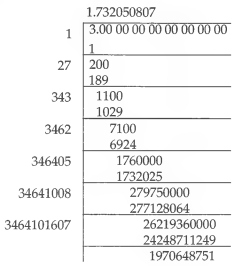
{tex}\therefore{/tex} {tex}\sqrt{3}{/tex} = 1.732050807
We observe that the decimal representation of{tex}\sqrt{3}{/tex} is neither terminating nor repeating. Hence, {tex}\sqrt{3}{/tex} is an irrational number.
Posted by Vijay Shadija 7 years, 3 months ago
- 1 answers
Yogita Ingle 7 years, 3 months ago
Principal focus of a concave mirror is a point where light rays parallel to principle axis converge.
The distance between pole of mirror to point of principle focus is focal length of mirror.
Focal length of spherical mirror is half of its radius of curvature.
Posted by Jasmine Kalsi 7 years, 3 months ago
- 0 answers
Posted by Kriti Kumari 6 years, 4 months ago
- 1 answers
Sia ? 6 years, 4 months ago
LCM of ( 4,7,13) = 364
Largest 4 digit number = 9999
On dividing 9999 by 364 we get remainder as 171
Greatest number of 4 digits divisible by 4, 7 and 13 = (9999 – 171) = 9828
Hence, required number = (9828 + 3) = 9831
Therefore 9831 is the number.
Posted by Vijaya Upadhyay 7 years, 3 months ago
- 0 answers
Posted by Ketan Manot 6 years, 4 months ago
- 1 answers
Sia ? 6 years, 4 months ago
Let the given polynomials are f(x) = {tex}{x^3} - 3\sqrt 5 {x^2} + 13x - 3\sqrt 5{/tex} and g(x) = {tex}(x - \sqrt 5 ){/tex}
∵ g(x) is a factor of f(x) so f(x) = q(x) {tex}(x - \sqrt 5 ){/tex}
Factor theorem, Euclid’s division algorithm.

But, f(x) = q(x) g(x)
{tex}\therefore f(x) = ({x^2} - 2\sqrt 5 x + 3)(x - \sqrt 5 ){/tex}
{tex}\Rightarrow f(x) = [{x^2} - \{ (\sqrt 5 + \sqrt 2 ) + (\sqrt 5 - \sqrt 2 )\} x{/tex}{tex} + (\sqrt 5 - \sqrt 2 )(\sqrt 5 + \sqrt 2 )][(x) - \sqrt 5 ]{/tex}
{tex}= \left[ {{x^2} - (\sqrt 5 + \sqrt 2 )x - (\sqrt 5 - \sqrt 2 )x} \right.{/tex}{tex}\left. { + (\sqrt 5 - \sqrt 2 )(\sqrt 5 + \sqrt 2 )][(x - \sqrt 5 )} \right]{/tex}
{tex}= x[ {x - (\sqrt 5 + \sqrt 2 )] - (\sqrt 5 - \sqrt 2 )}{/tex}{tex}{[x - (5 + \sqrt 2 )} ][x - \sqrt 5 ]{/tex}
For zeroes of f(x), f(x) = 0
{tex}\Rightarrow (x - \sqrt 5 - \sqrt 2 )(x - \sqrt 5 + \sqrt 2 )(x - \sqrt 5 ) = 0{/tex}
{tex}\Rightarrow (x - \sqrt 5 - \sqrt 2 ) = 0{/tex} or {tex}(x - \sqrt 5 + \sqrt 2 ) = 0{/tex} or {tex}(x - \sqrt 5 ) = 0{/tex}
{tex}\Rightarrow x = \sqrt 5 + \sqrt 2{/tex} or {tex}x = \sqrt 5 - \sqrt 2{/tex} or {tex}x = + \sqrt 5{/tex}
Hence the zeroes of given polynomoial are {tex}(\sqrt 5 + \sqrt 2 ),\;(\sqrt 5 - \sqrt 2 ){/tex} and {tex}\sqrt 5{/tex}.
Posted by Gurpreet Singh 6 years, 4 months ago
- 1 answers
Sia ? 6 years, 4 months ago

Given, In {tex}\triangle{/tex}ABC,
{tex}\angle{/tex}B = 2{tex}\angle{/tex}C .......(1)
AD = CD ........(2)
AD bisects {tex}\angle{/tex}BAC.
So, {tex}\angle BAD = \angle DAC{/tex} = {tex}\frac {1} {2}{/tex}{tex}\angle A{/tex}.....(3)
Since AD = CD ,hence in {tex}\triangle ADC{/tex} ;
{tex}\angle{/tex}C = {tex}\angle{/tex}DAC.......(4) [angles opposite to equal sides are equal]
But from (1),
{tex}\angle{/tex}B = 2{tex}\angle{/tex}C
{tex}\Rightarrow{/tex} {tex}\angle{/tex}B = 2 {tex}\angle{/tex}DAC [ from (4) ]
{tex}\Rightarrow{/tex} {tex}\angle{/tex}B = {tex}\angle{/tex}A [ from (3) ] ..........(5)
Clearly , from (1) & (5) ;
{tex}\angle A =\angle B =2 \angle C{/tex}.......(6)
Now, {tex}\angle{/tex}A + {tex}\angle{/tex}B + {tex}\angle{/tex}C = 180° [Angle Sum Property of triangle]
{tex}\Rightarrow \angle A + \angle A + \frac{\angle A}{2} = 180°{/tex}
{tex}\Rightarrow{/tex} {tex}\frac{4\angle A + \angle A}{2} =180°{/tex}
{tex}\Rightarrow{/tex}{tex}\frac{5\angle A}{2} = 180°{/tex} {tex}\Rightarrow{/tex} {tex}\angle A{/tex} = {tex}\frac{180^o \times 2}{5}{/tex}
{tex}\Rightarrow{/tex}{tex}\angle{/tex}A = 72o {tex}\Rightarrow{/tex} {tex}\angle{/tex}BAC = 72o
Posted by Anshumaan Sharma 5 years, 8 months ago
- 2 answers
Posted by Ayush Kumar Verma 5 years, 8 months ago
- 1 answers
Sia ? 6 years, 4 months ago
–5 + (–8) + (–11) + …. + (–230)
This is an AP.
Here, a = –5
d = –8 –(–5) = –8 + 5 = –3
l = –230
Let the number of terms of the AP be n
We know that
l = a + (n - 1)d
{tex} \Rightarrow {/tex} -230 = -5 + (n - 1) (-3)
{tex} \Rightarrow {/tex} (n - 1) (-3) = -230 + 5
{tex} \Rightarrow {/tex} (n - 1) (-3) = -225
{tex} \Rightarrow n - 1 = \frac{{ - 225}}{{ - 3}} = 75{/tex}
{tex} \Rightarrow {/tex} n = 75 + 1
{tex} \Rightarrow {/tex} n = 76
Again, we know that
{tex}{S_n} = \frac{n}{2}(a + l){/tex}
{tex} \Rightarrow {S_{76}} = \frac{{76}}{2}\left[ {( - 5) + ( - 230)} \right]{/tex}
{tex} \Rightarrow {/tex} S76 = 38(-235)
{tex} \Rightarrow {/tex} S76 = -8930
Hence, the required sum is -8930.
Posted by Mohit Raj 7 years, 3 months ago
- 2 answers
Yogita Ingle 7 years, 3 months ago
Let us assume that √3 is a rational number.
That is, we can find integers a and b (≠ 0) such that √3 = (a/b)
Suppose a and b have a common factor other than 1, then we can divide by the common factor, and assume that a and b are coprime.
√3b = a
⇒ 3b2=a2 (Squaring on both sides) → (1)
Therefore, a2 is divisible by 3
Hence ‘a’ is also divisible by 3.
So, we can write a = 3c for some integer c.
Equation (1) becomes,
3b2 =(3c)2
⇒ 3b2 = 9c2
∴ b2 = 3c2
This means that b2 is divisible by 3, and so b is also divisible by 3.
Therefore, a and b have at least 3 as a common factor.
But this contradicts the fact that a and b are coprime.
This contradiction has arisen because of our incorrect assumption that √3 is rational.
So, we conclude that √3 is irrational.
Posted by Kanchan Tiwari 7 years, 3 months ago
- 0 answers
Posted by Prajyot Patil 7 years, 3 months ago
- 2 answers
Sam Upadhayay 7 years, 3 months ago
Posted by Mohd Faizan 7 years, 3 months ago
- 2 answers
Riya Garg 7 years, 3 months ago
Posted by Utkarsh Raj 7 years, 3 months ago
- 3 answers
Posted by Abhi Kr 7 years, 3 months ago
- 0 answers
Posted by Anshika Sharma 7 years, 3 months ago
- 2 answers
Posted by Tanveer Ahmed 7 years, 3 months ago
- 2 answers

myCBSEguide
Trusted by 1 Crore+ Students

Test Generator
Create papers online. It's FREE.

CUET Mock Tests
75,000+ questions to practice only on myCBSEguide app
