
Ask questions which are clear, concise and easy to understand.
Ask QuestionPosted by Arjun Tomar 7 years, 3 months ago
- 2 answers
Posted by Prashant Godara 7 years, 3 months ago
- 3 answers
Anushka Biswas 7 years, 3 months ago
Posted by Dhruv Pawar 7 years, 3 months ago
- 2 answers
Posted by Nikhil Garg 7 years, 3 months ago
- 0 answers
Posted by Anmol Prasad 7 years, 3 months ago
- 1 answers
Posted by Xyz Abc 7 years, 3 months ago
- 1 answers
Posted by Abhi Rajput 7 years, 3 months ago
- 0 answers
Posted by Amod Singh 7 years, 3 months ago
- 1 answers
Posted by Piyush Patel 6 years, 4 months ago
- 1 answers
Sia ? 6 years, 4 months ago
Given,
{tex}\frac { 1 } { ( a + b + x ) } = \frac { 1 } { a } + \frac { 1 } { b } + \frac { 1 } { x }{/tex}
{tex}\Rightarrow \quad \frac { 1 } { ( a + b + x ) } - \frac { 1 } { x } = \frac { 1 } { a } + \frac { 1 } { b } \Rightarrow \frac { x - ( a + b + x ) } { x ( a + b + x ) } = \frac { b + a } { a b }{/tex}
{tex}\Rightarrow \quad \frac { - ( a + b ) } { x ( a + b + x ) } = \frac { ( a + b ) } { a b }{/tex}
On dividing both sides by (a+b)
{tex}\Rightarrow \quad \frac { - 1 } { x ( a + b + x ) } = \frac { 1 } { a b }{/tex}
Now cross multiply
{tex}\Rightarrow{/tex} x(a + b + x) = -ab
{tex}\Rightarrow{/tex} x2 + ax + bx + ab = 0
{tex}\Rightarrow{/tex} x(x +a) + b(x +a) = 0
{tex}\Rightarrow{/tex} (x + a) (x + b) = 0
{tex}\Rightarrow{/tex} x + a = 0 or x + b = 0
{tex}\Rightarrow{/tex} x = -a or x = -b.
Therefore, -a and -b are the roots of the equation.
Posted by Arush Chaubey 7 years, 3 months ago
- 2 answers
Manish Singh 7 years, 3 months ago
Posted by Archit Dutta 7 years, 3 months ago
- 1 answers
Piyush Patel 7 years, 3 months ago
Posted by Ramanujan Mondal 7 years, 3 months ago
- 2 answers
Posted by Loyola Seba 7 years, 3 months ago
- 1 answers
Posted by Radhika :) Mishra:} 7 years, 3 months ago
- 2 answers
Posted by Disha Mukheja 7 years, 3 months ago
- 1 answers
Posted by Bharat Shukla 7 years, 3 months ago
- 1 answers
Yuv Raj 7 years, 3 months ago
Posted by Nishant Singhal 7 years, 3 months ago
- 1 answers
Chetna Rawal 7 years, 3 months ago
Posted by Anne Lathwal 7 years, 3 months ago
- 1 answers
Posted by Vidhi Lahoti 6 years, 4 months ago
- 1 answers
Sia ? 6 years, 4 months ago
The largest positive integer that will divide 398, 436 and 542 leaving reminders 7, 11 and 15 respectively is the HCF of the numbers (398 – 7), (436 – 11) and (542 – 15) i.e. 391, 425 and 527.
HCF of 391,425 and 527:
HCF of 425 and 391:
425 = 391 × 1 + 34
391 = 34 × 11 + 17
34 = 17 ×2 + 0
HCF of 425 and 391 = 17
527 = 17 × 31
Similarly, HCF of 17 and 527 = 17
So, HCF of (391,425 ,527) = 17
∴ Required number is 17.
Posted by Nagaraj Pattanshetti 7 years, 3 months ago
- 1 answers
Posted by Navreet Sekhon 7 years, 3 months ago
- 1 answers
Posted by Prakhar Dixit 7 years, 3 months ago
- 1 answers
Posted by Amit Singh 7 years, 3 months ago
- 0 answers
Posted by Silve Mahajan 6 years, 4 months ago
- 1 answers
Sia ? 6 years, 4 months ago
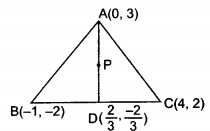
{tex}\because{/tex} BD : CD = 1 : 2
{tex}\therefore{/tex} Coordinate of D are
{tex}\left( \frac { 1 \times 4 + 2 \times - 1 } { 1 + 2 } , \frac { 1 \times 2 + 2 \times - 2 } { 1 + 2 } \right){/tex}, i.e, {tex}\left( \frac { 2 } { 3 } , \frac { - 2 } { 3 } \right){/tex}
AD = {tex}\sqrt { \left( \frac { 2 } { 3 } - 0 \right) ^ { 2 } + \left( \frac { - 2 } { 3 } - 3 \right) ^ { 2 } }{/tex}
{tex}= \sqrt { \frac { 4 } { 9 } + \frac { 121 } { 9 } } = \sqrt { \frac { 125 } { 9 } } = \frac { 5 \sqrt { 5 } } { 3 }{/tex} units
DP = AD - AP = {tex}\frac { 5 \sqrt { 5 } } { 3 } - \frac { 2 \sqrt { 5 } } { 3 } = \frac { 3 \sqrt { 5 } } { 3 } = \sqrt { 5 }{/tex} units
{tex}\therefore \frac { \mathrm { AP } } { \mathrm { DP } } = \frac { \frac { 2 \sqrt { 5 } } { 3 } } { \sqrt { 5 } } = \frac { 2 } { 3 }{/tex}
{tex}\Rightarrow{/tex} P divides AD in the ratio 2 : 3.
{tex}\therefore{/tex} x-coordinates of P is
x = {tex}\frac { 2 \times \frac { 2 } { 3 } + 3 \times 0 } { 2 + 3 } = \frac { 4 } { 15 }{/tex}
Similarly, y-coordinates of P is
y = {tex}\frac { 2 \times \frac { - 2 } { 3 } + 3 \times 3 } { 2 + 3 } = \frac { 23 } { 15 }{/tex}
{tex}\therefore{/tex} Coordinates of P are {tex}\left( \frac { 4 } { 15 } , \frac { 23 } { 15 } \right){/tex}.
Posted by Sagar Sinha 7 years, 3 months ago
- 1 answers
Posted by Nishant Hussain 7 years, 3 months ago
- 1 answers
Mahi Singh Oboroi 7 years, 3 months ago
Posted by Shraddha Rathi 7 years, 3 months ago
- 0 answers
Posted by Sakshi Kumari 7 years, 3 months ago
- 1 answers
Posted by Suman Sisodiya 6 years, 4 months ago
- 1 answers
Sia ? 6 years, 4 months ago
Let the point of x-axis be P(x, 0)
Given A(2, -5) and B(-2, 9) are equidistant from P
That is PA = PB
Hence PA2 = PB2 → (1)
Distance between two points is {tex}\sqrt{[(x_2 - x_1)^2 + (y_2 - y_1)^2]}{/tex}
PA = {tex}\sqrt{[(2 - x)^2 + (-5 - 0)^2]}{/tex}
PA2 = 4 - 4x +x2 + 25
= x2 - 4x + 29
Similarly, PB2 = x2 + 4x + 85
Equation (1) becomes
x2 - 4x + 29 = x2 + 4x + 85
- 8x = 56
x = -7
Hence the point on x-axis is (-7, 0)

myCBSEguide
Trusted by 1 Crore+ Students

Test Generator
Create papers online. It's FREE.

CUET Mock Tests
75,000+ questions to practice only on myCBSEguide app

Devanshi Grover 7 years, 3 months ago
0Thank You