
Ask questions which are clear, concise and easy to understand.
Ask QuestionPosted by Adwaitha Nair 7 years, 3 months ago
- 1 answers
Posted by Akshat Khandal 7 years, 3 months ago
- 1 answers
Posted by Kunal Singh 7 years, 3 months ago
- 2 answers
Mohammad Khan 7 years, 3 months ago
Rohan Gurjar 7 years, 3 months ago
Posted by Sagar Paliwal 7 years, 3 months ago
- 0 answers
Posted by Pankaj Chauhan 7 years, 3 months ago
- 0 answers
Posted by Radhika :) Mishra:} 7 years, 3 months ago
- 2 answers
Adwaitha Nair 7 years, 3 months ago
Aditya Kumar Tiwary 7 years, 3 months ago
Posted by Shikayna Panday 7 years, 3 months ago
- 2 answers
Pankaj Chauhan 7 years, 3 months ago
Sarthak Bhardwaj 7 years, 3 months ago
Posted by Gurpreet Singh 7 years, 3 months ago
- 0 answers
Posted by Radhika :) Mishra:} 7 years, 3 months ago
- 1 answers
Shamsher Ali 7 years, 3 months ago
Posted by Disha Sharma 7 years, 3 months ago
- 1 answers
Chanchal Dhiman 7 years, 3 months ago
Posted by Priyam Kumar 7 years, 3 months ago
- 1 answers
Posted by Anjali Raja 6 years, 4 months ago
- 1 answers
Sia ? 6 years, 4 months ago
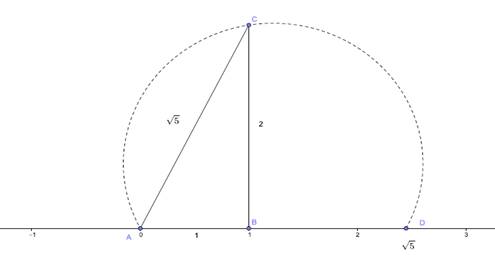
According to the Pythagoras theorem, we can conclude that {tex}{\left( {\sqrt 5 } \right)^2} = {\left( 2 \right)^2} + {\left( 1 \right)^2}{/tex} We need to draw a line segment AB of 1 unit on the number line. Then draw a straight line segment BC of 2 units. Then join the points C and A, to form a line segment BC. Then draw the arc ACD, to get the number {tex}\sqrt 5 {/tex} on the number line.
Posted by Raja Singh 7 years, 3 months ago
- 1 answers
Nitin Kumar?Hr35 Vala?(Narnaul)? 7 years, 3 months ago
Posted by Priyansh Upadhyay 7 years, 3 months ago
- 7 answers
Posted by Deepak Khatri 6 years, 4 months ago
- 1 answers
Sia ? 6 years, 4 months ago
We are given, an = 3n + 5 which is nth term.
So, a1 = 3(1) + 5 = 8
and, a2 = 3(2) + 5 = 6 + 5 = 11
so common difference, d = a2 - a1 = 11 - 8 = 3
Therefore common difference is 3
Posted by Pravesh Panghal 7 years, 3 months ago
- 1 answers
Posted by Prasha Ttsvv Bbaga 7 years, 3 months ago
- 0 answers
Posted by Palak Phogat 7 years, 3 months ago
- 1 answers
Posted by Gourav Chhabra 7 years, 3 months ago
- 2 answers
Posted by Sreejith Sreejith 7 years, 3 months ago
- 3 answers
Abhishek Varma 7 years, 3 months ago
Posted by Shaurya Singh 7 years, 3 months ago
- 1 answers
Posted by Keshav Agarwal 6 years, 4 months ago
- 1 answers
Sia ? 6 years, 4 months ago
According to the question,we are given that,
{tex}S _ { n } = \frac { 3 n ^ { 2 } } { 2 } + \frac { 5 n } { 2 } = \frac { 3 n ^ { 2 } + 5 n } { 2 }{/tex}
{tex}\Rightarrow S _ { n - 1 } = \frac { 3 ( n - 1 ) ^ { 2 } + 5 ( n - 1 ) } { 2 }{/tex}
{tex}= \frac { 3 \left( n ^ { 2 } - 2 n + 1 \right) + 5 n - 5 } { 2 }{/tex}
{tex}= \frac { 3 n ^ { 2 } - 6 n + 3 + 5 n - 5 } { 2 }{/tex}
{tex}= \frac { 3 n ^ { 2 } - n - 2 } { 2 }{/tex}
Now,
nth term = Tn=Sn-Sn-1={tex}= \frac { 3 n ^ { 2 } + 5 n } { 2 } - \frac { 3 n ^ { 2 } - n - 2 } { 2 } = \frac { 3 n ^ { 2 } + 5 n - 3 n ^ { 2 } + n + 2 } { 2 }{/tex}={tex}\frac{{6n + 2}}{2}{/tex}=3n+1
25th term=T25=3(25)+1=75+1=76.
Posted by Anuj Singh 7 years, 3 months ago
- 1 answers
Posted by Sibun Panda 7 years, 3 months ago
- 0 answers
Posted by Shreyash Kulkarni 7 years, 3 months ago
- 2 answers
Gauranshi Attal 7 years, 3 months ago
Posted by Naveen Khanna 7 years, 3 months ago
- 1 answers
Posted by Aaryan Pandey 7 years, 3 months ago
- 1 answers

myCBSEguide
Trusted by 1 Crore+ Students

Test Generator
Create papers online. It's FREE.

CUET Mock Tests
75,000+ questions to practice only on myCBSEguide app

Piyush Shah 7 years, 3 months ago
0Thank You