
Ask questions which are clear, concise and easy to understand.
Ask QuestionPosted by Sanskriti Sharma 7 years, 2 months ago
- 1 answers
Posted by Chandrakala Patil 6 years, 6 months ago
- 1 answers
Sia ? 6 years, 6 months ago
q = a + (p - 1)d ..... (i)
p = a + (q - 1)d ...... (ii)
q - p = (p - 1 - q + 1)d
{tex}\frac{{q - p}}{{p - q}} = d{/tex}
{tex} \Rightarrow d = - 1{/tex}
Put the value of d in eq (i)
q = a + (p - 1) (-1)
{tex} \Rightarrow {/tex} q = a - p + 1
{tex} \Rightarrow {/tex} a = q + p - 1
ap+q = a +(p + q - 1)d
= (q + p - 1) + (p + q - 1) (-1)
= q + p - 1 - p - q + 1
= 0
Posted by Chanchal Dhiman 6 years, 6 months ago
- 1 answers
Sia ? 6 years, 6 months ago
Given in triangle, {tex}{/tex}ABC DE {tex}\|{/tex} BC
{tex}\frac { \mathrm { AD } } { \mathrm { DB } } = \frac { \mathrm { AE } } { \mathrm { EC } }{/tex} (by BPT)
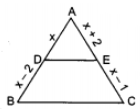
{tex}\Rightarrow \quad \frac { x } { x - 2 } = \frac { x + 2 } { x - 1 }{/tex}
{tex}\Rightarrow{/tex} x(x - 1) = (x + 2)(x - 2)
{tex}\Rightarrow{/tex} x2 - x = x2 - 22 {tex}\Rightarrow{/tex} x2 - x = x2 - 4
{tex}\Rightarrow{/tex} x = 4
Posted by Chanchal Dhiman 7 years, 2 months ago
- 1 answers
Posted by Ay Pandey 7 years, 2 months ago
- 1 answers
Yogita Ingle 7 years, 2 months ago
Let the present age of son = x
So, the present age of father = 45 - x
5 years ago,
Age of son = x - 5
and age of the father = 45 - x - 5 = 40 - x
Now, product of their ages = 124
⇒ (x - 5) × (40 - x) = 124
⇒ 40x - x2 - 5 × 40 + 5x = 124
⇒ 40x - x2 - 200 + 5x = 124
⇒ 45x - x2 - 200 = 124
⇒ 45x - x2 - 200 - 124 = 0
⇒ 45x - x2 - 324 = 0
⇒ x2 - 45x + 324 = 0
⇒ x2 - 36x - 9x + 324 = 0
⇒ x(x - 36) - 9(x - 36) = 0
⇒ (x - 36)×(x - 9) = 0
⇒ x = 9, 36
If the present age of son is 9 years
then present age of father = 45 - 9 = 36 years
Again, if the present age of son is 36 years
then present age of father = 45 - 36 = 9 years
which is not possible.
So, the present age of son is 9 years and the present age of the father is 36 years.
Posted by Furkhan Khan 6 years, 6 months ago
- 1 answers
Sia ? 6 years, 6 months ago
As DE {tex}\parallel{/tex} BC
{tex}\therefore \frac{AD}{AB}=\frac{AE}{AC}{/tex}, {tex}{/tex}
.{tex}\frac{x}{2x+1}=\frac{x+3}{2x+8}{/tex}
(x + 3)(2x + 1) = x(2x + 8)
2x2 + x + 6x + 3 = 2x2 + 8x
3 = 8x - 7x
x = 3
Posted by Megha Verma 7 years, 2 months ago
- 1 answers
Beauty Queen? Miss Sweetu? 7 years, 2 months ago
Posted by Sneha Sneha 7 years, 2 months ago
- 2 answers
Kunal Mishra 7 years, 2 months ago
Posted by Vipul Kumar Chauhan 7 years, 2 months ago
- 1 answers
Dhanashri Kadam 7 years, 2 months ago
Posted by Ajay Pandey 7 years, 2 months ago
- 1 answers
Aditya Chauhan 7 years, 2 months ago
Posted by Abhishek Kumar 7 years, 2 months ago
- 2 answers
Posted by Suraj Raj 7 years, 2 months ago
- 1 answers
Yogita Ingle 7 years, 2 months ago
“The line segment in a triangle joining the midpoint of two sides of the triangle is said to be parallel to its third side and is also half of the triangle.”
Posted by Sneha Sneha 7 years, 2 months ago
- 0 answers
Posted by Sonu Kate 7 years, 2 months ago
- 1 answers
Posted by Aastha Singh 7 years, 2 months ago
- 6 answers
Animesh Pawar 7 years, 2 months ago
Posted by Deepkant Singh 6 years, 6 months ago
- 1 answers
Sia ? 6 years, 6 months ago
Let ABCD be a square and B (x, y) be the unknown vertex.
AB = BC
{tex} \Rightarrow {/tex} AB2 = BC2
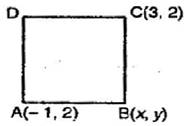
{tex} \Rightarrow {/tex} (x + 1)2 + (y - 2)2 = (x - 3)2 + (y - 2)2
{tex} \Rightarrow {/tex} x2 + 1 + 2x + y2 + 4 - 4x = x2 - 6x + 9 + y2 + 4 - 4x
{tex} \Rightarrow {/tex} 2x + 1 = - 6x + 9
{tex} \Rightarrow {/tex} 8x = 8
{tex} \Rightarrow {/tex} x = 1 ........ (i)
In {tex}\triangle{/tex}ABC, AB2 + BC2 = AC2
{tex} \Rightarrow {/tex} (x + 1)2 + (y - 2)2 + (x - 3)2 + (y - 2)2 = (3 + 1)2 + (2 - 2)2
{tex} \Rightarrow {/tex}x2 + 1 + 2x + y2 - 4x + 4 + x2 + 9 - 6x + y2 + 4 - 2y = 16 + 0
{tex} \Rightarrow {/tex} 2x2 + 2y2 + 2x - 4y - 6x - 4y + 1 + 4 + 9 + 4 = 16
{tex} \Rightarrow {/tex} 2x2 + 2y2 - 4x - 8y + 2 = 0
{tex} \Rightarrow {/tex} x2 + y2 - 2x - 4y + 1 = 0 ..... (ii)
Putting the value of x in eq. (ii),
1 + y2 - 2 - 4y + 1 = 0
{tex} \Rightarrow {/tex} y2 - 4y = 0
{tex} \Rightarrow {/tex} y(y - 4) = 0
{tex} \Rightarrow {/tex} y = 0 or 4
Hence the other vertices are (1, 0) and (1, 4).
Posted by Saurav Yadav 7 years, 2 months ago
- 0 answers
Posted by Deepa Sharma 7 years, 2 months ago
- 1 answers
Kunal Mishra 7 years, 2 months ago
Posted by Aryan Vashisht 7 years, 2 months ago
- 0 answers
Posted by Kunal Mishra 6 years, 4 months ago
- 1 answers
Sia ? 6 years, 4 months ago
Let a be the first term and d the common difference of the given A.P.
{tex}\therefore S_{p}=\frac{p}{2}{/tex} [2a + (p - 1)d] = q
{tex}\Rightarrow{/tex} 2a + (p - 1)d {tex}=\frac{2 q}{p}{/tex} ….(i)
And {tex}S_{q}=\frac{q}{2}{/tex} [2a + (q - 1)d] = p
{tex}\Rightarrow{/tex} 2a + (q - 1)d {tex}=\frac{2 p}{q}{/tex} ….(ii)
Subtracting eq. (ii) from eq. (i) we get
(p - q)d = {tex}\frac{2 q}{p}-\frac{2 p}{q}{/tex} {tex}\Rightarrow{/tex} (p - q)d {tex}=\frac{2\left(q^{2}-p^{2}\right)}{p q}{/tex}
{tex}\Rightarrow{/tex} (p - q)d {tex}=\frac{-2}{p q}{/tex}(p2 - q2)
{tex}\Rightarrow{/tex} (p - q)d {tex}=\frac{-2}{p q}{/tex} (p + q)(p - q) {tex}\Rightarrow d=\frac{-2}{p q}{/tex} (p + q)
Substituting the value of d in eq. (i) we get
2a + (p - 1) {tex}\left[\frac{-2(p+q)}{p q}\right]=\frac{2 q}{p}{/tex}
{tex}\Rightarrow 2 a=\frac{2 q}{p}+\frac{2(p-1)(p+q)}{p q}{/tex}
{tex}\Rightarrow a=\frac{q}{p}+\frac{(p-1)(p+q)}{p q}{/tex}
{tex}a=\frac{q^{2}+p^{2}+p q-p-q}{p q}{/tex}
Now Sp+q {tex}=\frac{p+q}{2}{/tex} [2a + (p + q - 1)d
{tex}=\frac{p+q}{2}\left[\frac{2 q^{2}+2 p^{2}+2 p q-2 q-2 q}{p q}+\frac{(p+q-1)[-2(p+q)}{p q}\right]{/tex}
{tex}=\frac{p+q}{2}\left[\frac{2q^{2} + 2p^{2} + 2pq - 2p - 2q -2p^{2} -2 p q+2 p-2 p q-2 q^{2}+2 q}{p q}\right]{/tex}
{tex}=\frac{p+q}{2}\left[\frac{-2 p q}{p q}\right]{/tex} = -(p + q) hence proved.
Posted by K D 7 years, 2 months ago
- 4 answers
Kunal Mishra 7 years, 2 months ago
Posted by Pitt Kushwaha 6 years, 4 months ago
- 1 answers
Sia ? 6 years, 4 months ago
x5 + a5 by x + a

We stop here since the remainder is zero,
So,
quotient {tex}= x ^ { 4 } - a x ^ { 3 } + a ^ { 2 } x ^ { 2 } - a ^ { 3 } x + a ^ { 4 }{/tex}
remainder = 0
Therefore,
{tex}\text { Quotient } \times \text { Divisor } + \text { Remainder }{/tex}
{tex}= \left( x ^ { 4 } - a x ^ { 3 } + a ^ { 2 } x ^ { 2 } - a ^ { 3 } x + a ^ { 4 } \right) ( x + a ) + 0{/tex}
{tex}= x ^ { 5 } + a x ^ { 4 } - a x ^ { 4 } - a ^ { 2 } x ^ { 3 } + a ^ { 2 } x ^ { 3 }{/tex}
{tex}+ a ^ { 3 } x ^ { 2 } - a ^ { 3 } x ^ { 2 } - a ^ { 4 } x + a ^ { 4 } x + a ^ { 5 }{/tex}
{tex}= x ^ { 5 } + a ^ { 5 }{/tex}
= Dividend
Therefore, the division algorithm is verified.
Posted by Jaskaran Jassi 7 years, 2 months ago
- 1 answers
Posted by Aman Prabhakar 7 years, 2 months ago
- 4 answers
Kannu Kranti Yadav 7 years, 2 months ago
Posted by Kunal Mishra 6 years, 6 months ago
- 1 answers
Sia ? 6 years, 6 months ago
Let a be the first term and d be the common difference
pth term = a +(p - 1)d = q(given)-----(1)
qth term = a +(q - 1) d = p(given)-----(2)
subtracting (2) from (1)
(p-q)d=q-p
(p-q)d=-(p-q)
{tex}\therefore{/tex} d = -1
putting d=-1 in (i)
a - (p - 1) = q
{tex}\therefore{/tex} a=p+q-1
{tex}\therefore{/tex} (p + q)th term = a + (p + q - 1)d
= (p + q - 1) - (p + q - 1) = 0
Posted by Archana Padwal 7 years, 2 months ago
- 1 answers
Posted by Priyanshi Chaudhary 7 years, 2 months ago
- 1 answers
Posted by Swetha 7 years, 2 months ago
- 1 answers

myCBSEguide
Trusted by 1 Crore+ Students

Test Generator
Create papers online. It's FREE.

CUET Mock Tests
75,000+ questions to practice only on myCBSEguide app

Harsh Malik 7 years, 2 months ago
1Thank You