
Ask questions which are clear, concise and easy to understand.
Ask QuestionPosted by Akash Elangovan 7 years, 1 month ago
- 1 answers
Posted by Komal Jha 6 years, 6 months ago
- 1 answers
Sia ? 6 years, 6 months ago
Clearly, the fez is in the shape of a frustum of a cone with radii of one base as {tex}r_1{/tex} = 10 cm and radii of another base as {tex}r_2{/tex} = 4 cm and slant height l = 15 cm. Let A be the area of the material used. Then,
A = Curved surface area + Area of the closed base
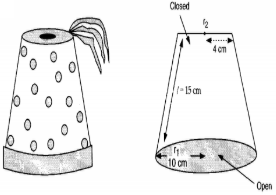
{tex}\Rightarrow \quad A = \pi \left( r _ { 1 } + r _ { 2 } \right) l + \pi r _ { 2 } ^ { 2 }{/tex}
{tex}\Rightarrow \quad A = \left\{ \frac { 22 } { 7 } \times ( 10 + 4 ) \times 15 + \frac { 22 } { 7 } \times 4 ^ { 2 } \right\} \mathrm { cm } ^ { 2 }{/tex}
{tex}\Rightarrow \quad A = \left( 352 \times 2 \times 15 + \frac { 352 } { 7 } \right) \mathrm { cm } ^ { 2 } = \left( 660 + \frac { 352 } { 7 } \right) \mathrm { cm } ^ { 2 } = 660 + 50.28 \mathrm { cm } ^ { 2 }{/tex}= 710.28cm2.
Posted by Anurag Yadav 6 years, 6 months ago
- 1 answers
Sia ? 6 years, 6 months ago
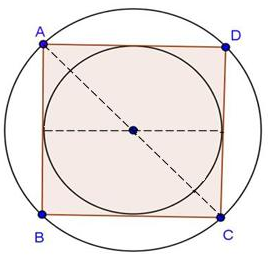
Side of square = 10cm
For incircle
diameter of circle = side of square
{tex}\Rightarrow r = \frac{{10}}{2} = 5cm{/tex}
{tex} \therefore {/tex} Area of incircle {tex}= \pi {r^2}{/tex}
{tex}= 3.14 \times 5 \times 5{/tex}
78.50 cm2
For circumcircle
AC will be the diameter because {tex} \angle B = 90^\circ {/tex}
Now, In {tex} \triangle ABC{/tex}, by pythagoras theorem
AC2 = AB2 + BC2
{tex}\Rightarrow {/tex} AC2 = 102 + 102
{tex}\Rightarrow {/tex} AC2 = 200
{tex}\Rightarrow AC = \sqrt {200} = 10\sqrt 2 cm{/tex}
{tex} \therefore {/tex} Area of circumcircle {tex}= \pi {r^2}{/tex}
{tex}= 3.14 \times {\left( {5\sqrt 2 } \right)^2}{/tex}
{tex}= 3.14 \times 50{/tex}
= 157cm2
Posted by Sakshi Laddha 7 years, 1 month ago
- 0 answers
Posted by Chitransh Upadhyay 7 years, 1 month ago
- 0 answers
Posted by Sutapa Sinha 7 years, 1 month ago
- 0 answers
Posted by Sukhveer Brar 7 years, 1 month ago
- 2 answers
Deepika Choudhary 7 years, 1 month ago
Posted by Arif Siddiqui 7 years, 1 month ago
- 0 answers
Posted by Paotinlien Haokip 7 years, 1 month ago
- 1 answers
Yogita Ingle 7 years, 1 month ago
Often in statistics, we tend to represent a set of data by a representative value which would approximately define the entire collection. This representative value is called as the measures of central tendency. The name itself suggests that it is a value around which the data is centered.
The measures of central tendency are given by various parameters but the most commonly used are mean, median and mode
Posted by Anurag Ojha 7 years, 1 month ago
- 1 answers
Posted by Anurag Ojha 7 years, 1 month ago
- 2 answers
Posted by Rohit Roy 6 years, 6 months ago
- 1 answers
Sia ? 6 years, 6 months ago
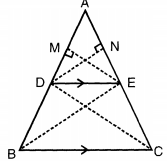
Given: ABC is a triangle in which DE {tex}\parallel{/tex} BC.
To prove: {tex}\frac { A D } { B D } = \frac { A E } { C E }{/tex}
Construction: Draw {tex}D N \perp A E{/tex} and {tex}E M \perp A D{/tex}., Join BE and CD.
Proof :
In {tex}\triangle ADE,{/tex}
Area of {tex} \Delta A D E = \frac { 1 } { 2 } \times A E \times D N{/tex} ...(i)
In {tex}\Delta D E C{/tex},
Area of {tex}\operatorname \Delta D C E = \frac { 1 } { 2 } \times C E \times D N{/tex} ...(ii)
Dividing equation (l) by equation (ii),
{tex}\Rightarrow\frac { \text { area } ( \Delta A D E ) } { \text { area } ( \Delta D E C ) } = \frac { \frac { 1 } { 2 } \times A E \times D N } { \frac { 1 } { 2 } \times C E \times D N }{/tex}
{tex}\Rightarrow{/tex} {tex}\frac { \text { area } ( \Delta A D E ) } { \text { area } ( \Delta D E C ) } = \frac { A E } { C E }{/tex} ...(iii)
Similarly, In {tex}\Delta A D E{/tex},
Area of {tex}\operatorname \Delta A D E = \frac { 1 } { 2 } \times A D \times E M{/tex} ...(iv)
In {tex}\Delta D E B,{/tex}
Area of {tex}\operatorname \Delta D E B = \frac { 1 } { 2 } \times E M \times B D{/tex} ...(v)
Dividing equation (iv) by equation (v),
{tex}\Rightarrow{/tex}{tex}\frac { \text { area } ( \Delta A D E ) } { \text { area } ( \Delta D E B ) }{/tex} {tex}= \frac { \frac { 1 } { 2 } \times A D \times E M } { \frac { 1 } { 2 } \times B D \times E M }{/tex}
{tex}\Rightarrow{/tex} {tex}\frac { \text { area } ( \Delta A D E ) } { \text { area } ( \Delta D E B ) } = \frac { A D } { B D }{/tex} ...(vi)
{tex}\Delta D E B \text { and } \Delta D E C{/tex} lie on the same base DE and between two parallel lines DE and BC.
{tex}\therefore{/tex} Area ({tex} \Delta D E B {/tex}) = Area ( {tex} \Delta D E C {/tex})
From equation (iii),
{tex}\Rightarrow\frac { \text { area } ( \Delta A D E ) } { \text { area } ( \Delta D E B ) } = \frac { A E } { C E }.{/tex}......(vii)
From equation (vi) and equation (vii),
{tex}\frac { A E } { C E } = \frac { A D } { B D }{/tex}
{tex}\therefore{/tex} If a line is drawn parallel to one side of a triangle to intersect the other two sides in two points, then the other two sides are divided in the same ratio.
Posted by Sanu Captain 7 years, 1 month ago
- 2 answers
Posted by Tainya Kumari 7 years, 1 month ago
- 5 answers
Kishan Dan 7 years, 1 month ago
Posted by Sejal Ameta 7 years, 1 month ago
- 5 answers
Posted by Vicky Gupta 7 years, 1 month ago
- 2 answers
Posted by Ajax Shrimali 7 years, 1 month ago
- 2 answers
Posted by Mohd Shahid 7 years, 1 month ago
- 1 answers
Posted by Sumit Kumar 6 years, 6 months ago
- 1 answers
Sia ? 6 years, 6 months ago
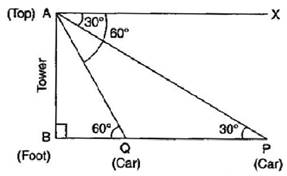
In right triangle ABP,
{tex}\tan 30 ^ { \circ } = \frac { \mathrm { AB } } { \mathrm { BP } }{/tex}
{tex}\Rightarrow \frac { 1 } { \sqrt { 3 } } = \frac { \mathrm { AB } } { \mathrm { BP } }{/tex}
BP = AB{tex}\sqrt3{/tex} ........ (i)
In right triangle ABQ,
{tex}tan\;60^0\;={AB\over BQ}{/tex}
{tex}\Rightarrow \sqrt { 3 } = \frac { A B } { B Q }{/tex}
{tex}\Rightarrow _ { B Q } = \frac { A B } { \sqrt { 3 } }{/tex}....... (ii)
{tex}\because{/tex} PQ = BP - BQ
{tex}\therefore{/tex} PQ = AB{tex}\sqrt { 3 } - \frac { A B } { \sqrt { 3 } } = \frac { 3 A B - A B } { \sqrt { 3 } } = \frac { 2 A B } { \sqrt { 3 } }{/tex} = 2BQ [From eq. (ii)]
{tex}\Rightarrow{/tex} BQ = {tex}\frac12{/tex}PQ
{tex}\because{/tex} Time taken by the car to travel a distance PQ = 6 seconds.
{tex}\therefore{/tex} Time taken by the car to travel a distance BQ, i.e. {tex}\frac12{/tex}PQ = {tex}\frac12{/tex} {tex}\times{/tex} 6 = 3 seconds.
Hence, the further time taken by the car to reach the foot of the tower is 3 seconds.
Posted by Karm Modh 7 years, 1 month ago
- 2 answers
Feba Roji 7 years, 1 month ago
Posted by Satish Kumar 6 years, 4 months ago
- 1 answers
Sia ? 6 years, 4 months ago
We have,
LHS = cosec2{tex}\theta{/tex} + sec2{tex}\theta{/tex}
{tex}\Rightarrow \quad \mathrm { LHS } = \frac { 1 } { \sin ^ { 2 } \theta } + \frac { 1 } { \cos ^ { 2 } \theta }{/tex}
{tex}\Rightarrow \quad \mathrm { LHS } = \frac { \cos ^ { 2 } \theta + \sin ^ { 2 } \theta } { \cos ^ { 2 } \theta \sin ^ { 2 } \theta } = \frac { 1 } { \sin ^ { 2 } \theta \cos ^ { 2 } \theta } = \frac { 1 } { \sin ^ { 2 } \theta } \times \frac { 1 } { \cos ^ { 2 } \theta } = \operatorname { cosec } ^ { 2 } \theta \sec ^ { 2 } \theta{/tex} = RHS
Posted by Satish Kumar 7 years, 1 month ago
- 1 answers
Kunal J 7 years, 1 month ago
Posted by Talha Ansari 7 years, 1 month ago
- 0 answers
Posted by Ishit Tater 6 years, 6 months ago
- 1 answers
Sia ? 6 years, 6 months ago
Given,
{tex}sec\ \theta+ tan\ \theta = p{/tex} ...(i)
Also, we know that,
{tex}sec^2 \theta - tan^2 \theta = 1{/tex}
{tex}\Rightarrow{/tex} (sec {tex}\theta{/tex} - tan {tex}\theta{/tex}) (sec {tex}\theta{/tex} + tan {tex}\theta{/tex}) = 1 [{tex}\because a^2-b^2=(a+b)(a-b){/tex}]
{tex}\Rightarrow{/tex} (sec {tex}\theta{/tex} - tan {tex}\theta{/tex})p = 1 [using equation (i)]
{tex}\Rightarrow{/tex} sec {tex}\theta{/tex} - tan {tex}\theta{/tex} {tex}=\frac{1}{p}{/tex} ...(ii)
(i)+(ii), we get,
{tex}sec\theta + tan\theta+ sec\theta - tan\theta = p+ \frac{1}{p}{/tex}
{tex}\Rightarrow 2sec\theta = \frac{p^2+1}{p}{/tex}
{tex}\Rightarrow sec\theta = \frac{p^2+1}{2p}{/tex}
{tex}\Rightarrow \frac{1}{cos\theta} =\frac{p^2+1}{2p}{/tex}
{tex}\Rightarrow cos\theta =\frac{2p}{p^2+1}{/tex}------(iii)
Now, we know that,
{tex}sin\theta = \sqrt( 1- cos^2\theta) {/tex}
put the value of {tex}cos\theta{/tex} from eq. (iii), we get,
{tex}sin\theta = \sqrt(1-(\frac{2p}{p^2+1})^2){/tex}
{tex}\Rightarrow sin\theta = \sqrt(1-\frac{4p^2}{(p^2+1)^2}){/tex}
{tex}\Rightarrow sin\theta = \sqrt(\frac{(p^2+1)^2-4p^2}{(p^2+1)^2}){/tex}
{tex}\Rightarrow sin\theta = \sqrt(\frac{p^4+1+2p^2-4p^2}{(p^2+1)^2}){/tex}
{tex}\Rightarrow sin\theta = \sqrt(\frac{p^4+1-2p^2}{(p^2+1)^2}){/tex}
{tex}\Rightarrow sin\theta = \sqrt(\frac{(p^2-1)^2}{(p^2+1)^2}){/tex}
{tex}\Rightarrow sin\theta = \frac{p^2-1}{p^2+1}{/tex}
{tex}cosec\theta = \frac{p^2+1}{p^2-1} [\because cosec\theta =\frac{1}{sin\theta}]{/tex}
hence, {tex}cosec\ \theta{/tex} {tex}=\frac{1+p^{2}}{1-p^{2}}{/tex}
Posted by Istekhar Don 6 years, 6 months ago
- 1 answers
Sia ? 6 years, 6 months ago
Given: Radius of base (r) and height (h) of the conical tank are 7 m and 24 m
⇒ Slant height (l) = r2 + h2
{tex}= \sqrt { r ^ { 2 } + h ^ { 2 } } = \sqrt { 7 ^ { 2 } + 24 ^ { 2 } }{/tex}
{tex}= \sqrt { 625 } = 25 \mathrm { m }{/tex}
C.S.A. {tex}= \pi r l{/tex}
{tex}= \frac { 22 } { 7 } \times 7 \times 25 = 550 \mathrm { m } ^ { 2 }{/tex}
Let x m of cloth is required
CSA of tent = area of cloth.
or, {tex}5 x = 550 \text { or, } x = \frac { 550 } { 5 } = 110 \mathrm { m }{/tex}
{tex}\therefore{/tex} 110 m of cloth is required.
Cost of cloth {tex}= 25 \times 110 = Rs. 2750{/tex}
Posted by Pssooskwj Jjsjw91Hwmse 7 years, 1 month ago
- 2 answers
Posted by Kishanth Seetha 7 years, 1 month ago
- 1 answers

myCBSEguide
Trusted by 1 Crore+ Students

Test Generator
Create papers online. It's FREE.

CUET Mock Tests
75,000+ questions to practice only on myCBSEguide app

Satish Kumar 7 years, 1 month ago
0Thank You